Australia’s EV Market Hits a Turning Point as Tesla and Polestar Sales Jump 91%
Stay connected via Google 'Electric Vehicle' News
Follow BijliWaliGaadi | India's Trusted EV Insights Portal
source on Google
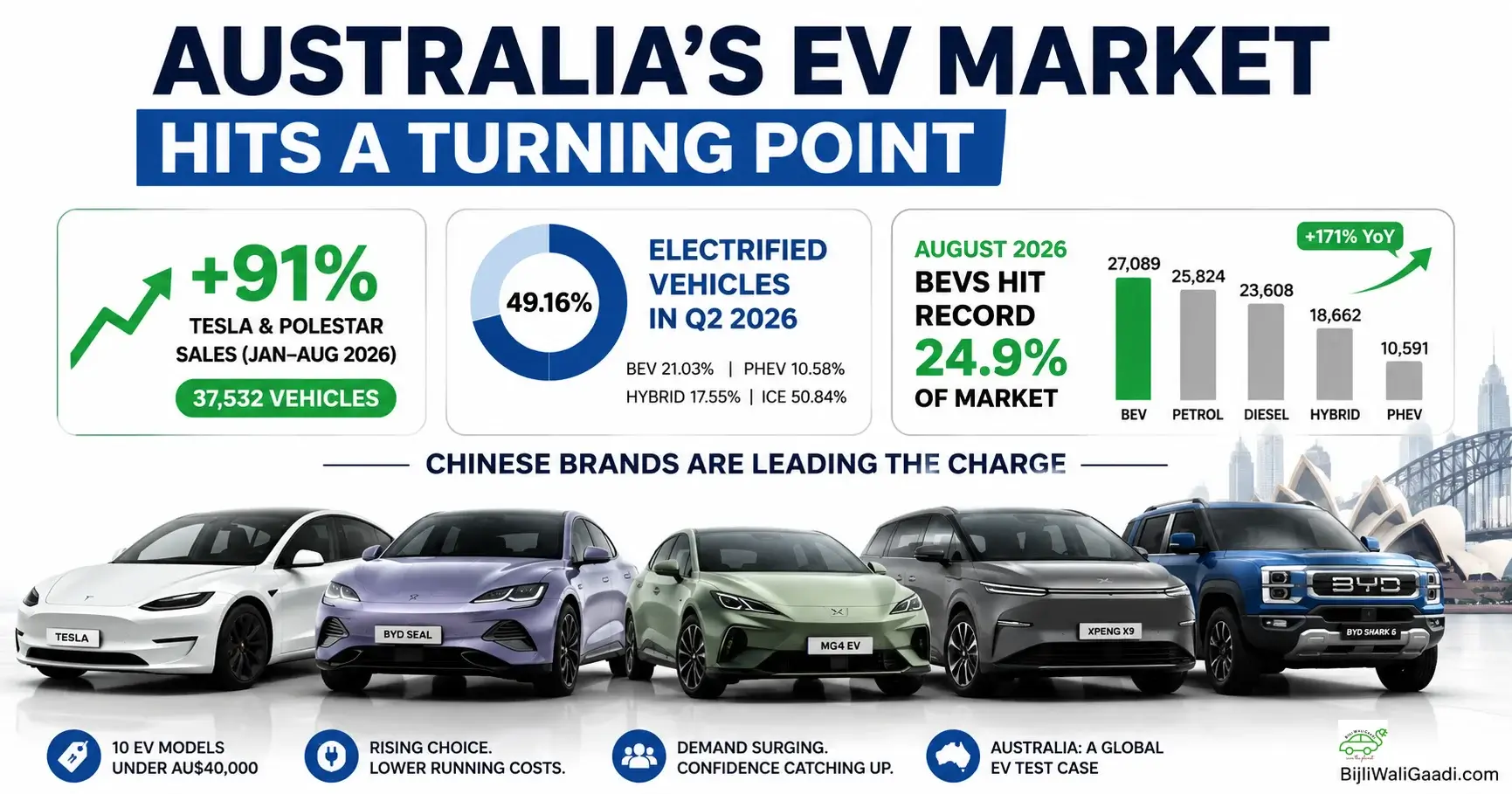
Around 10 EV brands are now operating in Australia and selling their electric cars for under AU$40,000. Four years ago, that price point was virtually absent from the market.
That expanding affordability sits behind one of the more striking numbers to come out of Australia’s auto industry this year. Electric Vehicle Council (EVC) data shows combined Tesla and Polestar battery-EV deliveries jumped 91% in the first eight months of 2026, reaching 37,532 vehicles. Tesla alone surpassed 36,000 units year-to-date.
That 91% figure describes two brands, not the entire Australian EV market. The broader market tells an even bigger story.
Australia’s EV Growth Is Bigger Than the 91% Headline
Tesla and Polestar together delivered 7,821 battery EVs in August 2026, up 148% on August 2025. It was their second-strongest month of the year, behind June’s 8,924.
Within the EVC’s Tesla-and-Polestar dataset, year-to-date sales more than doubled in New South Wales, Queensland and South Australia. Every other jurisdiction recorded increases ranging from 45% to 93%.
That’s a strong result for two brands. But it’s the wider market — tracked by the Australian Automobile Association (AAA) — that shows how far Australia’s EV shift has actually gone.
Electrified Vehicles Are Now Just 0.84 Percentage Points From Half the Market
In the second quarter of 2026, electrified vehicles — battery EVs, plug-in hybrids and conventional hybrids combined — reached 49.16% of all new light-vehicle sales, according to the AAA’s EV Index. That’s the highest share since the index began in 2022.
BEVs alone accounted for 21.03% of all new light-vehicle sales. The 49.16% figure is not a BEV number — it combines three distinct powertrain categories.
| Powertrain | Q2 2026 Sales | Market Share |
| BEV | 69,414 | 21.03% |
| PHEV | 34,937 | 10.58% |
| Conventional Hybrid | 57,919 | 17.55% |
| Total Electrified | 162,270 | 49.16% |
| ICE | 167,840 | 50.84% |
| Total New Light Vehicles | 330,111 | 100% |
Source: Australian Automobile Association (AAA) EV Index, Q2 2026.
Almost half of Australia’s new light-vehicle market is now electrified, but ICE vehicles still account for 50.84%. The transition is accelerating; it is not complete.
August Has Now Produced an Even Bigger EV Milestone
Australia’s EV shift accelerated again in August. VFACTS and Electric Vehicle Council data show 27,089 battery-electric vehicles were registered during the month, giving BEVs a record 24.9% share of the new-vehicle market.
For the first time, BEVs outsold every other individual powertrain in a monthly result, ahead of petrol at 25,824 units, diesel at 23,608, conventional hybrids at 18,662 and PHEVs at 10,591. BEV volume was up 171% year-on-year, out of a total August market of 108,760 new vehicles.
That makes the Q2 49.16% electrified figure more than a quarterly milestone. The momentum continued into the second half of the year.
Source: VFACTS/Australian Automotive Dealer Association and Electric Vehicle Council, August 2026.
BEVs More Than Doubled in a Single Quarter
Battery EV sales rose from 34,435 units in Q1 2026 to 69,414 in Q2 — the largest quarterly increase on record. That’s a quarter-on-quarter comparison. Measured year-on-year, the AAA puts Q2 BEV growth at 137%.
Both figures matter, but they answer different questions: one shows momentum within 2026, the other shows the scale of change against 2025.
In the medium-SUV segment — Australia’s most popular vehicle category — BEVs have grown from under 1% to 37.30% of sales in just over four years.
Australian Buyers Are Looking Harder at Running Costs
NRMA Insurance’s Changing Gears: Closing the Confidence Gap report, based on around 2,000 Australians, found consideration of battery EVs rose from 20% in 2024 to 31% in 2026.
Plug-in hybrid consideration climbed further, from 41% to 58% over the same period.
That rising interest hasn’t been matched by confidence in the ownership experience.
| Consumer Issue | Australians Reporting Concern/Need |
| Want battery-health testing before purchase | 82% |
| Battery health/longevity concern | 60% |
| Range concern | 56% |
| Charging-time concern | 54% |
| Battery-fire concern | 52% |
| Cannot charge at home | 35% |
Source: NRMA Insurance, “Changing Gears: Closing the Confidence Gap,” 2026.
Only around one in 10 Australian repairers are currently EV-certified — a gap that matters more as EV numbers grow.
Demand is rising faster than confidence in the ecosystem supporting it. That gap, not the sales figures alone, is the more revealing story.
The used-EV market shows the same pattern. In March 2026, used-EV sales more than doubled from 3,176 units in February to 7,557, while available stock fell 38% to 5,129 vehicles, according to the Australian Automotive Dealer Association (AADA). Supply compressed to just 28.6 days.
The surge coincided with sharply higher fuel prices and was led by value-oriented and Chinese-origin EVs. AADA noted the sustainability of that spike would depend partly on fuel-price conditions holding. Even so, used-EV sales were up an estimated 54.6% year-on-year across the first half of 2026, even as the wider used-car market contracted.
Chinese EV Brands Are Capturing the Growth
Chinese manufacturers’ momentum shows up clearly in first-half BEV data. Total Australian BEV sales reached 103,843 units in H1 2026, a 16.4% market share.
The most important shift is not simply that Chinese brands are selling EVs in Australia. It’s that BYD has overtaken Tesla as the country’s best-selling BEV brand on a first-half basis.
That lead has been built through model breadth as much as pricing: hatchbacks like the MG4 EV, which anchors the sub-$40,000 segment, and utes, where BYD’s Shark 6 competes alongside rivals from Ford, Chery and Isuzu in a category combustion vehicles have long dominated.
XPENG’s arrival with the seven-seat X9, priced from roughly $89,900, extends that push into premium territory once assumed to belong to established European names — brands now responding in kind, as Mercedes-Benz has with its GLC EV, priced from $112,200 with 630km of range.
Chinese manufacturers’ advantage isn’t one factor. It is competitive pricing, rapid product launches and a growing track record of products competing across multiple segments Australians actually buy.
The Real Risk Is for Automakers That Wait
For global automakers, Australia’s lesson isn’t simply that EV sales are growing. It’s that demand can accelerate before a manufacturer decides its market is ready.
Once a competitor establishes pricing, dealer coverage, product familiarity and customer trust, catching up becomes significantly harder.
BYD, MG, Geely, GWM, Chery, Zeekr and XPENG have moved quickly across the body styles Australians actually buy — utes, mid-size SUVs and affordable hatches — rather than waiting for demand to prove itself first.
None of this guarantees permanent Chinese dominance. Established manufacturers are responding, and trust in servicing and battery longevity is still being built. But the window to shape first impressions in a fast-moving market is narrowing.
Australia’s EV Shift Is Becoming a Global Automotive Test Case
Australia’s conditions are unusually demanding for EV adoption: long distances, a strong SUV and ute preference, significant regional driving, and home- and public-charging limitations that lag behind sales growth.
Vehicle prices remain relatively high by global standards, even as model availability expands rapidly and Chinese-brand competition intensifies.
Adoption here is increasingly influenced by household economics and running costs alongside policy, model availability and improving consumer familiarity — not any single factor alone.
If EV adoption can accelerate this quickly in a market where range, distance, charging and utility remain genuine concerns, global automakers should pay attention to how fast consumer economics can shift purchasing behaviour.
The Verdict
Australia’s EV market has moved from potential to competitive reality. The 91% figure belongs to two brands — but alongside it sits a market where BEVs just became the single largest powertrain category in a monthly result, electrified vehicles are approaching half of all new-car sales, and Chinese manufacturers are moving faster than most global rivals into the segments Australians actually buy.
For manufacturers still planning a “later” entry, Australia in 2026 is evidence that later may already be too late.
Stay connected via Google 'Electric Vehicle' News
Follow BijliWaliGaadi | India's Trusted EV Insights Portal
source on Google