Why Some Automakers Are Ditching Legacy EV Names — While Others Keep Them
Stay connected via Google 'Electric Vehicle' News
Follow BijliWaliGaadi | India's Trusted EV Insights Portal
source on Google
EV naming strategy | Legacy nameplates EV | Automakers changing EV names | EV sub-brand strategy
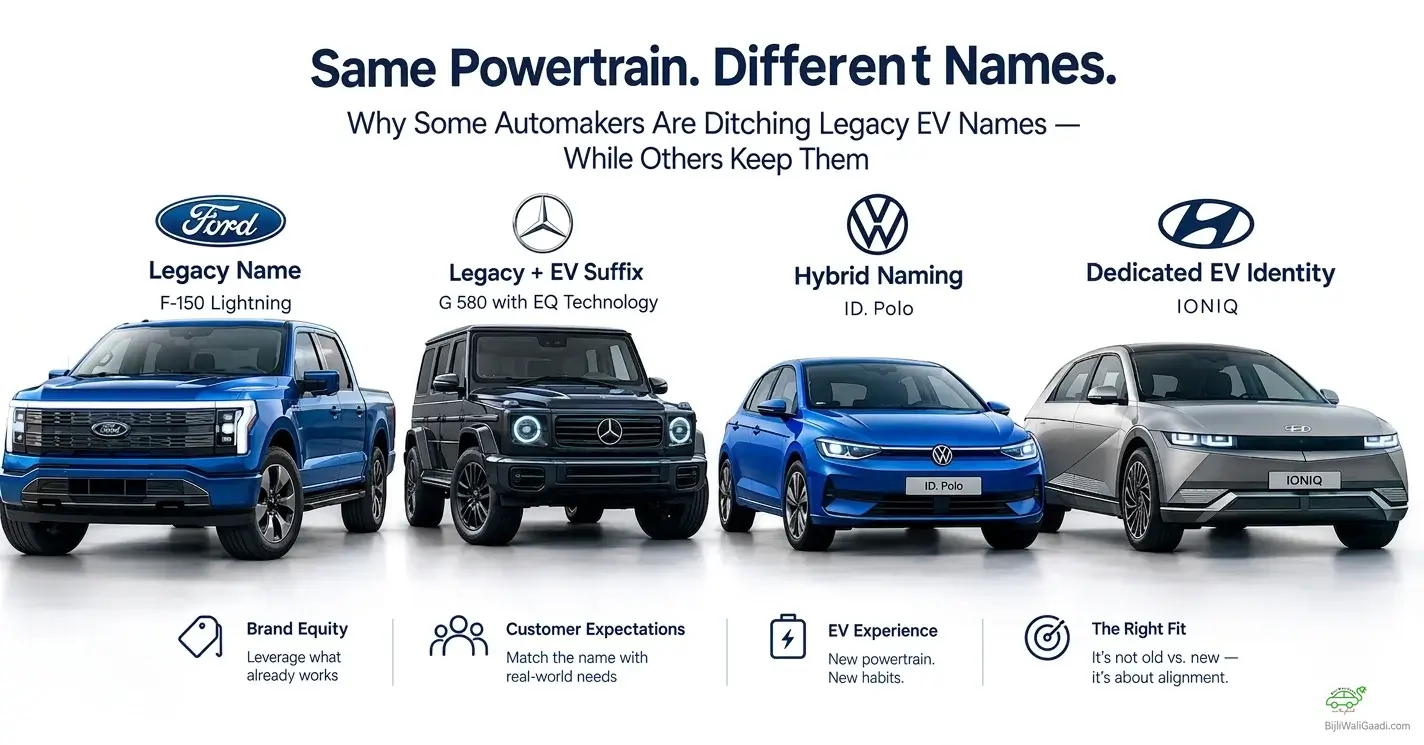
Quick Summary: Automakers aren’t following one universal EV naming playbook. Some keep legacy names outright (F-150 Lightning), some pair legacy names with an EV technology tag (Mercedes’ “with EQ Technology,” VW’s ID. Polo), and others build entirely new identities (Hyundai IONIQ). The right choice hinges on brand equity, customer expectations and how much the EV actually changes the ownership experience.
Legacy EV Names Carry Decades of Customer Expectations
A nameplate is shorthand. Say “F-150” to a truck buyer and they already know what they’re getting — decades of towing muscle, dealer familiarity, resale confidence, a refueling rhythm they’ve never had to think twice about.
Put that name on an EV, and none of that shorthand disappears. But some of it has to be re-earned in a different form.
Ford’s F-150 Lightning is the sharpest example. This isn’t a truck that fails at towing — it’s rated for up to 10,000 lb with the available Max Trailer Tow Package, and EPA-estimated range runs up to 320 miles on applicable configurations. The capability is real and documented.
What changes under a heavy trailer is range, not rated capacity. Independent testing and owner reports commonly show substantial range reductions under tow, often around 40–60% for substantial loads — but the actual number swings hard depending on trailer weight, aerodynamics, speed, temperature and terrain. There’s no single figure that applies to every trailer.
For a lifelong F-150 owner, that’s the real adjustment: not “can it tow,” but “how do I plan a trip around it.” Refueling was never load-dependent before. Now, charging stops are.
| Attribute | Legacy F-150 expectation | F-150 Lightning reality |
| Towing | Strong work capability | Up to 10,000 lb with Max Trailer Tow Package on applicable configurations |
| Range under load | Familiar ICE refuelling/range model | Towing can materially reduce range |
| Refuelling | Fast liquid-fuel stops | Charging requires more trip planning |
| Power delivery | Conventional ICE torque delivery | Instant electric torque |
Here’s the trade-off in one line: a legacy badge lowers the cost of explaining an EV, but it raises the bar the EV has to clear — the vehicle now has to satisfy an established use case, not just a new one.
The Pricing Question Is Just as Real
Price gaps between an ICE model and its EV counterpart vary a lot by brand, market and year — there’s no reliable industry-wide percentage worth quoting here. But large gaps can complicate a buyer’s mental math, and rapid EV price cuts alongside fast-moving battery technology have produced unusual depreciation patterns in several markets.
Whether that EV-specific depreciation bleeds into resale confidence for the ICE version of the same badge is a reasonable strategic hypothesis. Call it depreciation contagion if you like the label — just treat it as a lens for thinking about brand risk, not a proven, industry-wide effect.
Brand-strategy insight: A legacy badge can shrink the cost of explaining what an EV is — and grow the cost of explaining why it behaves differently.
Mercedes, Toyota and Volkswagen Are Blending EV Technology With Familiar Names
The story that alphanumeric EV sub-brands simply “failed” is too tidy. What’s actually happening at Mercedes, Toyota and VW is more interesting — and more instructive for anyone setting naming strategy today.
Mercedes hasn’t killed EQ. It’s repositioned it. Where EQ once functioned as its own standalone model family, it’s increasingly attached to familiar names as a technology tag: the G 580 with EQ Technology, the CLA 250+ with EQ Technology, the GLC 400 4MATIC with EQ Technology. The G-Class keeps its ladder-frame identity and off-road cachet; EQ simply flags the powertrain. That’s naming integration, not discontinuation.
Toyota shortened bZ4X to bZ for the 2026 model year in the U.S. and Canada — a name change bundled with a real product update. Manufacturer-estimated range on the top FWD configuration reaches up to 314 miles, and the 2026 bZ adds NACS charging compatibility. Toyota frames this as simplification, not retreat. Worth one mention: the original bZ4X was hit by a 2022 wheel-detachment recall that shaped early perception of the nameplate. Whether “Camry” or “RAV4” would have absorbed that episode more gracefully is a fair question — but it’s speculation, not something anyone can prove.
Volkswagen offers the cleanest example of a genuine hybrid strategy. Rather than choosing between its alphanumeric ID. family and its legacy names, VW is fusing them. The ID. Polo has already gone on sale in Europe in 2026, priced from roughly €24,990 — not a future concept, but a shipping product, built as the production version of the ID.2all concept. VW brand CEO Thomas Schäfer has said plainly that the company wants its established names carrying forward into the EV era rather than starting from zero with each new badge. More heritage-name pairings are expected to follow.
| Naming approach | Example | Strategic benefit | Main trade-off |
| Legacy name + EV suffix | Mercedes G 580 with EQ Technology | Preserves model equity while signaling EV tech | Longer naming |
| EV prefix + legacy name | Volkswagen ID. Polo | Combines EV identity with familiar name equity | Hybrid naming architecture |
| Simplified dedicated identity | Toyota bZ | Shorter, easier to recall | Still needs to build its own equity |
| Dedicated EV identity | Hyundai IONIQ | Unambiguous EV positioning | Requires new nameplate equity |
On the broader alphanumeric question: names like EQS or ID.4 do carry less pre-built emotional weight than Golf, Wrangler or 911 — those names have had decades to accumulate meaning that a new string of letters and numbers hasn’t had time to earn. That’s a fair observation about inherited equity. It’s not evidence that buyers dislike alphanumeric names outright, and no such research is cited here to claim otherwise.
Dedicated EV Platforms Let Automakers Rewrite the Product Story
A born-EV vehicle doesn’t inherit a specific ICE badge’s decades of accumulated expectations. That’s the real advantage — not the absence of promises, but the absence of old promises. Rivian still markets towing capability aggressively; it just isn’t answering to a legacy diesel-truck reputation while doing it.
Three related terms get conflated constantly, so it’s worth separating them cleanly:
| Term | Meaning |
| Born-EV | Vehicle developed primarily or exclusively around electric propulsion |
| Dedicated EV platform | Architecture engineered specifically for BEV propulsion |
| Skateboard architecture | Packaging approach placing battery and drive hardware low in the vehicle |
| SDV | Architecture where software increasingly controls and updates vehicle functions |
| EV sub-brand | Naming structure used to identify electric products |
Skateboard architecture describes physical packaging. SDV describes how software governs functionality over time. They overlap in the EV transition, but they’re not the same idea.
Hyundai’s E-GMP platform is the clearest documented example of the packaging payoff: mounting the battery beneath the floor eliminates the ICE-era transmission tunnel, producing a flatter cabin floor and more usable interior space — a benefit Hyundai attributes directly to building the platform exclusively for BEVs.
Tata’s acti.ev platform, launched with the Punch.ev in January 2024, follows similar logic in a different market: a flat floor without a transmission tunnel, an added frunk, and cloud-connected architecture supporting over-the-air updates. That’s a genuine EV-native design choice — not, more speculatively, proof that Tata has become “a software company.”
OTA updates, connected features, and cabin packaging are additional dimensions of EV differentiation. They sit alongside traditional attributes like range, power and towing — not in place of them. Software hasn’t replaced horsepower as a purchase driver; it’s added a new axis buyers now weigh.
Porsche’s Taycan Shows a Different Kind of Naming Choice
Porsche’s electric sports car debuted as the concept “Mission E” in 2015. In 2018, Porsche officially confirmed the production name as Taycan — not an electric 911, not an electric Panamera. It got its own identity from day one.
This can be read as a deliberate category-positioning choice: Porsche created a new model identity rather than folding the Taycan directly into the 911 nameplate. That’s a defensible reading of what Porsche did — not proof that standalone EV names are the universally superior approach.
The Right EV Name Depends on Brand Equity and Product Fit
There’s no formula with fixed percentage thresholds that reliably tells a CMO which way to go. What exists is a set of factors worth weighing together.
| Decision factor | Legacy name makes more sense when… | Dedicated/hybrid identity makes more sense when… |
| Nameplate equity | Strong, positive recognition | Associations are tightly tied to ICE traits |
| Customer expectation | EV performs the same core job | EV changes the ownership experience materially |
| Platform | Significant continuity with the existing model | Dedicated EV architecture |
| Price positioning | Similar market position | Significant repositioning |
| Product identity | Continuity itself is valuable | Genuinely new category for the brand |
| Portfolio maturity | EVs becoming integrated into the mainstream range | EV needs distinct positioning |
The more factors that point in one direction, the stronger the strategic case for that naming approach.
The pattern worth watching, though, is the hybrid one. Mercedes’ “with EQ Technology” suffix and VW’s ID. Polo both keep a trusted name while still flagging the electric powertrain clearly. That’s arguably the most interesting development in EV branding right now — not a winner between old and new, but a structure that carries both at once.
The Real EV Naming Battle Is About Expectations, Not Old Versus New
The naming debate was never really old name versus new name. It’s whether the name helps a buyer understand what the vehicle is, what it promises, and where it sits in the brand’s lineup.
A successful EV can wear a heritage badge, a technology suffix, a hybrid identity, or something built from scratch. What matters is whether the brand promise, the product’s real capability and the customer’s expectations reinforce each other — or quietly work against one another. That fit, not the letters on the tailgate, is the actual strategy.
FAQs
–
Stay connected via Google 'Electric Vehicle' News
Follow BijliWaliGaadi | India's Trusted EV Insights Portal
source on Google