Fortescue’s 6MW EV Charger Outguns Geely’s 2.2MW and BYD’s 1.5MW — But It’s Solving a Different Problem
Stay connected via Google 'Electric Vehicle' News
Follow BijliWaliGaadi | India's Trusted EV Insights Portal
source on Google
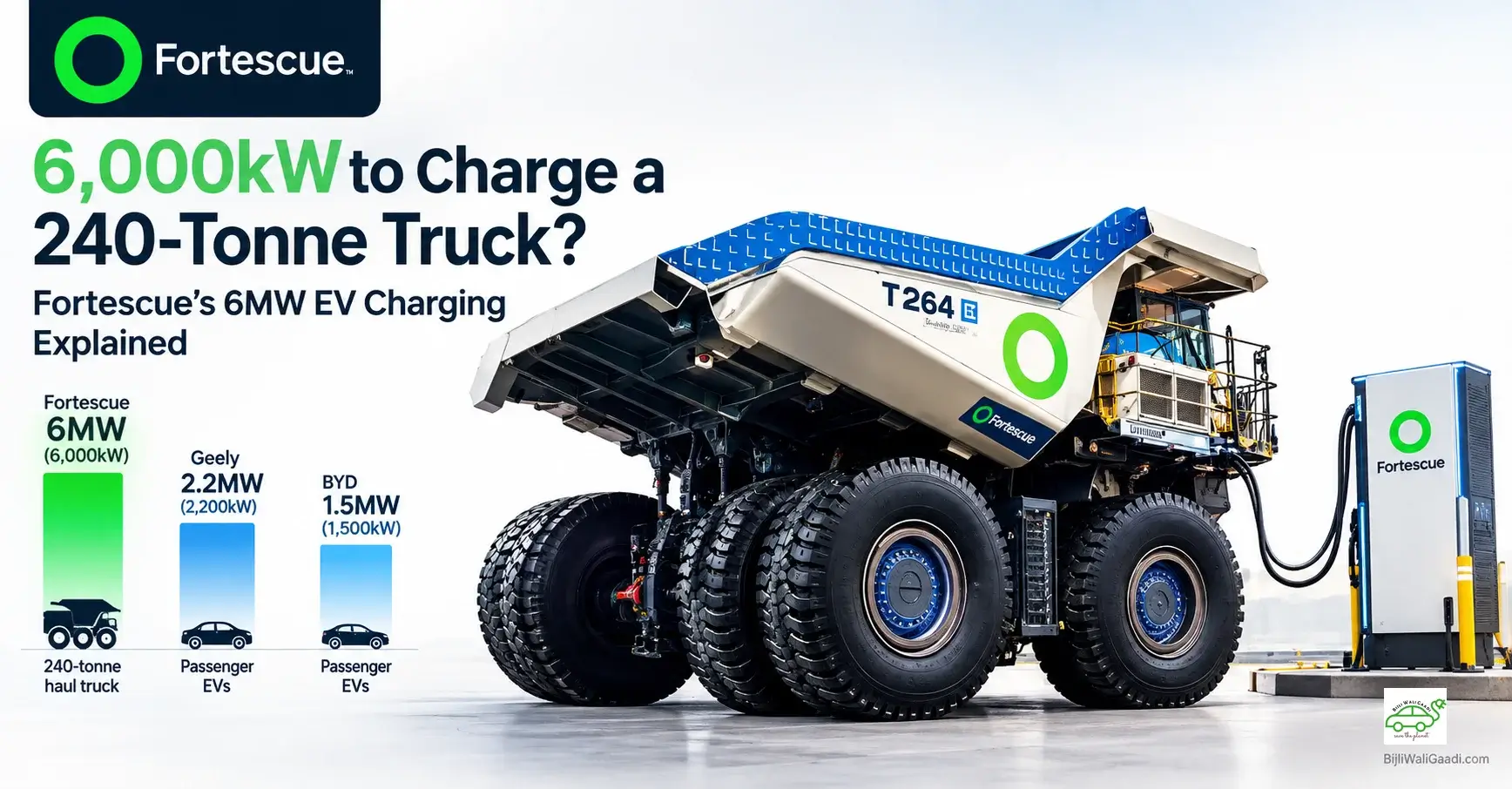
Fortescue 6MW Charger vs Geely 2.2MW Charger and BYD 1.5MW Flash Charger
Most EV chargers are rated in kilowatts. Fortescue is talking in megawatts — and at 6,000kW, its number is bigger than anything Geely or BYD has announced for passenger cars.
The Australian mining company says it is deploying 6MW fast chargers designed to recharge its 240-tonne electric haul trucks in under 30 minutes. That’s well above Geely’s new 2.2MW passenger-car charging system and BYD’s 1.5MW “Flash Charging” — but before anyone calls this a straight win, it’s worth understanding what each number is actually built for.
This isn’t a passenger-car charging story dressed up to look impressive. It’s a mining-fleet engineering problem, and the scale of it happens to dwarf even China’s fastest public EV chargers.
Why Does a 240-Tonne Electric Truck Need 6MW Charging?
A haul truck this size doesn’t sit parked for hours between trips the way a passenger car does. At Fortescue’s Pilbara iron ore operations in Western Australia, these trucks are expected to work in continuous cycles, hauling ore across extended shifts. Every minute spent charging is a minute the truck isn’t moving material.
Fortescue is aiming to electrify its Pilbara operations — including its roughly 300-strong haul truck fleet — by 2030, per the Canberra Times report. For a fleet that size to switch from diesel without losing output, charging speed has to fit the trucks’ existing operating cycles, not force new ones. That’s the specific problem the 6MW charging programme is built to solve.
Fortescue Says Its 6MW Chargers Can Recharge Haul Trucks in Under 30 Minutes
Fortescue’s own statement is direct: “We’re deploying 6MW fast chargers capable of recharging our 240-tonne haul trucks in under 30 minutes — aligned to the operating cycles of our fleet.” The company describes this as a deployment already under way, built for “continuous, high-demand operations,” adding: “if it can’t charge at scale, it can’t work at scale.”
The Canberra Times report separately describes the goal as charging trucks “in as little as 30 minutes” — language that aligns with, but isn’t identical to, Fortescue’s own “under 30 minutes” framing. Neither should be read as a guaranteed 0–100% charge time; it’s Fortescue’s stated target for this specific use case.
| Fortescue 6MW Charging: Key Fact | Details |
| Charging power | 6MW / 6,000kW |
| Vehicle application | 240-tonne electric haul trucks |
| Claimed recharge time | Under 30 minutes (Fortescue); “as little as 30 minutes” (news report) |
| Operational purpose | Continuous, high-demand mining operations |
| Location referenced | Pilbara, Western Australia |
| Related Formula E technology | 600kW Pit Boost |
Fortescue’s 6MW vs Geely’s 2.2MW vs BYD’s 1.5MW: How Do They Actually Compare?
On paper, Fortescue’s 6,000kW is nearly three times Geely’s new 2.2MW peak charging system, and four times BYD’s 1.5MW “Flash Charging 2.0” — both of which are aimed at passenger EVs, with Geely claiming roughly a four-minute charge and BYD around five minutes.
But raw kilowatt figures don’t translate cleanly across vehicle categories. Geely and BYD’s chargers are built to move a car’s relatively small battery through a short public charging stop. Fortescue’s 6MW charger is built to move enough energy into a 240-tonne mining truck to keep it working through another shift — a fundamentally larger and different energy task, running on dedicated industrial infrastructure rather than a public forecourt. Calling one “faster” than the other isn’t a meaningful comparison; they’re solving different problems at different scales.
What is fair to say: all three companies are part of the same broader shift toward megawatt-class charging, each pushing the ceiling in their own category — Fortescue in heavy mining equipment, Geely and BYD in passenger EVs.
What Does Formula E’s 600kW Pit Boost Have to Do With Fortescue’s Charging Strategy?
Fortescue Zero — the company’s technology division, which began as Williams Advanced Engineering, a Williams Formula 1 spin-off still based in England — has confirmed it will enter the 2026/27 Formula E season under the slogan “from track to truck,” per the Canberra Times report.
The division has already introduced Pit Boost to Formula E: a 600kW system that can add 10% battery charge to a race car in as little as 30 seconds during a pit stop. Fortescue Energy and Growth CEO Gus Pichot said motorsport serves as an “incubator and proving ground,” noting: “in racing every second counts, and innovations can be the difference between winning and losing. The same goes for decarbonising our mining operations.”
The available reporting doesn’t state that Pit Boost directly powers or creates the 6MW mining charger. Rather, Fortescue positions its Formula E work as a proving ground feeding its broader ultra-fast-charging ambitions, of which the haul truck programme is one part.
Why Fortescue Is Pushing Ultra-Fast Charging Into Mining
Electrifying a diesel-dependent fleet isn’t purely an emissions decision. Fortescue says it can save more than 680 million litres of diesel annually by switching its haul fleet to battery power, according to the Canberra Times report — a saving that matters given volatile diesel prices. Fast, fleet-compatible charging is what makes that switch operationally realistic rather than just aspirational.
Is Fortescue’s 6MW Charger Designed for Passenger EVs?
No. Nothing in the available reporting or Fortescue’s own statement suggests this system is meant for road-going passenger cars. It’s built specifically for 240-tonne electric haul trucks operating in Fortescue’s Pilbara mining fleet — a different category from Geely’s and BYD’s passenger-EV chargers entirely.
What’s documented so far is a company-stated deployment aimed at one demanding use case: keeping a mining fleet charged without losing productivity. It happens to out-power the fastest passenger-EV chargers on the market today — but that’s a side effect of scale, not a competition Fortescue set out to win.
FAQs
–
Stay connected via Google 'Electric Vehicle' News
Follow BijliWaliGaadi | India's Trusted EV Insights Portal
source on Google