JSW Greentech Ampstar: New Commercial EV Brand with 100,000-Truck Vision
Stay connected via Google 'Electric Vehicle' News
Follow BijliWaliGaadi | India's Trusted EV Insights Portal
source on Google
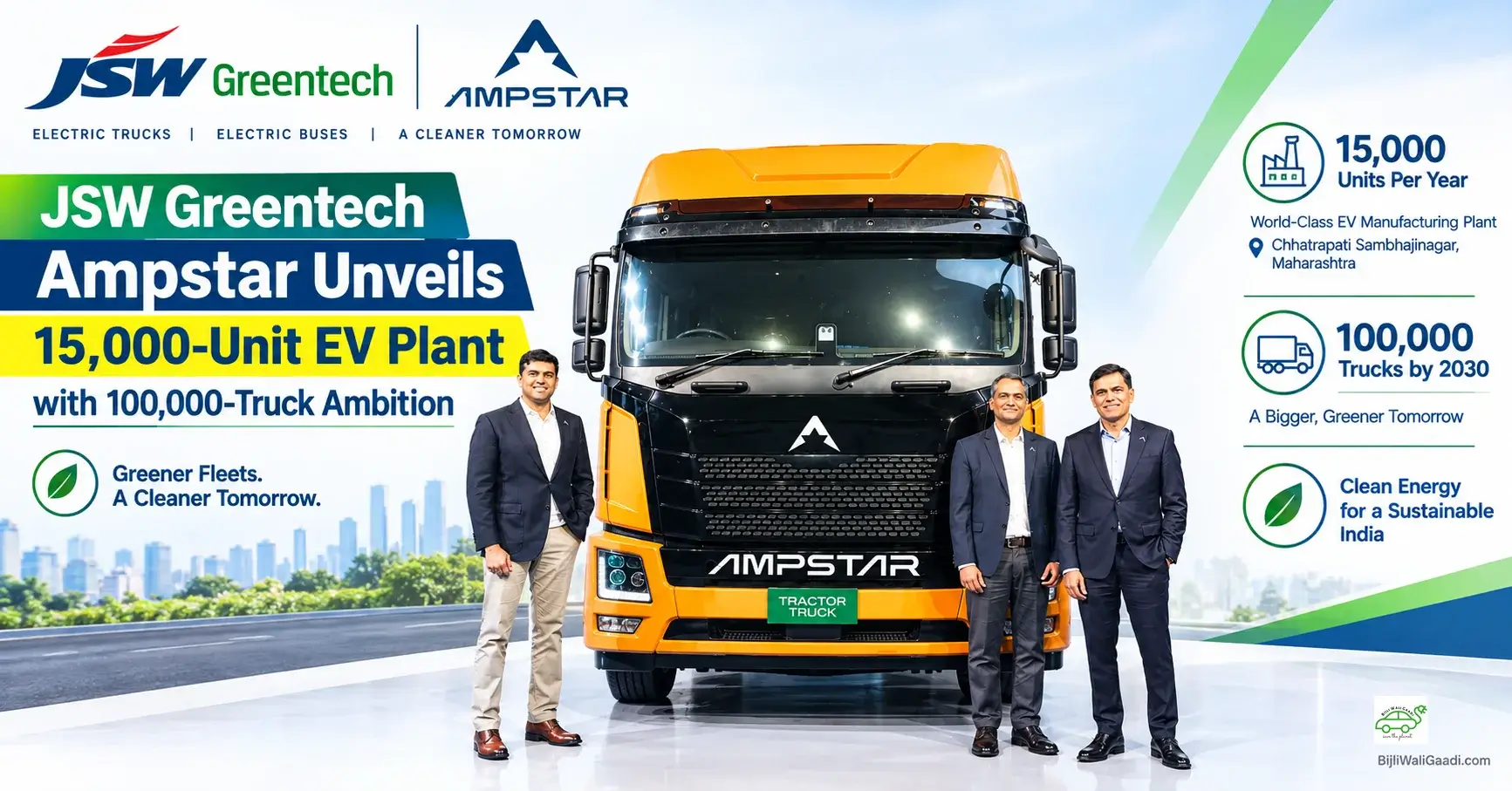
JSW Greentech Ampstar, the company’s new electric commercial vehicle brand, launched in Mumbai on September 22, 2026. The initial focus is electric trucks and buses, with a 55-tonne electric tractor-trailer and an electric bus revealed at the event. Manufacturing is planned at a greenfield facility in Chhatrapati Sambhajinagar, Maharashtra, with commercial production expected within 30 days.
Ampstar belongs to JSW Greentech Limited, a subsidiary of JSW Green Mobility Limited under the JSW Group. The name combines “ampere,” the unit of electric current, with “star.” Brand consultancy Interbrand worked with JSW Greentech on Ampstar’s identity.
What Is Ampstar and Why Has JSW Entered Electric Commercial Vehicles?
Chairman Sajjan Jindal described the move into trucks and buses as a deliberate diversification, aimed at accelerating India’s shift away from diesel commercial vehicles.
The plant broke ground in October 2024. JSW Greentech’s engineering work is based at an R&D centre in Pune, combined with select global technology partnerships and in-house localisation, per the company.
JSW Greentech Ampstar: What Has the Company Revealed?
CEO Sumit Mittal said Ampstar’s products are customised by application, not sold off the shelf, so pricing will vary.
Ampstar Product and Manufacturing Snapshot
| Parameter | Details |
| Company | JSW Greentech Limited |
| EV brand | Ampstar |
| Segment | Electric trucks and buses |
| Launch date | September 22, 2026, Mumbai |
| Products shown | 55-tonne electric tractor-trailer; electric bus |
| Bus sizes | 7 metres to 18 metres |
| Manufacturing location | Chhatrapati Sambhajinagar, Maharashtra (90-acre site) |
| Planned annual capacity | 15,000 units (10,000 buses + 5,000 trucks) |
| Certification | ARAI CMVR Type Approval for the JSW 12M 51+D AC SDX electric bus (Feb 2026) |
Ampstar EV Powertrain: What JSW Has Revealed
Battery Architecture
JSW has disclosed Ampstar truck battery configurations of 282 kWh, 400 kWh, 450 kWh and 500 kWh, in fixed and swappable formats. These figures represent stored electrical energy; actual range depends on duty cycle, payload, speed, terrain and other operating conditions. Battery chemistry has not been disclosed.
Vehicle Controls and Software
JSW Greentech says Ampstar’s vehicle-control software, battery-pack design and vehicle-control unit are developed in India, with global suppliers ZF and Dana handling mechanical systems. These form important elements of the vehicle’s electronic and energy-management architecture, though the detailed control strategy has not been disclosed.
Motor type, peak power, peak torque and detailed drivetrain architecture have not been publicly disclosed for the Ampstar truck in the supplied material.
| Powertrain element | What JSW has disclosed | Why it matters |
| Battery capacity | 282/400/450/500 kWh options | Application-specific energy capacity |
| Battery format | Fixed and swappable | Supports different fleet strategies |
| Battery-pack engineering | Developed in India | Indicates local engineering capability |
| Vehicle-control software | Developed in India | Supports integrated vehicle control |
| Vehicle Control Unit | Developed in India | Core electronic control element |
| Motor type | Not disclosed | — |
| Motor power/torque | Not disclosed | — |
| Battery chemistry | Not disclosed | — |
| Charging time/range | Not disclosed | — |
Swappable batteries can potentially reduce downtime on suitable routes, since a depleted pack can be exchanged rather than recharged. A specific swap time has not been disclosed.
Inside JSW’s 15,000-Unit EV Manufacturing Plant
JSW describes the facility as a cell-to-battery-pack integrated operation, but battery cells will initially be imported. Its role therefore includes battery-pack assembly rather than domestic cell manufacturing at launch. JSW also describes it as the first Indian CV plant with a PTED corrosion-protection process.
| Manufacturing parameter | Details |
| Location | Chhatrapati Sambhajinagar, Maharashtra |
| Site | 90 acres |
| Annual e-bus capacity | 10,000 units |
| Annual e-truck capacity | 5,000 units |
| Total designed capacity | 15,000 units/year |
| Manufacturing scope | Vehicle assembly, truck cabin, bus body, battery-pack assembly |
| Digital manufacturing | ERP + PLM + MES (Industry 4.0) |
| PTED | Corrosion-protection process (JSW-described first for an Indian CV plant) |
The 15,000-unit figure is designed annual capacity, not current output. JSW Greentech has set a current-financial-year production target of 500–1,000 vehicles, roughly 60% trucks and 40% buses — a target, not actual production. JSW has separately stated a longer-term ambition to build capacity for 100,000 electric trucks by 2030, distinct from the plant’s 15,000-unit figure and not a confirmed order or sales number.
Why Closed-Loop Fleets Matter to Ampstar
Commercial EVs depend heavily on duty cycle, route predictability, payload, utilisation, charging/swapping availability and total cost of ownership. Ampstar’s initial deployment strategy is focused on steel, cement, mining and port operations, where predictable routes can simplify charging or battery-swapping infrastructure planning.
JSW says its wider steel, cement and port operations involve around 17,000 trucks, which it intends to draw on as an early deployment base. Predictable routes can ease infrastructure planning versus open-ended long-haul use, though this does not guarantee specific savings.
What the Ampstar Launch Means for India’s Commercial EV Market
FACT: JSW has built an integrated plant for trucks, buses and battery-pack assembly, has received financing approvals from ICICI Bank, HDFC Bank, Canara Bank and SBI, and plans outright sale, cost-per-km, wet-lease and battery-as-a-service models.
ANALYSIS: JSW’s existing industrial operations could provide early deployment environments for Ampstar, ahead of wider commercial sales.
JSW Greentech plans an initial direct B2B sales approach rather than a nationwide dealer network, with limited dealers in select clusters.
What JSW Has Not Yet Disclosed
Several buyer-facing specifications remain unavailable: pricing, range, charging time, motor specifications, battery chemistry, exact payload/GVW, and service or warranty terms. Whether or when these will be disclosed has not been indicated.
FAQs
–
Stay connected via Google 'Electric Vehicle' News
Follow BijliWaliGaadi | India's Trusted EV Insights Portal
source on Google