A 406 MPH Hydrogen Rocket in Utah, a $1 Billion Factory in Texas: Inside JCB’s Big American Move
Stay connected via Google 'Electric Vehicle' News
Follow BijliWaliGaadi | India's Trusted EV Insights Portal
source on Google
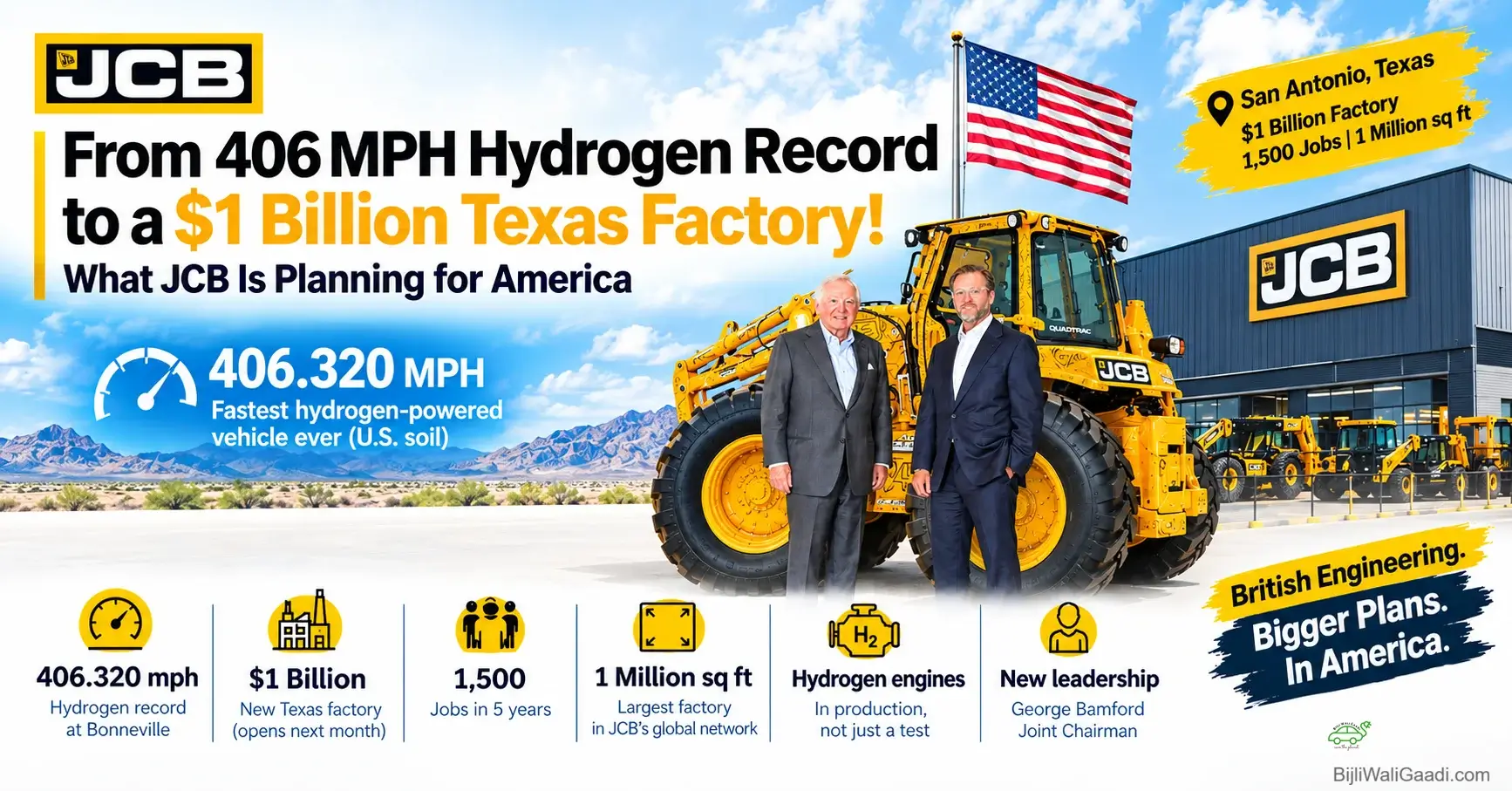
Quick answer: In August 2026, JCB’s hydrogen-powered Hydromax set a provisional world record of 406.320 mph at Utah’s Bonneville Salt Flats. Now JCB is opening its $1 billion, one-million-square-foot factory in San Antonio, Texas next month. It is the company’s largest in the world and will create 1,500 jobs over five years.
Key Takeaways
- 406.320 mph: the fastest hydrogen-powered vehicle of any kind, set on U.S. salt.
- More than double the previous hydrogen combustion record of 185.5 mph (BMW H2R, 2004).
- $1 billion: the cost of JCB’s San Antonio plant, opening next month.
- 1,500 jobs over the next five years.
- Hydrogen engines are in production, after a £100 million development programme.
- George Bamford becomes Joint Chairman, the first change at the top in more than 50 years.
Why Is JCB Building Its Biggest Factory Ever in Texas?
JCB’s press release says North America is “the world’s biggest construction equipment market.”
The San Antonio plant will build Loadall telescopic handlers and access equipment for that market. It is JCB’s largest factory anywhere in the world, and it opens next month.
The timing was deliberate. As our earlier analysis of the Hydromax hydrogen land speed record noted, a record run on American soil, just before the Texas opening, gives JCB technological credibility with U.S. customers.
How Many U.S. Jobs Will JCB’s San Antonio Factory Create?
JCB expects to create 1,500 jobs over the next five years in Texas. JCB has 23 factories and more than 20,000 employees worldwide, and this site is its biggest by floor space.
What Exactly Did the JCB Hydromax Do at Bonneville?
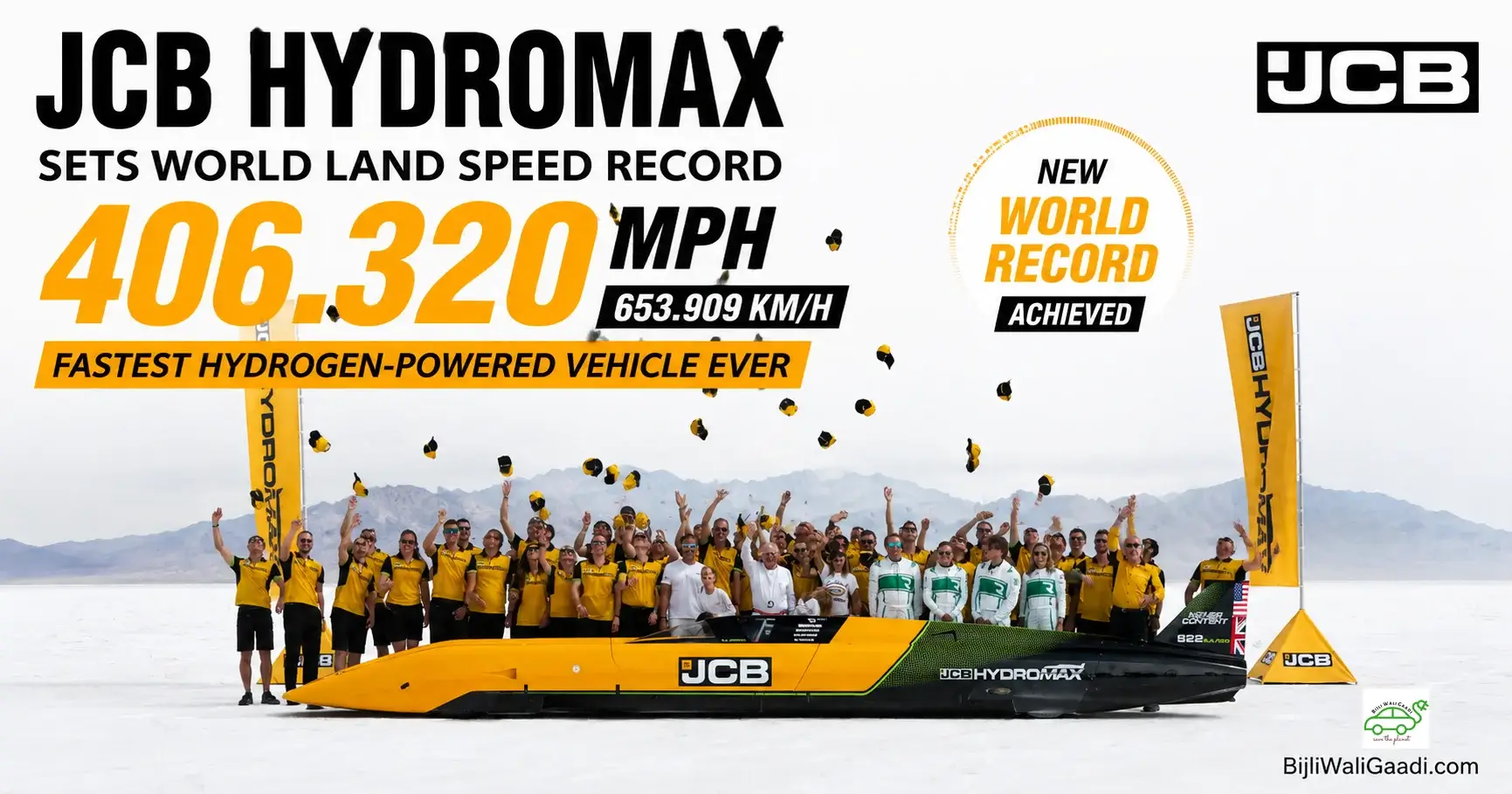
On August 11, 2026, Wing Commander Andy Green OBE drove the Hydromax to a two-way average of 406.320 mph (653.909 km/h). Green holds the outright land speed record of 763.035 mph.
Under FIA rules the run required two passes within an hour:
- First pass: 400.623 mph
- Return pass: 412.135 mph
- Official average: 406.320 mph
The record is provisional and awaits FIA ratification. It falls under Category A, Group XIV, Class 7.
The Hydromax also beat JCB’s own 350.092 mph Dieselmax diesel record, set on the same salt flats 20 years earlier and also driven by Green. Days before, it had run 368.347 mph at Bonneville Speed Week, a Southern California Timing Association class record.
For the full story of the run, read our report on the JCB Hydromax 406 mph world land speed record.
How Much Faster Is 406 MPH Than Every Other Hydrogen Record?
| Hydrogen record | Speed | Year |
|---|---|---|
| BMW H2R (hydrogen combustion) | 185.5 mph | 2004 |
| Buckeye Bullet 2 (hydrogen fuel cell) | 303 mph | 2009 |
| JCB Hydromax (hydrogen combustion) | 406.320 mph | 2026 |
The Hydromax more than doubled the combustion record and passed the fuel-cell mark, making it the fastest hydrogen vehicle of any kind.
What’s Under the Hood of the Hydromax?
The Hydromax is a 32-foot, twin-engined, all-wheel-drive streamliner. Its engines are production-based and were built at JCB’s factory in Foston, Derbyshire.
- Power: two turbocharged four-cylinder hydrogen engines, tuned from 80 hp in production form to about 800 hp each, for a combined 1,600 bhp.
- Partners: Prodrive built the car, Ricardo tuned and calibrated the engines, and Xtrac supplied the twin-transmission drivetrain.
- Versus Dieselmax: about 10% lighter and 10% more aerodynamically efficient.
- Cooling: the engines sit at an 82-degree angle to make room for a larger cooling package.
- Emissions: water vapor, with trace NOx from high-temperature combustion.
The car went from idea to world record in just 18 months.
Hydrogen Combustion vs. Fuel Cell: Which One Did JCB Bet On?
JCB chose hydrogen internal combustion. The engine burns hydrogen directly in its cylinders, using familiar pistons, crankshafts and turbochargers.
A fuel cell instead combines hydrogen and oxygen electrochemically to make electricity for electric motors.
Our earlier analysis argued that combustion suits heavy equipment such as construction machinery. These machines work in remote locations on long shifts, where batteries are harder to use. That analysis also cited hydrogen’s higher energy density than lithium batteries by weight, and diesel-like refuelling speeds.
We also noted the record does not make hydrogen better than battery-electric power across the board. The two technologies serve different uses.
Is This Just a Publicity Stunt? Hydrogen JCBs Are Already in Production
JCB says the record followed a £100 million hydrogen programme. That made it the first construction equipment company in the world to bring a fully approved hydrogen-fuelled combustion engine to market. Hydrogen-powered machines are now in production.
The Hydromax’s engines are the same basic engines that power JCB machines leaving its UK production lines. FIA President Mohammed Ben Sulayem said the project shows how “innovation, performance, speed, and sustainability can go hand in hand.”
What Do JCB’s 2025 Results Reveal About Its Spending Power?
| Metric | 2025 (£) | 2025 (US$) | 2024 (£) |
|---|---|---|---|
| Turnover | £5.7 billion | $7.64 billion | £5.8 billion |
| Profit before tax | £642.0 million | $860.2 million | £687.3 million |
| Machine sales (units) | 113,498 | n/a | 119,848 |
- JCB stayed debt-free with no net borrowings.
- It increased global market share, despite flat demand in North America and a 12% market contraction in India.
- CEO Graeme Macdonald expects moderate growth in 2026 as new capacity comes on stream in Texas and Staffordshire.
Who Is George Bamford, and What Does the Leadership Shift Mean?
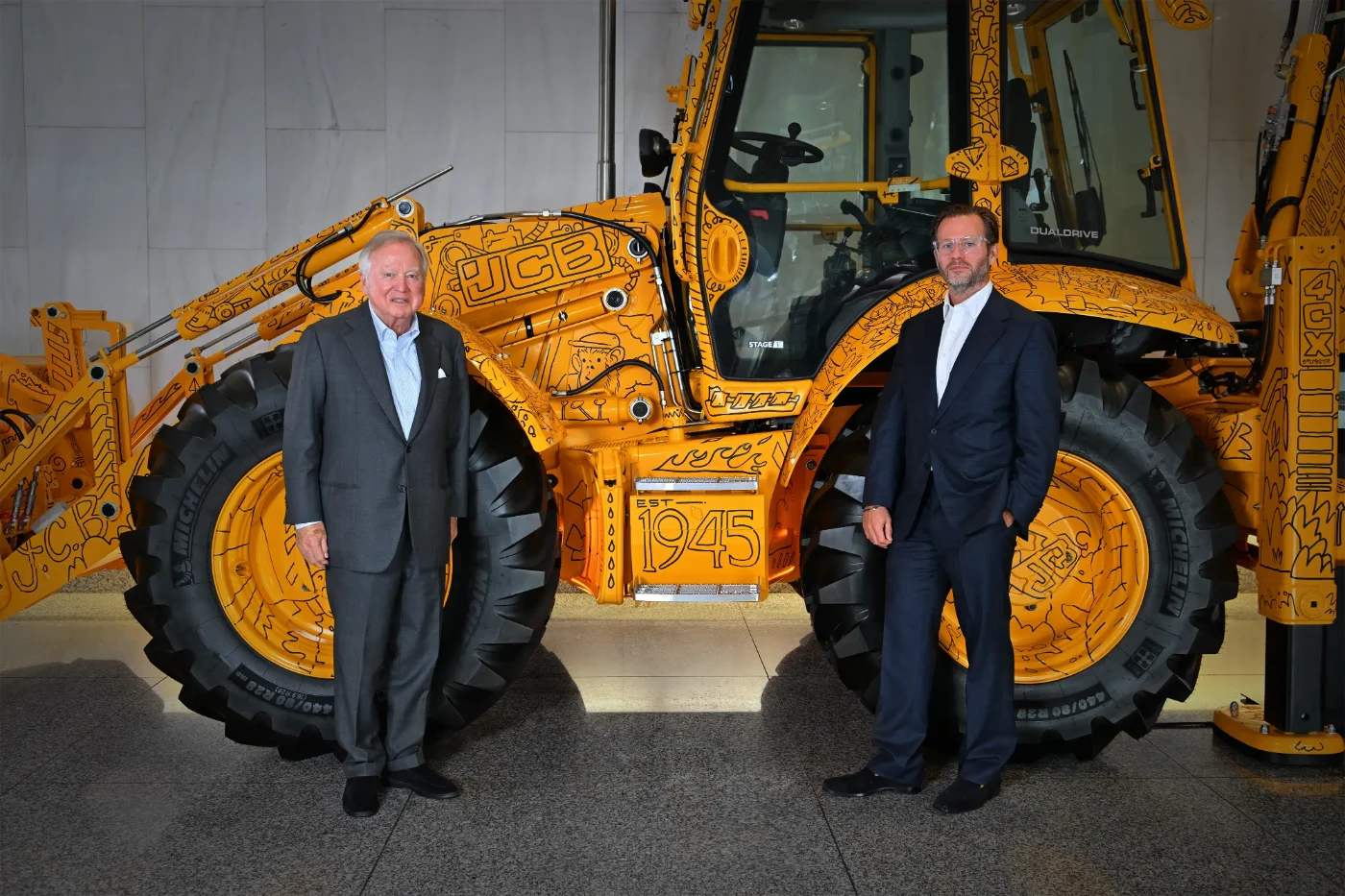
George Bamford will become Joint Chairman alongside his father, Lord Bamford. It is the first change at the top of JCB in more than 50 years.
George Bamford said the Hydromax “showed the world what British engineering can achieve.” For U.S. partners and dealers, the message is continuity, with a family-owned company planning its next chapter.
Is JCB Still Investing in Britain?
Yes. JCB is spending £100 million to transform its Staffordshire headquarters, its home since 1950. The plan includes a £60 million fully automated powder paint plant and a modernized shop floor, and helps secure more than 8,000 UK jobs.
Who Will Staff the Factories of the Future?
The JCB Academy received 708 applications for 314 places this September. Since opening in 2010, it has educated around 3,750 young people, with a 100% record of leavers moving into work or further education. This month, 116 new apprentices, undergraduates and graduates, picked from more than 6,300 applicants, joined JCB.
Frequently Asked Questions
Stay connected via Google 'Electric Vehicle' News
Follow BijliWaliGaadi | India's Trusted EV Insights Portal
source on Google