Slash Your Home and EV Power Bills: How Evolve’s New Solar Centre Simplifies Rooftop Savings
Stay connected via Google 'Electric Vehicle' News
Follow BijliWaliGaadi | India's Trusted EV Insights Portal
source on Google
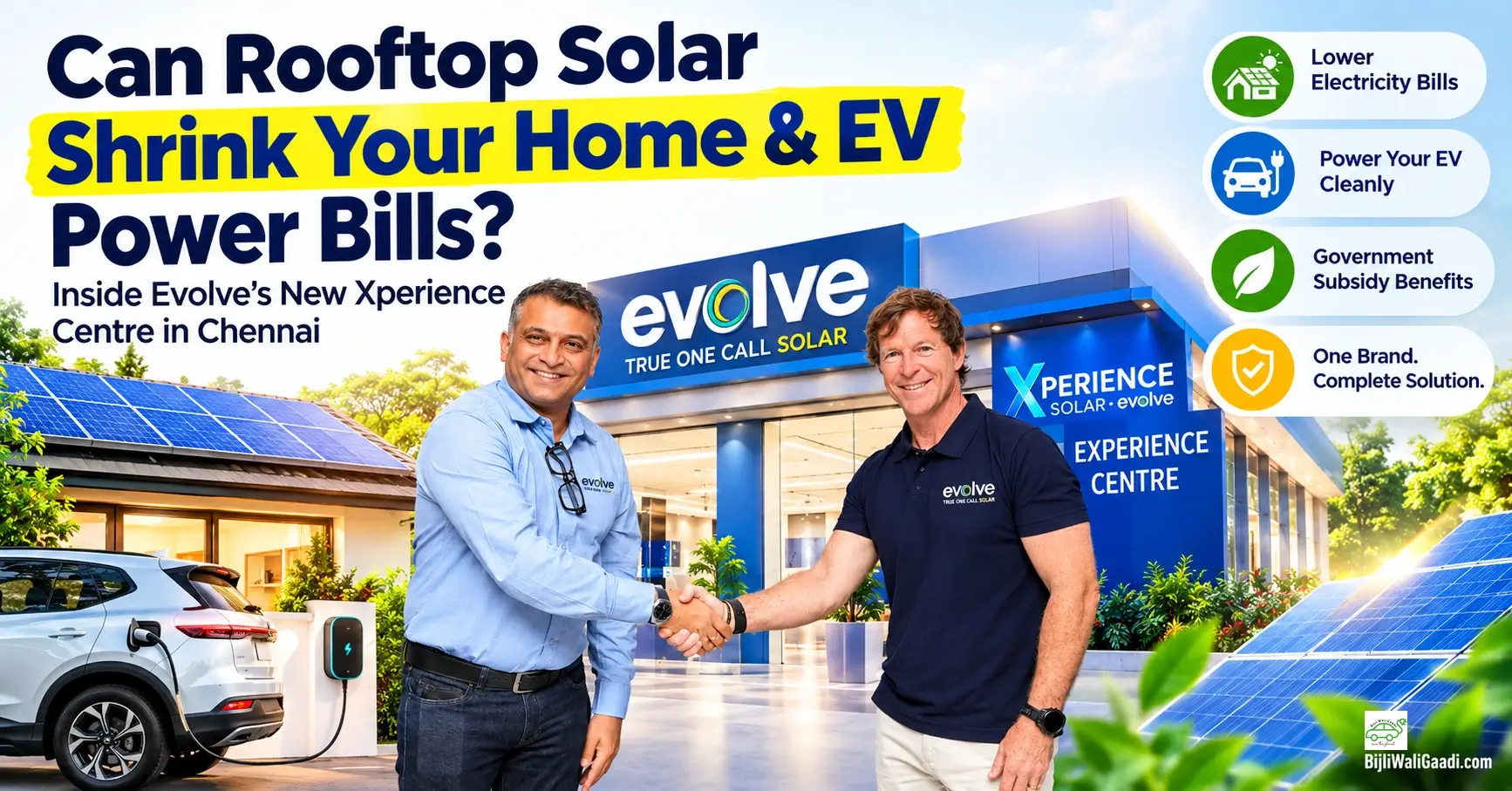
Evolve Energy Group, the flagship company of Evolve Green Energies, inaugurated its Evolve Solar Xperience Centre in Chennai, with cricketing legend and Group Brand Ambassador Jonty Rhodes leading the launch. Held under the theme “Evolved for Legendary Performance,” the event witnessed the participation of hundreds of customers and marked the unveiling of the Group’s new brand identity, reinforcing its commitment to making rooftop solar solutions more accessible to homeowners.
Every unit you buy from the grid is a recurring cost, whether it runs a fan, an air conditioner or an electric car. The extra units a household uses often land in the ₹7 to ₹10 per unit range on Indian domestic bills, according to our July 2026 solar EV charging calculator guide, and an EV pushes consumption into exactly those slabs. Rooftop solar attacks the cost at the source, and it generates clean power on your own roof. That double benefit, lower day-to-day running costs and greener energy, is why a new one-brand solar showroom in Chennai is worth a close look.
Key Highlights: What Homeowners Should Know in 60 Seconds
- The launch: Former South African cricketer Jonty Rhodes, Evolve’s Group Brand Ambassador, inaugurated the Evolve Solar Xperience Centre in Chennai with founder Rajesh V. Shah, under the theme “Evolved for Legendary Performance.”
- The pitch: One brand handles equipment, installation, approvals and after-sales service, summed up as “Direct warranty. Direct support. Direct price. One brand. One call. One solution.”
- The sizing rule: At about 4 units per kW per day, each kW of rooftop solar generates roughly 120 units a month, according to our guide’s assumptions.
- The money: The central PM Surya Ghar subsidy reaches ₹78,000 for systems of 3 kW and above, and after-subsidy payback is estimated at about 3 to 4 years.
- The EV bonus: A car driven 50 km a day adds roughly 1.35 kW to 2.15 kW to the sizing, depending on the model.
Why Do Solar Panels Make Sense for Your Home Electricity Bill?
A rooftop system turns the sun into units you would otherwise buy. Our guide assumes an average yield of about 4 units per kW per day, so a 3 kW system generates around 360 units a month. With a grid-tied setup and a net meter, daytime surplus is exported and credited against what you draw later, including at night.
The cost logic is straightforward. You pay once for the system, the subsidy reduces the outlay, and after payback the marginal cost of the units you generate is close to zero apart from cleaning and servicing. Savings depend on your tariff, your consumption pattern and your state’s net-metering rules, and generation dips in heavy monsoon months, by 30 to 50 percent in our guide’s estimate.
How Big a Solar System Does Your Home Need?
Start with your monthly units from the electricity bill and divide by 120, the approximate monthly output of 1 kW at 4 units per kW per day. The table below applies that rule of thumb; it is our illustration, not an Evolve quotation.
| Monthly home consumption (units) | Approximate rooftop solar needed (kW) |
| 150 | 1.25 |
| 300 | 2.5 |
| 450 | 3.75 |
| 600 | 5.0 |
Real designs also depend on roof area, shading, orientation and your day-versus-night usage, which is why a site survey matters. Avoid oversizing: net-metering accounts are typically settled annually, and surplus units left at the end are usually paid at a much lower rate than the tariff you avoid by using solar power yourself.
Got an Electric Vehicle? Add It to the Sum
An EV is simply a large extra load, and it is easy to overlook when sizing. Our guide’s worked example: a Tata Nexon EV Empowered driven 50 km a day at about 135 Wh/km uses 6.75 kWh, which becomes about 7.94 units from the supply after charging losses (a 0.85 efficiency factor). At an assumed ₹8 per unit that is about ₹63.50 a day, roughly ₹1,905 a month, or about ₹1.27 per km.
Daily distance and consumption, not battery size, decide the solar requirement. For a 50 km commute:
| EV model | Daily energy (kWh) | Solar array needed (kW) |
| MG Comet EV | 4.50 | 1.35 |
| Tata Punch EV | 6.00 | 1.8 |
| Tata Nexon EV | 6.75 | 2.0 |
| Mahindra BE 6 | 7.00 | 2.1 |
Source: BijliWaliGaadi solar EV charging guide. Check your own car’s real Wh/km before sizing.
The numbers add up quickly. A Nexon at 50 km a day draws about 238 units a month, while a 3 kW system generates about 360. That leaves roughly 120 units for the rest of the house, so a home with an EV and heavy air-conditioning may need 4 to 5 kW. Electric two-wheelers need far less, about 0.42 kW to 0.65 kW for a 40 km daily commute.
Jonty Rhodes Inaugurates Evolve Solar’s Xperience Centre in Chennai
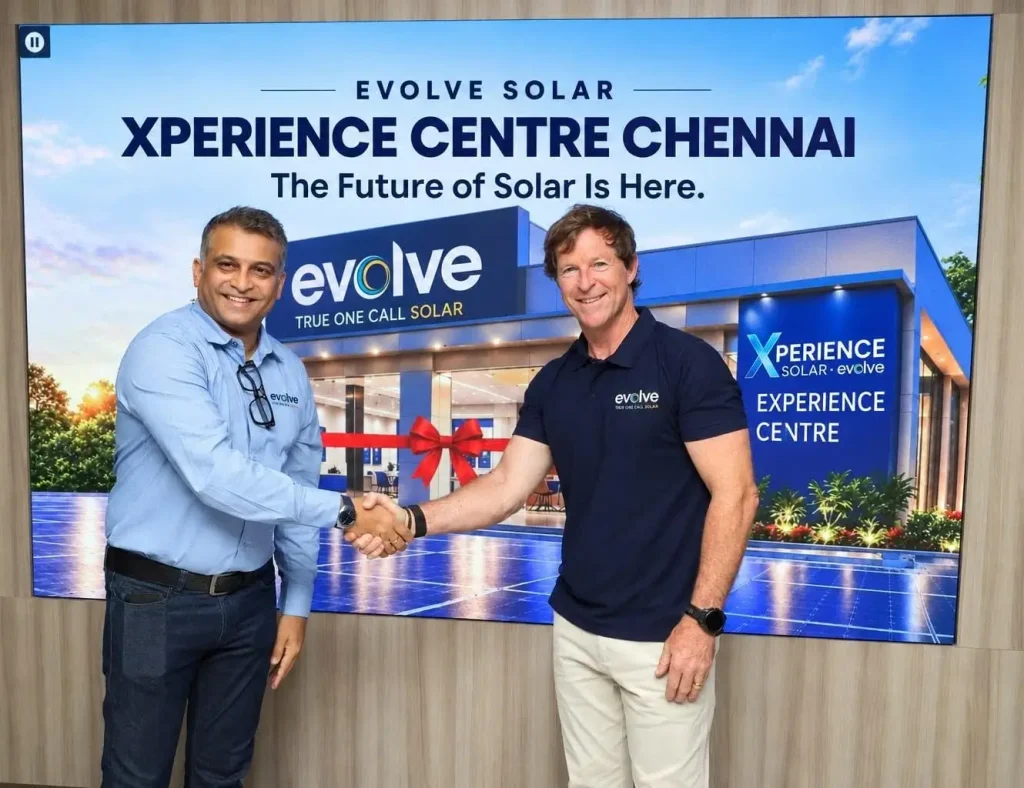
Evolve Energy Group, the flagship company of Evolve Green Energies, inaugurated its Evolve Solar Xperience Centre in Chennai in October 2026. Jonty Rhodes led the launch alongside Rajesh V. Shah, Founder, Chairman and Managing Director of the Group.
The event, held under the theme “Evolved for Legendary Performance,” drew hundreds of customers and marked the unveiling of the Group’s new brand identity. Evolve says the aim is to make rooftop solar more accessible to homeowners.
One Brand, One Call: Evolve’s Answer to Buying Solar From Five Different Vendors
Shah’s argument is simple. A homeowner should not buy panels from one vendor, an inverter from another, and then search separately for installation and service. He likened solar to an air conditioner: nobody buys one part by part, so solar should be offered as a complete branded solution with transparent pricing, a clear warranty and a single point of accountability.
On its new website, Evolve describes “one-call” as covering equipment selection, electrical design, project execution and long-term operation. For a household, that means one accountable provider from the first bill review to later servicing, which is easier to hold to account than a chain of separate vendors.
Inside the Evolve Family: Green Homes, EVVO and 101
The new evolvegreen.com platform sits across the Group’s brands, and the company’s pages describe them as follows:
- Green Homes: rooftop solar solutions for homes and residential communities.
- EVVO Solar: solar products, including on-grid, hybrid and off-grid inverters, and PV modules in Mono PERC, bifacial Mono PERC and half-cell technologies.
- 101 (101 Solar Care): plant care, covering cleaning, inspection and maintenance.
The new site is oriented mainly to businesses, investors and energy offtakers, and points homeowners to the Green Homes brand. The site is launch at REI Expo 2026 today.
From Bill Check to Switch-On: Evolve’s Six-Step Solar Journey
Evolve describes the customer journey like this:
- Free site visit. A solar expert assesses your rooftop, electricity use and feasibility at no cost.
- Personalised proposal. You receive system sizing, equipment, installation scope, applicable subsidies, savings and pricing in writing.
- Approvals and subsidy support. Evolve handles documentation and coordination with the local electricity board, including subsidy applications.
- Installation. Certified engineers install the system. Evolve says small residential systems typically take 1 to 2 weeks.
- Grid connection and net metering. Evolve manages net-metering approvals, DISCOM clearances and meter upgrades.
- Commissioning and support. After testing, customers can access warranty support, monitoring, maintenance and service through the same brand.
Bring your last three months of electricity bills to the first visit. If you own an EV, add your daily kilometres and the car’s real Wh/km.
Subsidy, Net Metering and Warranty: The Fine Print Before You Sign
PM Surya Ghar subsidy. The central subsidy is ₹30,000 for a 1 kW system, ₹60,000 for 2 kW and a maximum of ₹78,000 for 3 kW and above, according to Business Today’s July 2026 explainer. Applications are made at pmsuryaghar.gov.in, and the subsidy is paid to your bank account after DISCOM inspection and net-meter commissioning. Some states add top-ups, so check your DISCOM before finalizing.
Net metering. A grid-tied system with a bi-directional net meter exports surplus daytime power and credits it against later use, so the grid works as a virtual battery and you avoid buying one. Credit rules and settlement periods vary by state.
Inverter type. On-grid inverters suit net-metered homes. Hybrid inverters are for systems with battery storage, which adds cost. Choose based on how often your area has outages.
Panel compliance. Our guide advises confirming in writing that panels and inverters are on MNRE’s Approved List of Models and Manufacturers (ALMM) for your installation date, because non-compliant equipment can put the subsidy claim at risk. Verify against the live list.
Warranty. Evolve Energy Group states an 8-year service warranty on inverters, a 15-year product warranty on panels and a 30-year linear performance warranty on panels. Ask for the exact terms in your proposal.
How Fast Does Rooftop Solar Pay Back? Under 4 Years in These Estimates
The table below uses illustrative city-average costs from our guide, with ₹8 per unit and 4 units per kW per day. Actual quotes vary by state, vendor, panel technology and roof structure, so compare more than one.
| System size | Cost before subsidy (₹) | Central subsidy (₹) | Net cost (₹) | Monthly savings (₹) | Payback (years) |
| 2 kW | 1,30,000 | 60,000 | 70,000 | 1,920 | about 3.0 |
| 3 kW | 1,96,000 | 78,000 | 1,18,000 | 2,880 | about 3.4 |
| 5 kW | 2,90,000 | 78,000 (capped) | 2,12,000 | 4,800 | about 3.7 |
Source: BijliWaliGaadi solar EV charging guide. Payback assumes every generated unit offsets a ₹8 tariff and excludes financing costs and tariff changes.
Seven Questions to Ask Any Solar Installer Before You Pay
- What system size do you recommend for my household load, and for my EV if I have one? How did you calculate it?
- Are the panels and inverters on the current ALMM list, and can you confirm that in writing?
- Which module technology is being supplied (Mono PERC, bifacial, TOPCon), and why?
- Who files the subsidy and net-metering applications, and what is the timeline in my DISCOM area?
- What are the product, inverter and performance warranty terms, and who honours them?
- What does the proposal say about monitoring, cleaning and annual maintenance?
- What is the all-in price, and what is excluded?
Meet Evolve Energy Group and Credentials Behind the Chennai Launch
Founded in 2011 and headquartered in Chennai, Evolve Energy Group serves residential, commercial and industrial customers across more than 15 states, with over 350 professionals. Its capabilities span manufacturing, project execution, renewable asset ownership and maintenance.
According to the Group’s own site, it has supplied more than 3 GW of inverters and modules and installed over 350 MW of projects. Evolve Green Homes has installed more than 3 MW of rooftop solar for over 1,500 homeowners. These figures are company-reported and we have not independently verified them.
Frequently Asked Questions
Stay connected via Google 'Electric Vehicle' News
Follow BijliWaliGaadi | India's Trusted EV Insights Portal
source on Google