Electric Trucks Can Tow 12,000 Pounds, But Your Range Might Get Cut in Half
Stay connected via Google 'Electric Vehicle' News
Follow BijliWaliGaadi | India's Trusted EV Insights Portal
source on Google
Electric trucks deliver instant torque that makes a loaded trailer feel almost weightless on a grade. Then you hitch a camper or boat, check the dash, and watch your driving range collapse.
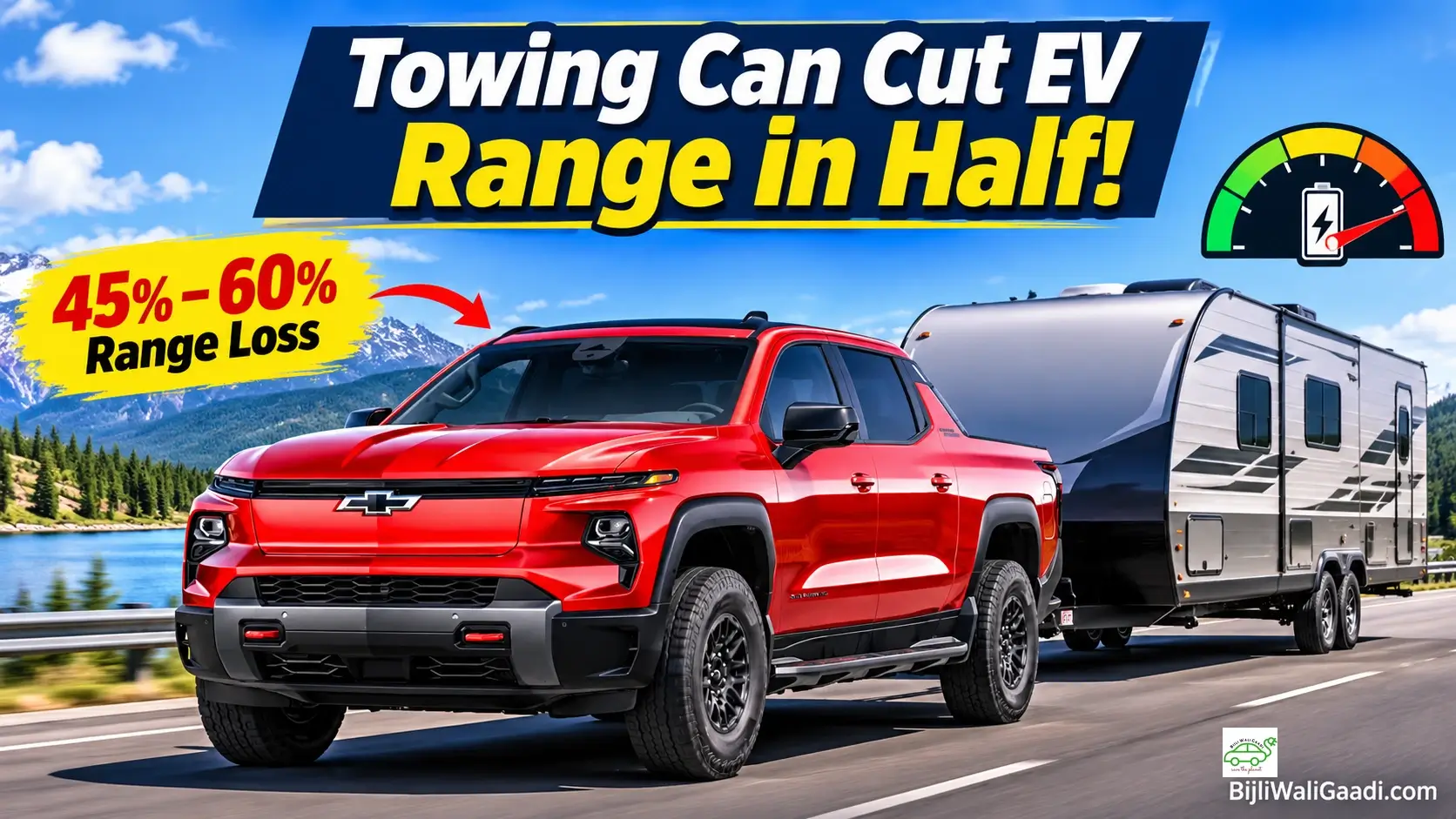
The core takeaway: a boxy trailer at 65–70 mph can cut electric truck range by 45%–60%, while gear in the bed costs only about 20%–25%. Plan your charging stops around real-world towing range, not the EPA number on the window sticker.
How Much Does Towing and Hauling Reduce Electric Truck and SUV Range?
Towing a boxy travel trailer cuts electric truck range by roughly 45%–60%, while hauling the same weight inside the bed cuts it by only about 20%–25%. The difference comes down to airflow, not weight.
At 65–70 mph on the interstate, aerodynamic drag is the biggest energy drain. Drag rises with the square of speed, so a flat-fronted trailer pushing a wall of air behind your tailgate hurts far more than extra pounds on the axles.
A truck carrying 1,400 lbs of gear in the bed keeps clean airflow over its body. It might drop from about 2.0 mi/kWh to roughly 1.5 mi/kWh. Hook up a tall travel trailer, and efficiency often falls to 0.9–1.2 mi/kWh.
Cold weather, extreme heat, and long mountain climbs compound the loss, though regenerative braking recovers a meaningful share on descents.
Does Slowing From 70 mph to 60 mph Really Recover Towing Range in an Electric Truck?
Yes. Dropping from 70 mph to 60 mph on a U.S. interstate cuts aerodynamic drag sharply and typically recovers 15%–20% of lost towing range.
Use your truck’s tools, too. Select tow/haul drive mode so the truck sharpens throttle response, adjusts air suspension ride height where equipped, and optimizes regenerative braking. Connect the trailer’s integrated brake controller and set the gain with the rig on level pavement, so braking stays smooth and the truck isn’t fighting the trailer’s weight.
What Are the Best Electric Pickup Trucks and SUVs for Towing in the U.S.?
The Chevrolet Silverado EV and GMC Sierra EV Denali lead on real-world towing range, while the Rivian R1T and Tesla Cybertruck balance towing capacity with fast charging. Figures below use certified EPA ratings and an estimated tow range at about 1.0–1.2 mi/kWh.
| Model | Battery (kWh) | Max Tow Rating (lbs) | EPA Unladen Range | Est. Real-World Tow Range | Peak DC Charging |
| Chevrolet Silverado EV / GMC Sierra EV Denali | ~205 | 10,000–12,500 | 440–460 mi | ~205 mi | ~350 kW |
| Rivian R1T (Max Pack) | ~141 | 11,000 | Up to 420 mi | ~168 mi | ~220 kW |
| Tesla Cybertruck (AWD) | ~123 | 11,000 | Up to 340 mi | ~147 mi | ~325 kW |
| Ford F-150 Lightning (Extended Range) | ~131 | 10,000 | 300–320 mi | ~90–131 mi | ~150 kW |
| GMC Hummer EV Pickup | 200+ | 12,000 | Up to 381 mi | ~190 mi | ~350 kW |
| Cadillac Escalade IQ | ~205 | 8,000 | ~460 mi | ~190 mi | ~350 kW |
| Rivian R1S | ~141 | 7,700 | Up to 410 mi | ~155 mi | ~220 kW |
| Kia EV9 | ~100 | 5,000 | ~300 mi | ~100 mi | ~210 kW |
| BMW iX | ~105 | 5,500 | ~310 mi | ~105 mi | ~195 kW |
| Tesla Model X | ~100 | 5,000 | ~335 mi | ~100 mi | ~250 kW |
The R1T figure reflects about 1.19 mi/kWh measured with an Airstream. The Silverado EV adds roughly 100 miles in 10 minutes.
Which rig fits which job:
- Long-distance campers: The Silverado EV and Sierra EV Denali need the fewest stops. The Hummer EV matches their capacity but is heavier and thirstier.
- Boats and utility hauling: The R1T and Cybertruck cover weekend trips under 150 miles and charge quickly.
- Light trailers and family SUVs: The F-150 Lightning, EV9, iX, and Model X suit small campers and utility trailers. The Escalade IQ and R1S handle mid-size loads.
What Is the 10%–15% Tongue Weight Rule and How Does It Reduce Electric Truck Payload?
Tongue weight should equal 10%–15% of the trailer’s loaded weight, and every pound of it counts against your truck’s payload. A 10,000-lb trailer puts 1,000–1,500 lbs directly on the rear axle.
That weight adds to the passengers, gear, and frunk cargo already counted against the door-jamb payload rating. Payload often runs out before the max tow rating does, so check the sticker and weigh your loaded rig.
How Do You Use Pull-Through EV Charging Stations and Unhitch a Trailer Safely?
Look for pull-through stalls whenever you tow, and if none exist, unhitch in under three minutes with a prepared kit. Most U.S. DC fast chargers use nose-in stalls with 13-to-16-foot cables, so rigs over 35–45 feet long rarely fit without blocking lanes.
Charging port location matters. The Ford F-150 Lightning and Rivian R1T and R1S have front-left (driver-side front fender) ports, which make pulling nose-in to a charger much easier. The Chevrolet Silverado EV, GMC Sierra EV Denali, GMC Hummer EV, and Tesla Cybertruck have rear-left (driver-side rear quarter panel) ports. Those trucks require backing in, using pull-through stalls, or unhitching when cables are short.
Pull-through etiquette and fast unhitching checklist:
1. Filter first. Use route planners to filter for pull-through and trailer-friendly stalls before you leave.
2. Choose end-cap stalls as a backup. When no pull-through exists, take an end-of-row stall with open space beside it so your trailer doesn’t intrude on neighbors.
3. Respect the lot. Never park across multiple stalls or block active charging bays and fire lanes.
4. Pack a kit. Keep wheel chocks, a tongue jack pad, and a cordless impact wrench in the frunk.
5. Know your jack. An electric tongue jack drops the coupler with one button, while a manual speed crank is slower but never fails with a dead battery. Carry a crank as backup either way.
6. Chock before you disconnect. Set the trailer wheel chocks first, then release the safety chains and the 7-pin wiring harness.
7. Inspect the breakaway cable. Check it for fraying and confirm it’s clipped to the truck, not the hitch ball, when you rehitch.
8. Secure the coupler. Lock it if you leave the trailer in a regular parking spot.
Frequently Asked Questions About Towing With an Electric Vehicle
Stay connected via Google 'Electric Vehicle' News
Follow BijliWaliGaadi | India's Trusted EV Insights Portal
source on Google