Hyundai Ioniq 5 & EV6 Battery Replacement Cost in India: Up to ₹18.5 Lakh
Stay connected via Google 'Electric Vehicle' News
Follow BijliWaliGaadi | India's Trusted EV Insights Portal
source on Google
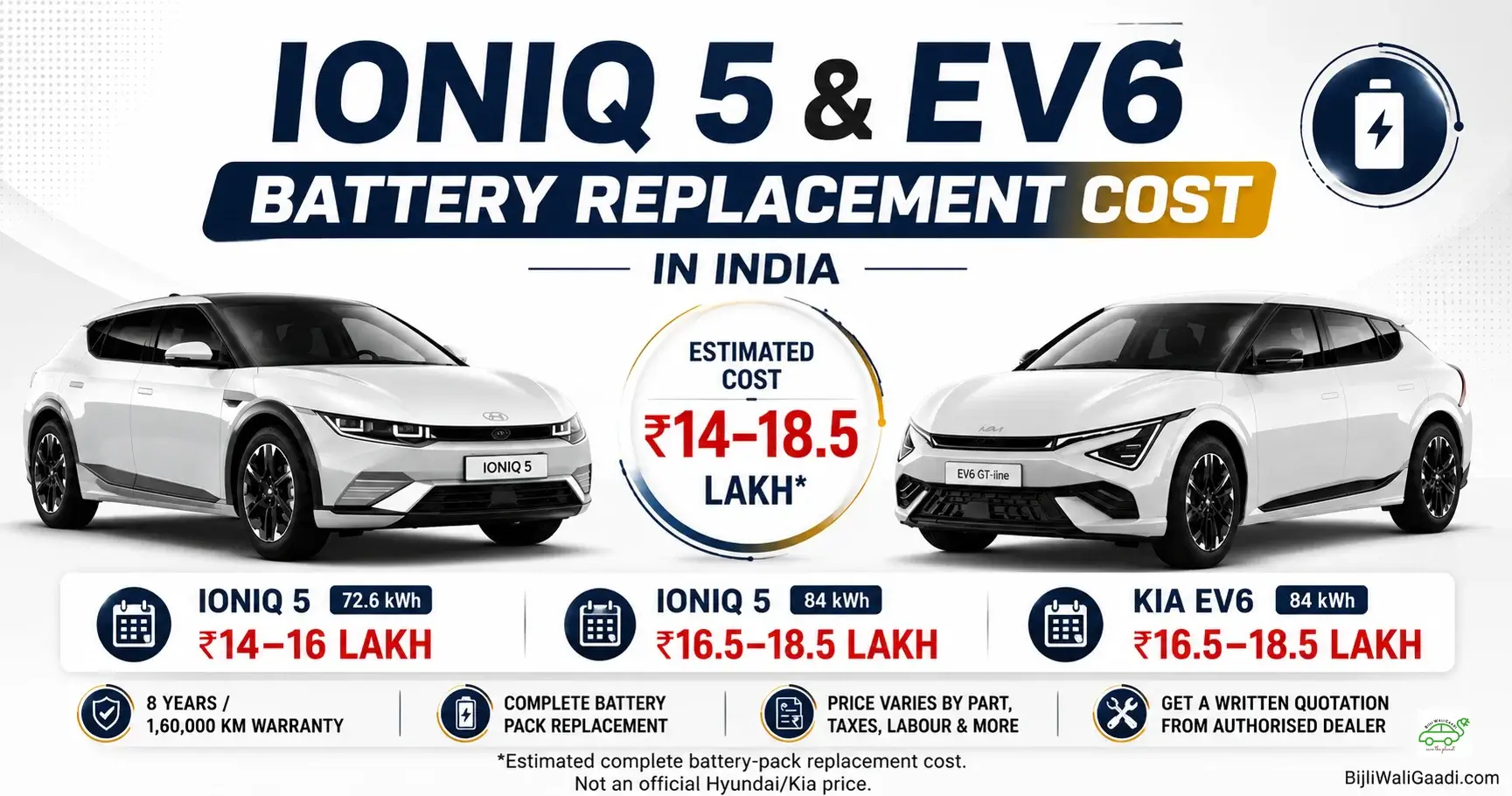
Hyundai Ioniq 5 battery replacement cost in India is estimated at ₹14–16 lakh for the earlier 72.6 kWh model and ₹16.5–18.5 lakh for the updated 84 kWh model. The Kia EV6 84 kWh battery replacement cost is also estimated at ₹16.5–18.5 lakh. These are indicative complete battery-pack replacement estimates, not official Hyundai or Kia dealer prices.
The replacement costs quoted in this article are estimated planning ranges for a complete high-voltage battery pack. They are not official Hyundai India or Kia India published spare-part prices or guaranteed dealer quotations. The actual customer invoice can vary depending on the exact battery part number, vehicle VIN, battery availability, taxes, logistics, labour, diagnostics and other applicable service charges.
Quick Cost Table
| Model | Battery Capacity | Estimated Battery-Pack Replacement Cost | Warranty |
| Hyundai Ioniq 5 — earlier model | 72.6 kWh | ₹14–16 lakh* | 8 years / 1,60,000 km |
| Hyundai Ioniq 5 — 2026 update | 84 kWh | ₹16.5–18.5 lakh* | 8 years / 1,60,000 km |
| Kia EV6 GT-Line AWD | 84 kWh | ₹16.5–18.5 lakh* | 8 years / 1,60,000 km |
*Estimated complete high-voltage battery-pack replacement cost for planning purposes. These are not official Hyundai India/Kia India published replacement prices. Actual quotations can vary by battery part number, VIN, availability, taxes, logistics, labour, diagnostics and other applicable charges.
This article covers both India-spec Ioniq 5 battery versions relevant to Indian owners: the earlier Ioniq 5 with a 72.6 kWh battery, and the updated 2026 Ioniq 5 with an 84 kWh battery. The current India-spec Kia EV6 GT-Line AWD uses an 84 kWh battery. Use the table above to identify which estimate applies to your vehicle.
Hyundai Ioniq 5 72.6 kWh Battery Replacement Cost in India
Estimated cost: ₹14–16 lakh
This estimate applies to the earlier India-spec Ioniq 5 fitted with the 72.6 kWh battery pack, launched in India in 2023. It does not automatically apply to the newer 84 kWh version — check your VIN and battery capacity before relying on this figure.
The final customer invoice can vary depending on the availability of the earlier E-GMP battery assembly, applicable GST, labour, diagnostics, logistics and other service charges.
Hyundai Ioniq 5 84 kWh Battery Replacement Cost in India
Estimated cost: ₹16.5–18.5 lakh
This estimate applies to the updated 2026 India-spec Ioniq 5, which uses a larger 84 kWh battery pack. It is a separate estimate from the earlier 72.6 kWh model and should not be assumed to be the same.
Given this is a newer battery assembly with its own part number, owners should confirm the exact replacement quotation using their vehicle VIN and battery part number through an authorised Hyundai dealer.
Kia EV6 84 kWh Battery Replacement Cost in India
Estimated cost: ₹16.5–18.5 lakh
This estimate applies to the India-spec Kia EV6 GT-Line AWD, which uses an 84 kWh battery pack. As with the Ioniq 5, the actual replacement quotation depends on the exact battery assembly/part number, vehicle VIN and availability at the time of service. Kia India does not publish a fixed customer-facing replacement price.
Cost Comparison
| Vehicle / Battery Version | Battery Capacity | Estimated Replacement Cost |
| Ioniq 5 — earlier model | 72.6 kWh | ₹14–16 lakh |
| Ioniq 5 — 2026 model | 84 kWh | ₹16.5–18.5 lakh |
| Kia EV6 GT-Line AWD | 84 kWh | ₹16.5–18.5 lakh |
The higher estimate for the 84 kWh packs reflects the larger battery assembly and should not be interpreted as a simple ₹/kWh calculation. Actual replacement pricing depends on the complete battery assembly, part number, sourcing, taxes, logistics and installation — battery capacity is one factor among several, not the sole determinant of the final cost.
What the Replacement Estimate Includes
| Cost Component | What It Covers |
| Complete HV battery pack | The major replacement component, per the model-specific estimate above |
| Battery removal/installation | Labour required to remove the old pack and fit the new one |
| Diagnostics | HV system scanning and fault-code assessment — dealer/service-centre quotation |
| HV safety/commissioning | Isolation, safety checks, and calibration/programming where required; exact procedures vary by vehicle and service centre |
| Logistics | Transportation and sourcing-related costs, where the part isn’t held in local stock |
| Applicable taxes/GST | As applicable to the actual dealer invoice |
| Other service charges | Any additional workshop charges specific to the job |
Always ask your service advisor for a written, itemised quotation before authorising work.
Why the Final Invoice Can Differ
The ₹14–16 lakh and ₹16.5–18.5 lakh figures refer to estimated complete battery-pack replacement exposure, not necessarily the final workshop invoice. The final bill may include applicable GST/taxes, diagnostics, battery removal/installation labour, HV safety procedures, commissioning/programming where required, logistics, and other service charges — though not every vehicle will incur every possible charge. Treat the model-specific figures above as a starting reference, and get a written quotation for your specific VIN and part number before proceeding.
Battery Warranty: 8 Years / 1,60,000 km
Both the Hyundai Ioniq 5 (either battery version) and the Kia EV6 carry an 8-year / 1,60,000 km high-voltage battery warranty, whichever occurs first.
Kia India specifies a 70% capacity threshold for the EV6’s high-voltage battery capacity warranty — a warranty claim for capacity loss is generally tied to the pack’s measured capacity falling below this level within the warranty period, subject to Kia’s diagnostic assessment. Hyundai’s Ioniq 5 battery warranty is subject to Hyundai India’s own stated warranty conditions and diagnostic assessment; the same 70% threshold should not be assumed to apply to Hyundai unless confirmed in Hyundai’s warranty documentation.
Normal battery degradation does not automatically mean the battery gets replaced under warranty. A pack can show measurable capacity loss over time and still sit within normal operating parameters — replacement is assessed against the OEM’s specific diagnostic criteria, not simply “the range has dropped.”
Can the Battery Be Repaired Instead of Replaced?
Possibly — it depends on the diagnosis. The E-GMP battery pack used in both the Ioniq 5 and EV6 is built from multiple modules rather than one solid block, and module-level diagnostics may technically be possible. Whether a module-level repair is actually offered depends on:
- The specific fault identified during diagnostics
- Availability of replacement modules/components for that battery version
- Hyundai/Kia’s authorised service procedures
- The service centre’s technical capability for that repair
Owners should always obtain a written diagnosis and itemised quotation before assuming a full pack replacement is unavoidable — a targeted repair may be technically viable in some cases and not in others.
Battery Degradation in Indian Conditions
Both battery versions of the Ioniq 5, and the EV6, use a liquid-cooled battery with an integrated heating system as part of the E-GMP platform, designed to keep cell temperature within a controlled range and help limit thermal stress.
Actual degradation depends on mileage, charging pattern, ambient temperature, battery operating temperature, and individual usage. Frequent high-power DC fast-charging while the battery is already hot can add to thermal stress even with active cooling in place. Public, India-specific fleet data on long-term Ioniq 5/EV6 SOH is limited, so a reliable degradation percentage for Indian conditions can’t be stated at this time. Degradation on its own does not mean the entire battery needs replacement — a diagnostic assessment is required to determine the actual cause and remedy.
Insurance
If battery damage results from an insured accident, flooding or another covered event, the owner’s out-of-pocket cost may differ significantly from an out-of-warranty, degradation-related replacement — depending on the specific policy and its terms. This is distinct from normal battery ageing, which insurance does not typically address. Check your policy’s terms before assuming coverage either way.
Is Battery Replacement Economically Worth It?
An estimated replacement exposure of ₹14–16 lakh for the earlier 72.6 kWh Ioniq 5, or ₹16.5–18.5 lakh for the 84 kWh Ioniq 5/EV6, does not automatically mean replacement is the right financial call. Before approving a replacement, compare the actual quotation with the vehicle’s current market value — on an older or heavily depreciated vehicle, the cost can approach or exceed what the car is worth. Check whether a module-level repair is possible instead of a full pack swap, and whether insurance applies if the damage is accident- or flood-related.
Weigh the vehicle’s age, overall condition, and how much longer you plan to keep it. A second technical opinion from another authorised service centre is a reasonable step before committing to a high-value repair.
Used-Car Buyer Checklist
If you’re buying a used Ioniq 5 or EV6, verify the following before finalising the purchase:
- Exact battery capacity (72.6 kWh or 84 kWh) and model year
- Vehicle VIN and battery part number
- Remaining battery warranty period
- A recent battery SOH/diagnostic report
- Any history of accident or flood exposure
- Charging history, where available
- Whether any HV battery repairs have already been performed
An authorised Hyundai or Kia dealer can verify most of this against the vehicle’s records.
Conclusion
The estimated Hyundai Ioniq 5 battery replacement cost in India ranges from ₹14–16 lakh for the earlier 72.6 kWh model to ₹16.5–18.5 lakh for the updated 84 kWh model. The Kia EV6 84 kWh battery replacement cost is also estimated at ₹16.5–18.5 lakh. All are indicative planning estimates, not official OEM prices, and all versions are backed by an 8-year/1,60,000 km battery warranty. For an exact number, the only reliable step is a written diagnosis and quotation from an authorised service centre for your specific VIN and part number.
Related reading on BijliWaliGaadi.com: our EV battery replacement cost guides for other India-spec EVs, a dedicated explainer on EV battery degradation and State of Health (SOH), a comparison of EV battery warranty terms across brands, and our guide to EV battery recycling and second-life value in India.
FAQs
Stay connected via Google 'Electric Vehicle' News
Follow BijliWaliGaadi | India's Trusted EV Insights Portal
source on Google