Lithium-Sulfur EV Batteries: 549–700 Wh/kg in the Lab, 2030 as the Target, and the Gap in Between
Stay connected via Google 'Electric Vehicle' News
Follow BijliWaliGaadi | India's Trusted EV Insights Portal
source on Google
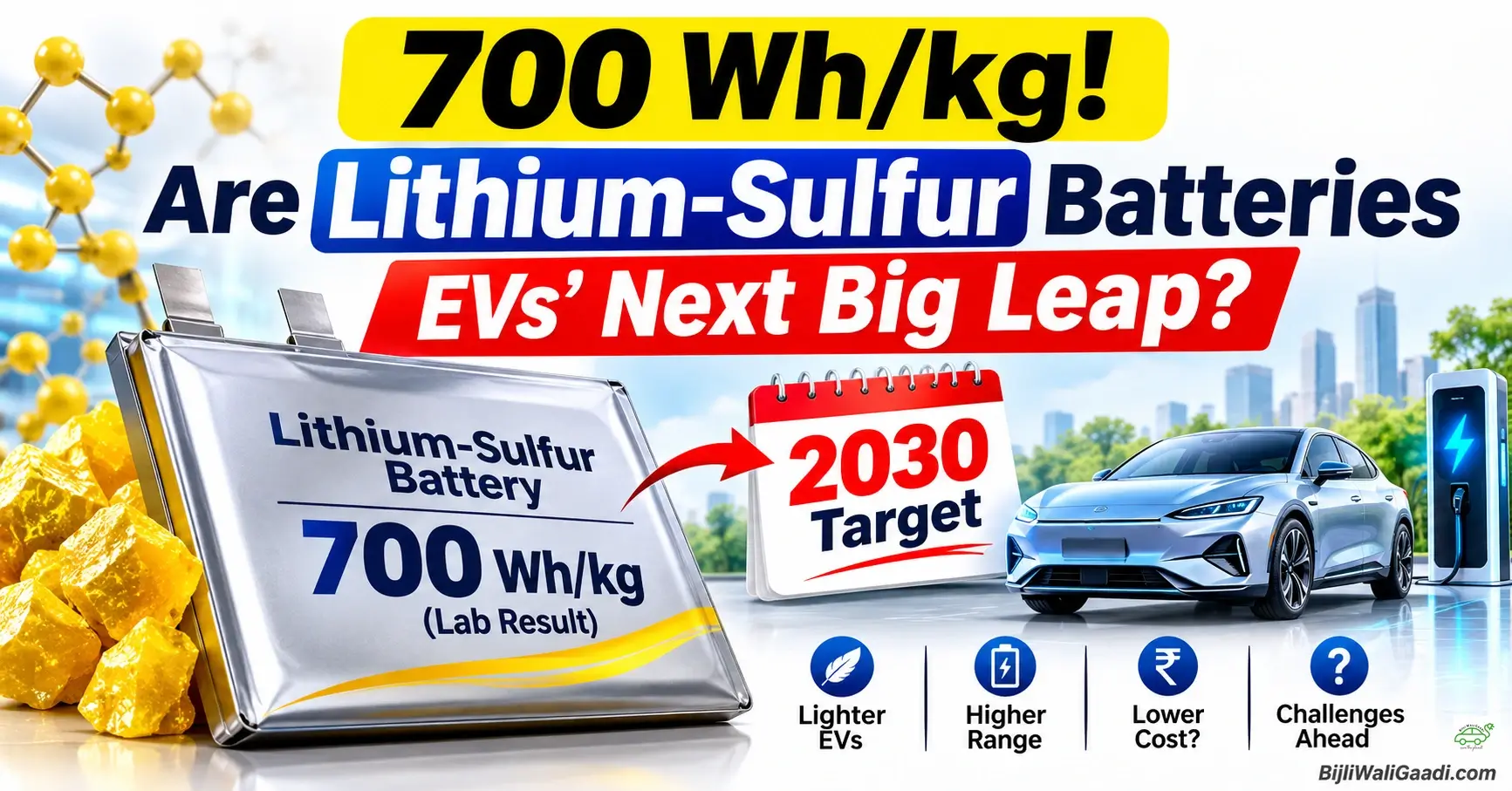
Lithium-sulfur (Li-S) EV batteries use a sulfur cathode and a lithium-metal anode instead of the metal-oxide cathode and graphite anode in today’s lithium-ion cells. That makes them potentially much lighter per unit of energy, with reported laboratory pouch cells at 549 to about 700 Wh/kg. As of November 2026, no passenger car is sold with a lithium-sulfur battery. The nearest announced EV target is Stellantis and Zeta Energy’s 2030 goal, which is a development target, not a launch commitment. Early commercial use is in drones and defense systems.
Quick Take-away: Lithium-Sulfur Batteries in Brief
How Lithium-Sulfur Differs From NMC, LFP and Solid-State Batteries
In NMC and LFP cells, lithium ions move in and out of a metal-oxide or phosphate cathode and a graphite anode. The cathode is heavy and the host structures add weight that stores no energy. A lithium-sulfur cell instead converts sulfur through a series of chemical steps as it discharges. Sulfur is light and carries a lot of charge per gram, and the lithium-metal anode removes the graphite host. Together they explain the high gravimetric energy density.
A sulfide solid-state battery is a different thing. Its “sulfide” is the solid electrolyte that replaces the liquid, and its cathode is typically still a conventional oxide. Sodium-ion batteries swap lithium for sodium. Neither is a lithium-sulfur battery.
Why Lithium-Sulfur Is Hard to Build: Four Engineering Problems
1. The polysulfide shuttle. Intermediate lithium polysulfides dissolve in the electrolyte, drift to the anode and react there. This wastes energy, thickens the electrolyte and fades capacity.
2. Poor sulfur conductivity. Sulfur barely conducts electricity, so it needs conductive carbon scaffolds or coatings, which add weight and limit high-rate performance.
3. Volume change. Sulfur and lithium sulfide differ in density, so the cathode swells and shrinks during cycling and can lose structural integrity.
4. An unstable lithium-metal anode. Metallic lithium is chemically aggressive and can grow dendrites. It needs protection through a host structure, coating or electrolyte design.
Electrolytes are the common thread. High energy density needs very little electrolyte per unit of sulfur, but a lean electrolyte makes the polysulfide and anode problems worse.
Cell-Level vs Pack-Level Energy Density: Why the Number Needs Context
Gravimetric energy density (Wh/kg) measured on a cell counts only the cell’s mass. A complete EV pack also carries the enclosure, cooling, wiring, electronics and structure, so pack-level figures are lower than cell-level ones. A 700 Wh/kg cell therefore does not mean a 700 Wh/kg pack.
Volumetric density (Wh/L) matters too. Sulfur cathodes have historically struggled on volume, and Zeta Energy and Stellantis describe their goal as lithium-ion-comparable volumetric density at much lower mass. Lab pouch cells, company targets and theoretical limits should not be compared as if they measured the same thing. A theoretical limit is physics, a laboratory result is one cell, a target is a plan and a product is something a customer can buy.
Why Lithium-Sulfur Batteries Are Not Yet Ready for Mass-Market EVs
High laboratory energy density alone does not establish EV readiness. Passenger cars also need:
Lithium-Sulfur Battery Developers Compared
Genuine lithium-sulfur developers
| Company | Country | Core technology | Reported performance or target | Development stage | EV relevance |
| theion | Germany | Crystalline sulfur wafer cathode, pre-lithiated lithium host anode, semi-solid electrolyte | Target: 500 Wh/kg (2026–2028), 1,000 Wh/kg (2029) | Pre-commercial; company targets | Long-term; modelled EV range gains |
| Lyten | US | 3D graphene platform to hold sulfur | Not publicly disclosed | Li-S cells shipping to drone and defense customers | Early; Swedish and Polish sites not yet making Li-S cells |
| Zeta Energy | US | Sulfurized carbon cathode, 3D metallic lithium anode | Development goals: faster charging, under half the cost per kWh | Joint development with Stellantis | Direct; 2030 target |
| LG Energy Solution | South Korea | Sulfur-carbon cathode, lithium-metal anode | More than twice lithium-ion gravimetric density (company statement) | Commercialization planned 2029 | Initially high-altitude UAVs and urban air mobility |
| Conamix | US | Sulfur cathode materials and additives | Not publicly disclosed | In development | Targets automotive use |
| General New Energy | China | Coatings and electrolyte additives | About 700 Wh/kg prototype (reported) | Prototype; own pilot line | Not publicly disclosed |
| Tsinghua SIGS | China | “Premediator” additive | 549 Wh/kg, 14.2 Ah pouch cell, 800 cycles | Laboratory research | Drones and low-altitude aircraft first |
Adjacent technologies that are not lithium-sulfur
| Company or group | Technology | Reported performance or target | Why it is not Li-S |
| Sion Power (US) | Licerion protected lithium-metal anode | 500 Wh/kg claimed; a 17 Ah Licerion-EV cell independently verified at 400 Wh/kg per the company | Paired with conventional cathodes |
| Nankai University and Shanghai Institute of Space Power-Sources | Fluorine-coordinated electrolyte | 707 Wh/kg lithium-metal pouch cells | Lithium-metal research, not confirmed Li-S |
| CATL and BYD | Sulfide solid-state, sodium-ion | CATL: 20 Ah samples targeting about 500 Wh/kg; both: small-scale production around 2027 | Sulfide is the electrolyte, not the cathode |
theion: A Crystalline Sulfur Wafer Cell From Berlin
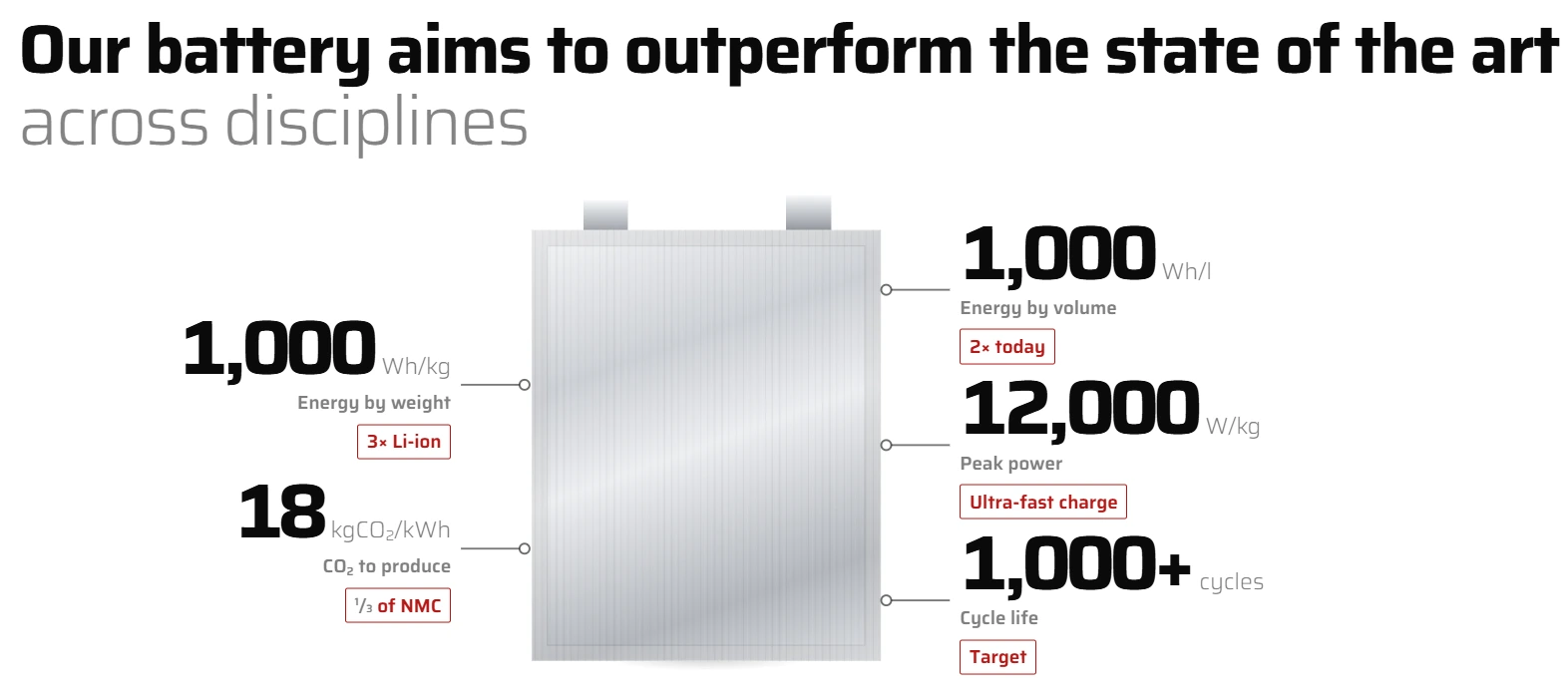
Theion‘s cell uses a grown monoclinic crystalline sulfur cathode with a conductive coating, a pre-lithiated host structure for the lithium anode, a semi-solid electrolyte and a pouch format. Its stated aims are 3× the energy per kilogram of today’s lithium-ion cells, one-third of the material cost per cell and one-third of the production CO₂ per kWh. Its sulfur argument is that about 5 million of the roughly 85 million tonnes produced each year as a by-product could cover total battery demand.
Company roadmap (targets, not achieved results):
| Year | Energy density | Cycles | Cell size |
| 2026 | 500 Wh/kg | 50 | More than 2 Ah |
| 2027 | 500 Wh/kg | 500 | 5 Ah |
| 2028 | 500 Wh/kg | 500 | 20+ Ah |
| 2029 | 1,000 Wh/kg | 500 | 50+ Ah, with a planned 50 MWh pilot line |
The 1,000 Wh/kg figure is a 2029 target, not a demonstrated cell. Theion’s EV illustration, a 2,000 kg car with a 100 kWh pack, shows range rising from 633 km to 2,532 km at constant battery mass. That model compares a 250 Wh/kg baseline with a 1,000 Wh/kg cell, so it is an upper-bound scenario, not a forecast. Theion says it is not building a gigafactory and plans own production, partnerships and licensing.
Lyten: Lithium-Sulfur Cells for Drones, and Northvolt Assets Still Being Restarted
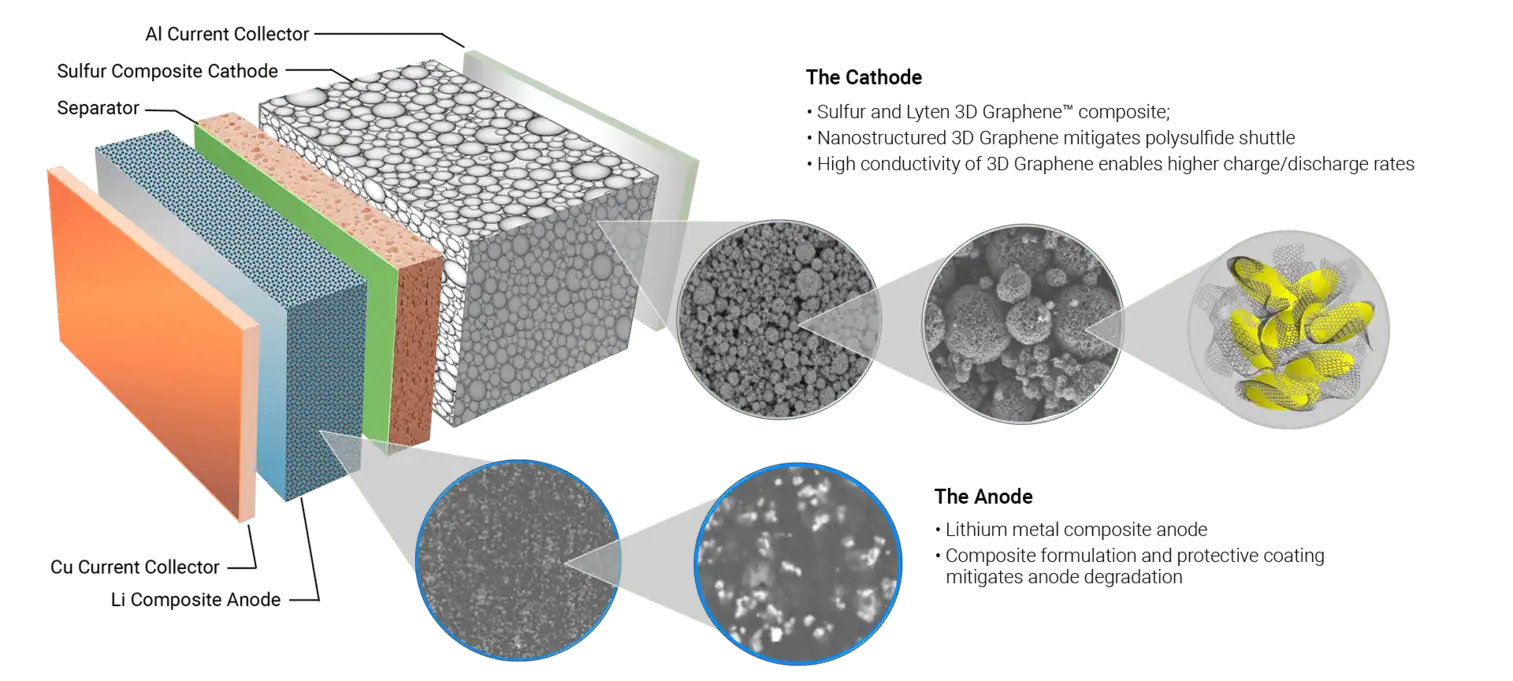
Lyten‘s platform uses 3D graphene to hold sulfur and limit polysulfide shuttling. Its lithium-sulfur cells are currently made in San Jose, California, for drone, autonomous-system and defense customers.
The Northvolt acquisitions need careful reading:
These sites provide lithium-ion and lithium-metal manufacturing capability. They have not yet demonstrated commercial lithium-sulfur EV cell production.
Zeta Energy and Stellantis: A 2030 Target, Not a Launch Commitment
In December 2024, Stellantis and Zeta Energy signed a joint development agreement covering pre-production development and planning. Zeta’s cell pairs a sulfurized-carbon cathode with a 3D metallic lithium anode. The partners’ stated goals are a lighter pack with the same usable energy, up to 50% faster charging, and a cost per kWh below half that of lithium-ion, with batteries aimed at Stellantis vehicles by 2030 and designed for existing gigafactory technology.
All of these are development goals. None is a confirmed production or vehicle-launch commitment. Stellantis also backs Lyten.
LG Energy Solution: Aviation First, With 2029 as the Commercialization Plan
LG Energy Solution describes a sulfur-carbon composite cathode with a lithium-metal anode and says it delivers more than twice the gravimetric energy density of lithium-ion. It plans commercialization in 2029, starting with high-altitude UAVs and urban air mobility before the broader aviation market. In 2020, an LG Chem-powered high-altitude solar UAV flew for 13 hours, including 7 hours in the stratosphere. Earlier targets were 2025 and 2027, and the company has not confirmed passenger EV production in 2029.
General New Energy: A Reported 700 Wh/kg Prototype
General New Energy, founded in 2022, announced in October 2024 a lithium-sulfur prototype with about 700 Wh/kg. It reports using nano-material coatings and electrolyte additives to improve sulfur conductivity and ion transport and reduce the shuttle effect. It runs its own Li-S production line. Public information gives no cycle-life figure, independent verification, safety validation or automotive-readiness claim, so this should be read as a reported prototype result.
Tsinghua SIGS: A “Premediator” for Sulfur Chemistry
A Tsinghua Shenzhen International Graduate School team led by Zhou Guangmin reported a premediator additive in a peer-reviewed paper published in May 2026. It stays inactive until polysulfides trigger it. It then forms low-solubility clusters through dynamic molecular coordination, confining the intermediates near the positive electrode and opening faster charge-transfer pathways. The team screened 196 candidate molecules with quantum chemistry and machine learning and selected 4-trifluoromethyl-2-chloropyrimidine.
The 14.2 Ah-level pouch cell reached 549 Wh/kg and 81.7% average capacity retention over 800 cycles. That is useful progress, not perfect stability. The team reports internal resistance about 75% lower than conventional designs. Its first target is drones and low-altitude aircraft, not cars. A separate academic group has reported 622 Wh/kg in a 10 Ah-level pouch cell.
Sion Power, Nankai and CATL/BYD: Lithium-Metal and Solid-State Neighbours
Sion Power has Li-S heritage, but its Licerion cells combine a protected lithium-metal anode with conventional cathodes. Its 500 Wh/kg figure is a lithium-metal claim, not a lithium-sulfur achievement. The company says its 17 Ah Licerion-EV cell was independently verified at 400 Wh/kg, and it now focuses on defense and aerospace, with initial shipments expected in late 2026.
Nankai University and the Shanghai Institute of Space Power-Sources used a 1,3-difluoropropane electrolyte to reach 707 Wh/kg in lithium-metal pouch cells. They retained about 400 Wh/kg at −50 °C. Published descriptions do not call these cells lithium-sulfur.
CATL and BYD are prioritising sulfide solid-state batteries and sodium-ion. CATL expects small-scale solid-state production in 2027, and BYD targets small-batch production in 2027 and mass production around 2030.
Conamix: A Sulfur-Cathode Materials Specialist
Conamix, based in Ithaca, New York, focuses on the sulfur cathode, using additives to replace other parts of a conventional Li-S cathode. Its CEO regards EVs as the best use case. Performance figures are not publicly disclosed.
Outlook: Where Lithium-Sulfur Batteries Arrive First, and What Must Happen Before Cars
The pattern across developers is consistent. Weight matters most in drones, high-altitude aircraft, urban air mobility and defense systems, so these are likely first adopters. Lyten already ships to drone customers, LG targets aviation first and Tsinghua’s work is aimed at low-altitude aircraft.
Before passenger EVs, developers need to show:
1. Cycle life in the hundreds to thousands, in full-size cells.
2. Performance at practical sulfur loading and lean electrolyte.
3. Safe, fast charging.
4. Consistent large-format manufacturing at competitive cost.
5. Pack designs that preserve the weight advantage.
Against that checklist, the 2030 target is plausible but unproven. Theion’s own roadmap reaches 1,000 Wh/kg only in 2029, and it still needs to prove those results at scale. For Indian buyers, lithium-sulfur is worth watching, but LFP and NMC will remain the practical choices for years.
FAQs
Stay connected via Google 'Electric Vehicle' News
Follow BijliWaliGaadi | India's Trusted EV Insights Portal
source on Google