Ecosystem vs. Engineering: How Europe’s Commercial and Passenger EV Transition Is Redefining Mobility
Stay connected via Google 'Electric Vehicle' News
Follow BijliWaliGaadi | India's Trusted EV Insights Portal
source on Google
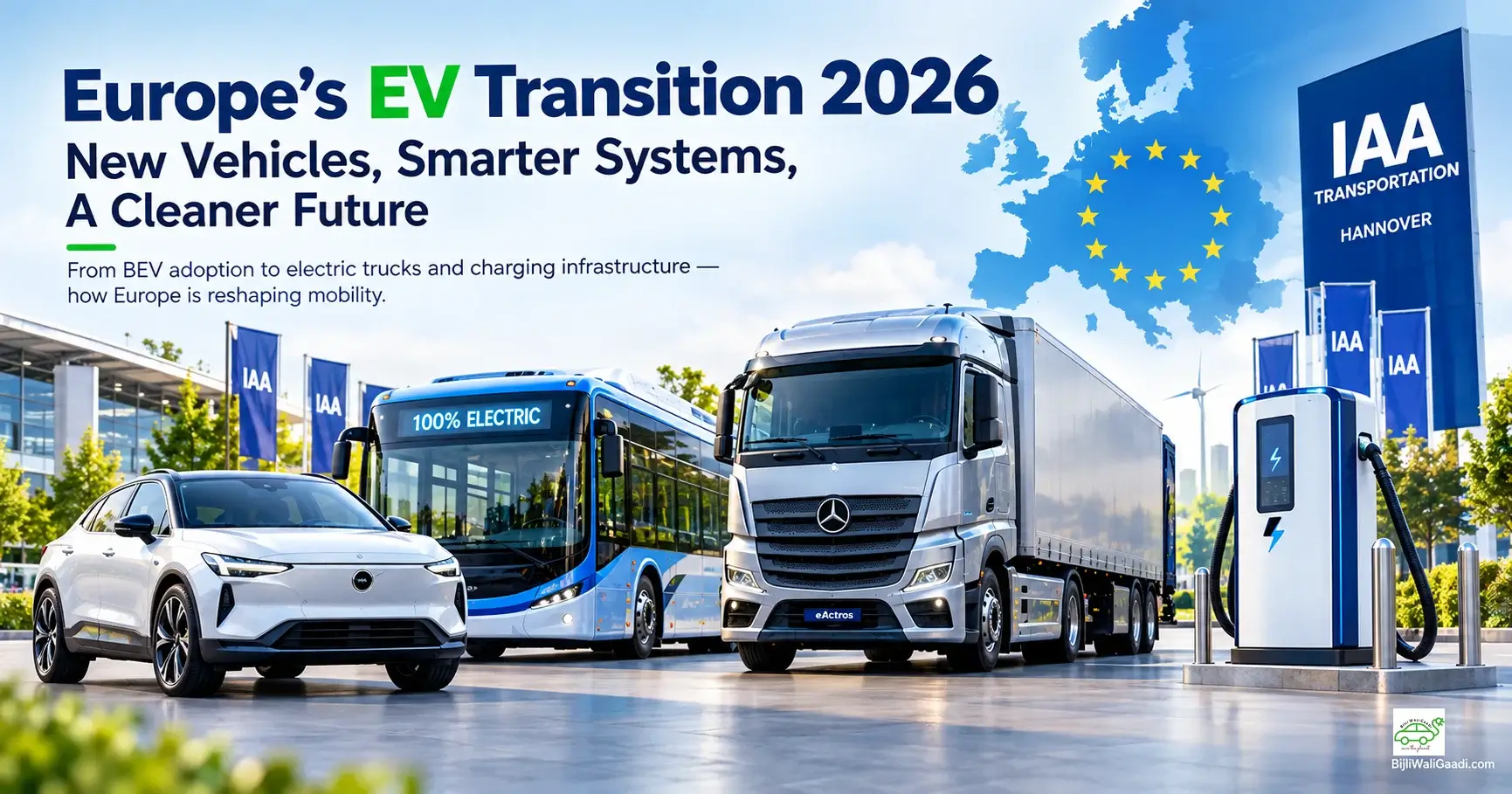
Battery electric vehicles (BEVs) took 29% of new passenger car registrations across Europe in August 2026, per the ICCT’s Car Market Monitor, while electric trucks unveiled at IAA Transportation 2026 in Hanover pushed past 700 km of range. Together, the ICCT’s EV Transition Check 2026 and the IAA show floor point to one shift: competition among automakers is moving from who builds the best vehicle to who builds the best charging, software and fleet-operations system around it. Both trends vary by country, segment and duty cycle, so the data below is read segment by segment.
How Fast Are Electric Cars, Buses and Trucks Scaling?
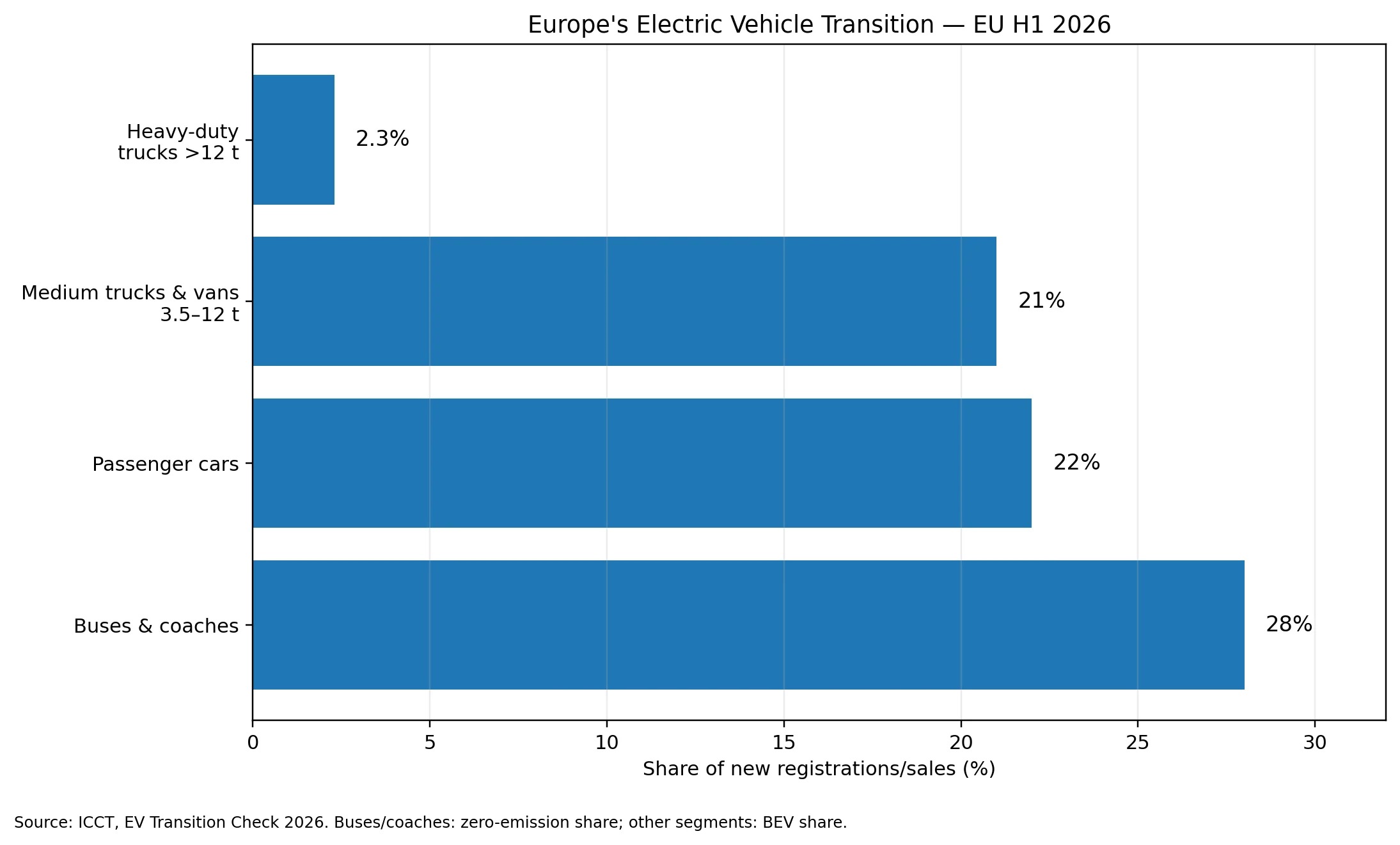
The ICCT’s EV Transition Check 2026 (September 2026) reports BEVs reached a 22% share of new passenger car registrations in the EU in H1 2026, with manufacturers less than 2 g/km short of the 93 g CO₂/km average target for 2025–2027. Buses and coaches led commercial electrification at 28.4% of H1 2026 sales, ahead of medium trucks (3.5–12t) at 21.2% and heavy-duty trucks (above 12t) at 2.3%. These are reported as “zero-emission” shares, but fuel-cell trucks were under 0.5% of new heavy-duty registrations, so the totals are effectively battery electric.
The ICCT’s more recent Car Market Monitor for August 2026 shows further acceleration: BEVs reached 29% of new car registrations in August, lifting the January–August 2026 average for Europe (EU plus Norway and Iceland) to 23%, up 6 percentage points year-on-year.
Table 1 — European EV transition snapshot
| Segment | BEV/zero-emission share | Period | Geography |
| Passenger cars | 22% | H1 2026 | EU |
| Passenger cars | 23% (Jan–Aug avg.); 29% (Aug) | Jan–Aug 2026 | Europe (EU + Norway + Iceland) |
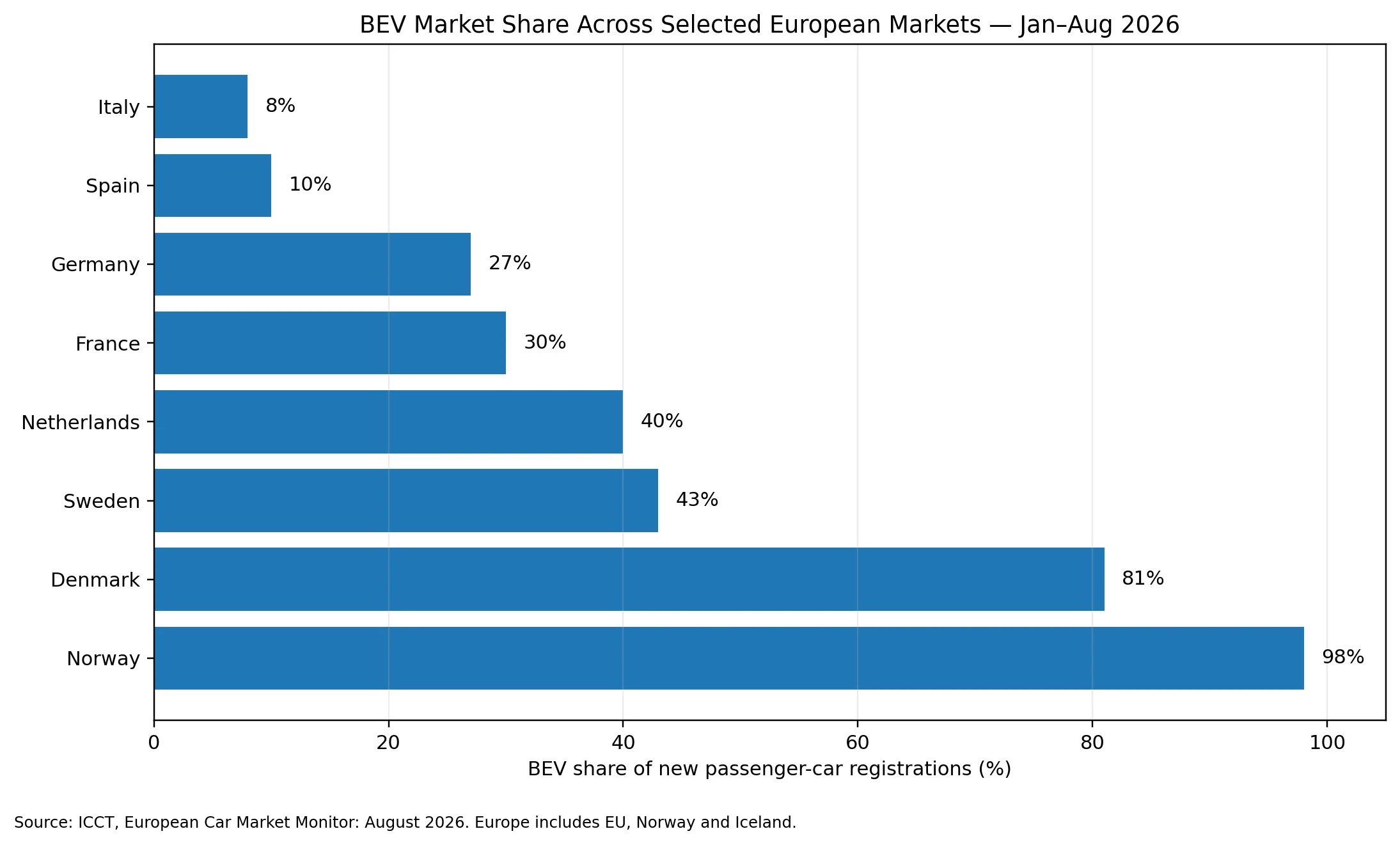
| Germany / France, cars | 27% / 30% | Jan–Aug 2026 | Germany / France |
| Norway / Denmark, cars | 98% / 81% | Jan–Aug 2026 | Norway / Denmark |
| Buses & coaches | 28.4% | H1 2026 | EU |
| Medium trucks (3.5–12t) | 21.2% | H1 2026 | EU |
| Heavy-duty trucks (>12t) | 2.3% | H1 2026 | EU |
Source: ICCT, EV Transition Check 2026 and European Car Market Monitor, August 2026. Sweden (43%) and the Netherlands (40%) sit above the average; Italy (8%) and Spain (10%) sit below it.
Why Electric Truck Economics Are Changing
BEVs were about 33% cheaper to run than gasoline cars in 2025, even on public charging alone, per the ICCT — a running-cost figure, not a full ownership-cost one. BEVs on European roads already save the EU an estimated €4.5 billion a year in fossil-fuel imports.
For trucks, the ICCT’s TCO modelling for Germany — where CO₂-based road charges apply — found battery electric trucks already cheaper to operate than diesel on both regional and long-haul routes in 2026. This should not be generalized: parity elsewhere depends on charging costs, CO₂ charges and road-toll design, and in most markets the two are still only approaching parity. On energy cost alone, the ICCT projects BEVs will be roughly 50–60% cheaper to recharge than an ICEV running on imported e-diesel by 2030 — a fuel-cost, not TCO, comparison. Public charging in the EU costs roughly twice private/depot charging, so long-haul trucks reliant on public chargers do not yet reach parity with diesel.
What IAA Transportation 2026 Revealed About Electric Trucks
IAA Transportation 2026 (15–20 September, Hanover) showed every major European truck maker advancing electric long-haul trucks, generally built around new battery-pack architectures and the Megawatt Charging System (MCS), a heavy-duty fast-charging standard. The table below is descriptive of what each OEM showed or shipped in 2026, not a ranking; no independent, measurable comparison across OEMs was available.
Table 2 — Electric truck technology at IAA Transportation 2026
| OEM | 2026 product evidence | Charging / software |
| Mercedes-Benz Trucks | eActros 600: 621 kWh, 500 km; eActros 400: 414 kWh, ~25t payload for depot routes | Fleetboard fleet services; Coretura software unit; future MCS to 1,000 kW; Torc autonomy shown |
| Volvo Trucks | FH Aero Electric extended range: up to 700 km via new e-axle; series production started at IAA | MCS up to 700 kW, 20–80% in ~50 min |
| Scania | Modular electric platform for urban, regional and configurable long-haul use | MCS from early 2026, up to 750 kW; Smart Dash linked to fleet/cloud services |
| MAN | New eTGX: up to 720 km with seventh pack (644 kWh); packs built in-house at Nuremberg | Optional MCS to 750 kW, in series production since July 2026 |
| Renault Trucks | E-Tech T 780 long-haul, claimed range up to 660 km, dedicated electric axle | High-energy-density batteries to preserve payload |
| IVECO / DAF | IVECO: fuel-cell truck with Toyota, 900+ km target. DAF: XD Electric, 350 kW/525 kWh, 500+ km for regional duty | — |
Sources: Daimler Truck, Volvo Trucks, MAN Truck & Bus press materials (2026); CleanTechnica, Sustainable Truck&Van IAA coverage.
Most electric trucks on display — including the eActros series, MAN’s eTGX, Scania’s electric trucks and the DAF chassis shown — use cells or packs from China’s CATL, per trade coverage; Tesla and BYD were the only exhibitors with in-house cell production.
Europe’s Charging Network Is Stronger for Cars Than Trucks
Table 3 — EU charging infrastructure, June 2026
| Metric | Value |
| Public chargers | 1.16 million (~8× since 2020); sufficient for the current car fleet, per ICCT |
| HDV-dedicated chargers | 2,450 — a small base vs. the light-duty network |
| TEN-T coverage, DC ≥150 kW (cars) | 92% |
| TEN-T coverage, HDV-dedicated | 16% — the main constraint for long-haul electric trucks |
| Ad hoc charging price | ~€0.50/kWh AC; ~€0.62/kWh DC, incl. VAT — roughly 2× private/depot rates |
| Dynamic tariffs | 304 in place (2025) |
| Smart-meter penetration | 63% EU average; 5.5% in Germany (end-2025) |
Source: ICCT, EV Transition Check 2026. Car-charging infrastructure exceeds EU regulatory targets (AFIR) in every member state except Malta. Heavy-duty corridor charging is far less developed, and both the ICCT and OEM roadmaps point to MCS corridor build-out as the key bottleneck for long-haul electric trucking.
Real-World Emissions Change the PHEV and BEV Comparison
BEV cars produce 73% lower life-cycle greenhouse gas emissions than gasoline cars, and battery electric long-haul trucks produce 86% lower emissions than diesel trucks, per the ICCT. Road-transport air pollution (fine particulates, ozone, nitrogen dioxide) was linked to an estimated 74,000 premature deaths and 11,000 pediatric asthma cases in Europe in 2024.
Real-world CO₂ emissions from plug-in hybrid electric vehicles (PHEVs) in the EU run about 4.6 times higher than official type-approval values, a gap that has widened even as PHEVs’ official electric range has grown, per the ICCT. This is a finding about a specific measurement gap; it does not, on its own, show that manufacturers’ overall fleet CO₂ compliance is unreliable.
Europe’s Battery and EV Manufacturing Challenge
BEVs made up 19% of EU passenger car production in 2025, and Germany alone produced 56% of the EU’s combined BEV and plug-in hybrid output. About half the battery cells in EU-built BEVs are made within the EU; manufacturers headquartered in South Korea, China and Japan hold 78% of installed EU cell capacity (69% South Korea, 9% China, under 1% Japan) — capacity by company headquarters, including EU plants built through foreign investment, not vehicle imports. Capacity in 2025 was technically sufficient for demand, but low utilization — uncertain domestic demand, ramp-up difficulties, higher costs than rivals — limited output. The battery supply chain supported an estimated 62,300 jobs in Europe in 2025.
Energy security is part of the same picture: 97% of the EU’s oil and petroleum-product consumption was imported in 2025, a bill worth €336.7 billion, while the EU remained a net exporter of electricity, per Eurostat data cited by the ICCT.
What the 2026 Data Means for Europe’s EV Transition
For fleet operators, electric trucks currently look most cost-competitive on predictable, depot-based regional routes with private/depot charging and enough utilization to offset upfront costs; long-haul routes reliant on public charging remain more cost-sensitive.
For automakers, the IAA 2026 line-up shows range, MCS charging speed, battery design and fleet software now developed together, while most manufacturers still depend on external cell suppliers.
For policymakers, the picture is a two-speed network: car charging is largely ahead of demand, while heavy-duty corridor charging, smart-meter rollout and dynamic pricing remain uneven across member states.
Frequently Asked Questions
–
Stay connected via Google 'Electric Vehicle' News
Follow BijliWaliGaadi | India's Trusted EV Insights Portal
source on Google