California EV Mandate 2026: What Car Buyers Need to Know
Stay connected via Google 'Electric Vehicle' News
Follow BijliWaliGaadi | India's Trusted EV Insights Portal
source on Google
Quick Answer
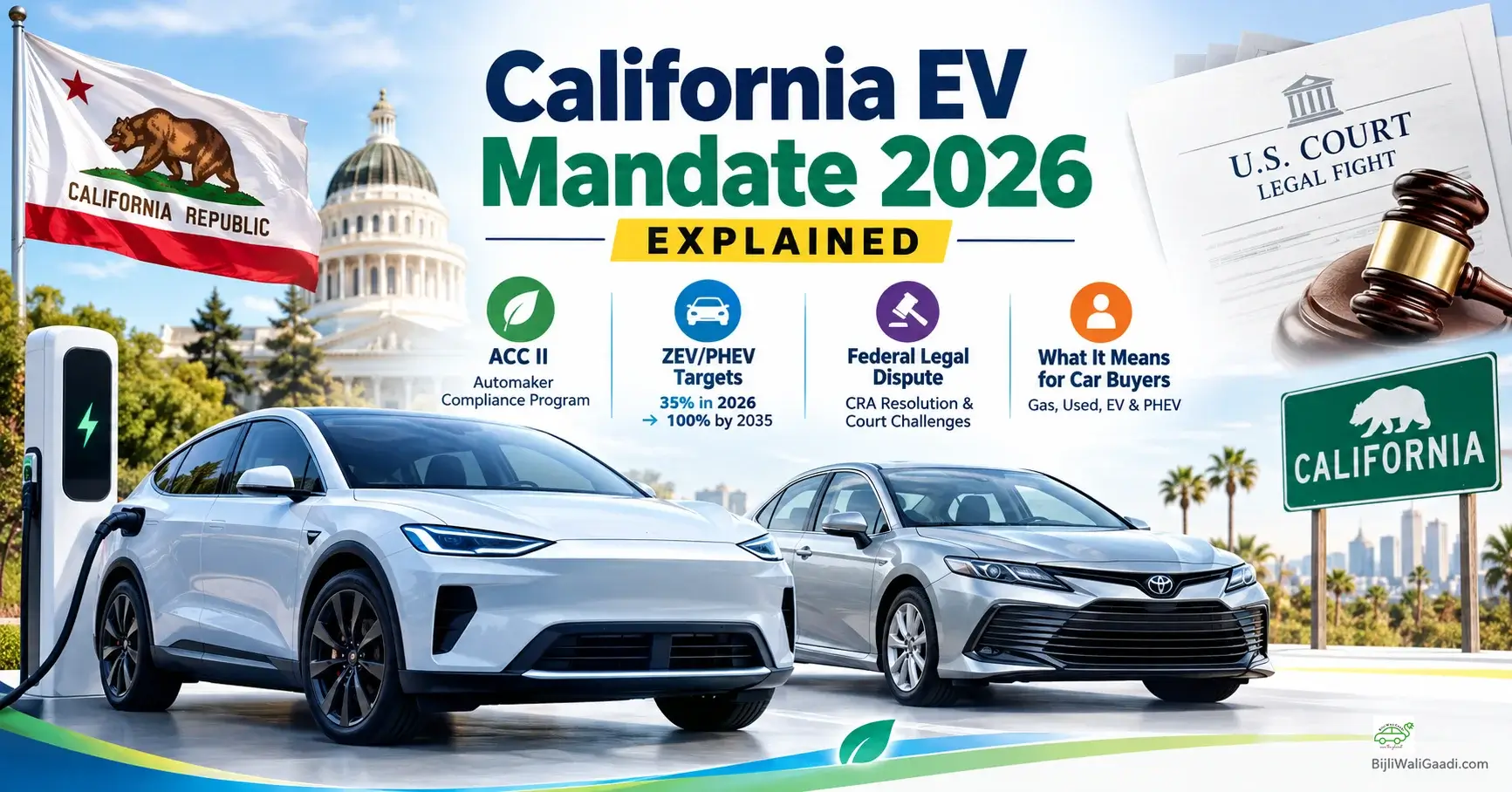
- ACC II is a manufacturer-focused regulation. It does not require individual Californians to buy an EV.
- As adopted, ACC II starts at 35% ZEV/PHEV sales for model year 2026 and rises toward 100% by 2035, with plug-in hybrids capped at a portion of that total.
- The federal Clean Air Act waiver that let California enforce ACC II was the subject of a Congressional Review Act (CRA) resolution the President signed in June 2025. California is challenging that action in court, and the case remains pending.
- A separate dispute over four different California Clean Air Act waivers produced a September 2, 2026 preliminary injunction in California’s favor, but that ruling did not directly restore ACC II’s ZEV sales requirement. The federal government appealed the ruling on September 15.
California’s Advanced Clean Cars II regulation does not require individual drivers to buy an electric vehicle. ACC II is a compliance program aimed at automakers: it does not make existing gasoline vehicles illegal, and it does not stop anyone from buying a used gas-powered car. The federal waiver authority behind ACC II’s new-vehicle sales requirement remains under litigation as of September 2026.
Why California’s EV Rules Are Back in Federal Court
Three separate legal threads are often blended together in coverage of this issue. It helps to keep them apart.
Thread A — the ACC II waiver. EPA transmitted the ACC II, Advanced Clean Trucks and Low NOx Omnibus waiver actions to Congress in early 2025 after treating them as “rules” under the Congressional Review Act. Congress passed three joint resolutions disapproving those actions, and the President signed them into law in June 2025. California and other states challenged the action in federal court, arguing Clean Air Act waivers are adjudicatory orders rather than CRA-eligible rules — not that Congress had repealed ACC II itself. That case remains pending.
Thread B — a separate 2026 waiver dispute. On June 12, 2026, EPA transmitted four other California Clean Air Act waiver actions to Congress for CRA review — covering the state’s 2008 greenhouse-gas vehicle standards, the 2012 Advanced Clean Cars I waiver, a 2022 reinstatement of parts of ACC I, and 2022 Small Off-Road Engine amendments. These are distinct from the ACC II waiver. California, Governor Gavin Newsom, and CARB sued EPA in the U.S. District Court for the District of Columbia on June 22, 2026.
Thread C — a federal preemption lawsuit. In March 2026, the DOJ and DOT separately sued California, challenging specified California vehicle standards as allegedly preempted by federal fuel-economy law. That is the federal government’s legal argument, not a court finding — no court has ruled California’s ZEV rules are preempted, and the case does not automatically invalidate every California ZEV rule.
What the September 2026 Court Ruling Actually Changed
On September 2, 2026, U.S. District Judge Beryl Howell granted California a preliminary injunction in the Thread B case. She found the four waivers at issue were properly adjudicatory orders rather than CRA-eligible rules, denied EPA’s motion to dismiss, and ordered the agency to restore the status quo that existed before its June 12, 2026 announcement.
This ruling is significant but narrow. It applies to the four waivers named in that case — not the ACC II waiver — and ordered EPA, not Congress, to restore the relevant pre-June status quo. It does not permanently protect those waivers, does not prevent Congress from acting later, and does not mean California has won the broader dispute. The federal government appealed the ruling on September 15, 2026; the appeal remains pending as of September 20, 2026.
The separate Thread A litigation over the ACC II waiver itself remains unresolved, and the September 2 ruling did not directly restore ACC II’s ZEV sales requirement. The precise, current legal enforceability of ACC II’s model-year 2026 sales percentage cannot be stated with certainty based on available public records.
How the 35% 2026 ZEV Target Works
| Model Year | ACC II ZEV/PHEV Sales Target |
| 2026 | 35% |
| 2030 | 68% |
| 2035 | 100% |
These are automaker-level compliance targets, not requirements for individual consumers to buy an EV. Qualifying plug-in hybrids can count toward the requirement, capped at up to 20% of the overall ZEV/PHEV requirement under the adopted rule.
What California’s EV Rules Mean for Car Buyers in 2026
Buying a New Gasoline Car
California’s ACC II rule does not prohibit consumers from buying a new gasoline vehicle. Because the ACC II waiver’s legal status is being litigated, the enforceability of the ACC II ZEV/PHEV sales target for model-year 2026 remains unsettled. Automaker product planning, inventory decisions, and separate compliance arrangements with CARB can still influence which vehicles show up on a given lot.
Buying a Used Gasoline Car
ACC II does not ban ownership or resale of existing gasoline vehicles. Used gasoline vehicles can still be bought, sold and owned; this litigation does not change that. Other, unrelated California registration or emissions-testing rules may apply independently.
Buying an EV or PHEV
ACC II is not battery-electric-only. Qualifying plug-in hybrids are included in its ZEV framework, subject to the program’s PHEV limits. Automakers continue to sell and market both EVs and PHEVs in California regardless of the litigation’s outcome.
The Federal Tax Credit Is a Separate Issue
The federal New Clean Vehicle Credit is separate from California’s ACC II rules. It is unavailable for vehicles acquired after September 30, 2025 — a federal tax-policy change, not a California incentive.
Timeline of California’s Clean-Car Legal Fight
| Date | Development |
| 2022 | CARB adopts ACC II |
| December 2024 | EPA grants the Clean Air Act waiver for ACC II |
| June 2025 | Congress passes a CRA resolution disapproving the ACC II waiver action, and the President signs it; California and other states challenge the action in court |
| March 2026 | DOJ and DOT file a separate lawsuit challenging specified California vehicle standards on federal-preemption grounds |
| June 12, 2026 | EPA transmits four other California Clean Air Act waiver actions to Congress for CRA review |
| June 22, 2026 | California sues EPA over the June 12 waiver action |
| September 2, 2026 | Judge Howell grants a preliminary injunction concerning the June 2026 waiver action |
| September 15, 2026 | Federal government appeals the September 2 ruling |
What California Drivers Should Watch Next
Several pending proceedings will shape where the issue goes next, including:
- California’s challenge to the 2025 CRA action involving the ACC II waiver, still pending in federal court.
- The federal government’s appeal of the September 2, 2026 preliminary injunction.
- The DOJ/DOT federal-preemption lawsuit filed in March 2026.
Because other states have adopted California vehicle standards under Section 177 of the Clean Air Act, developments in California can have implications beyond the state. However, each state’s adoption dates, regulations and legal posture can differ, so the effects are not necessarily uniform nationwide.
FAQ
–
Stay connected via Google 'Electric Vehicle' News
Follow BijliWaliGaadi | India's Trusted EV Insights Portal
source on Google