Indian Automotive Supply Chain 2026: How EVs Are Rewiring the Industry
Stay connected via Google 'Electric Vehicle' News
Follow BijliWaliGaadi | India's Trusted EV Insights Portal
source on Google
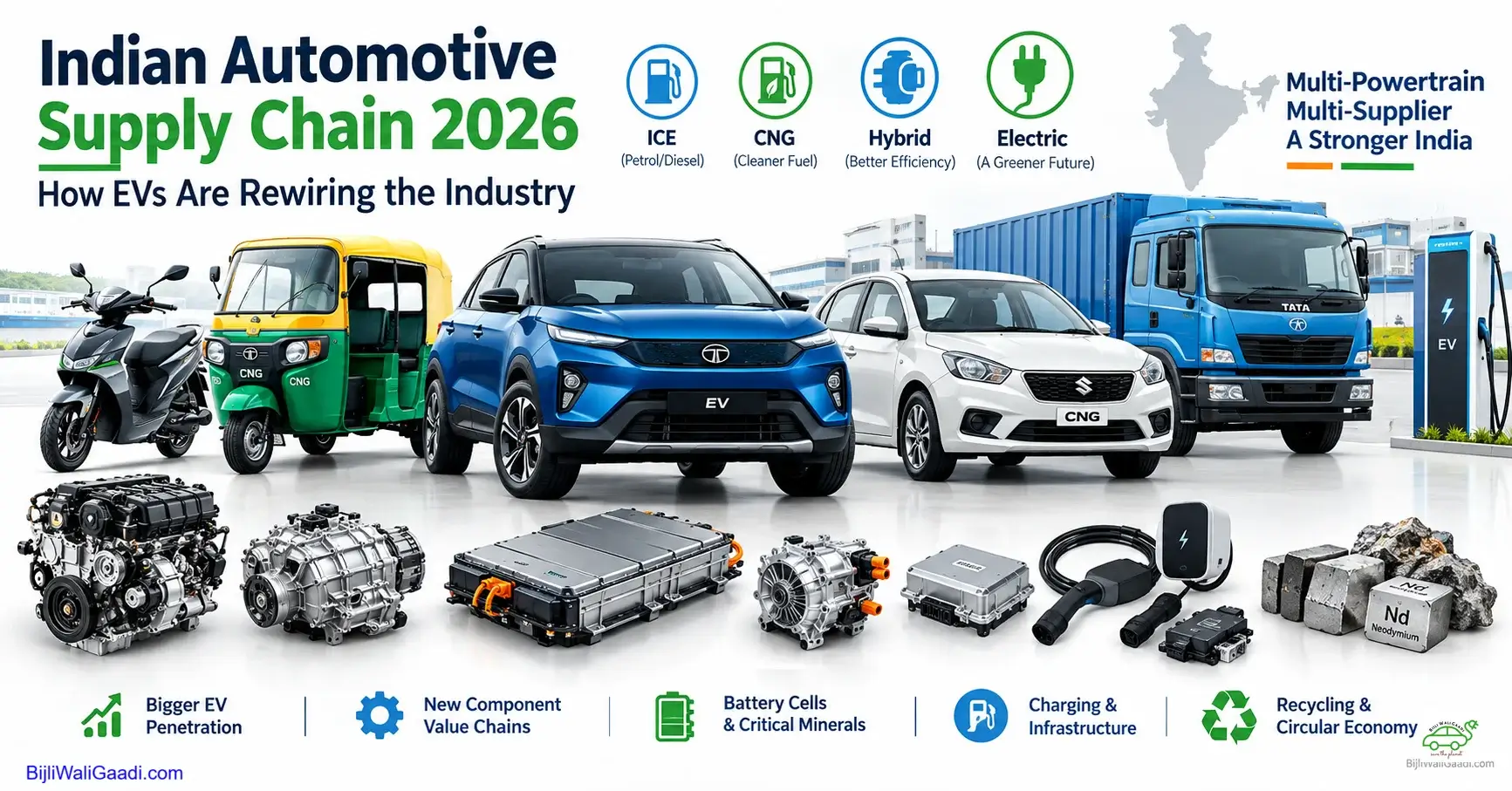
India’s auto industry did something in August 2026 that would have sounded unlikely three years ago: CNG, hybrid and electric passenger vehicles collectively overtook petrol/ethanol cars in monthly retail, 41.95% to 40.85%. The bigger story is not what happened in showrooms, but what that shift is doing to the factories and suppliers behind them.
For decades, India’s supply chain ran on one script — steel, an engine, a gearbox, a fuel tank, a dealer. That script is splitting into several: ICE, CNG, strong hybrids, battery EVs and early electric commercial vehicles, each growing at its own pace and pulling a different part of the supplier base with it.
How EVs Are Changing India’s Automotive Supply Chain
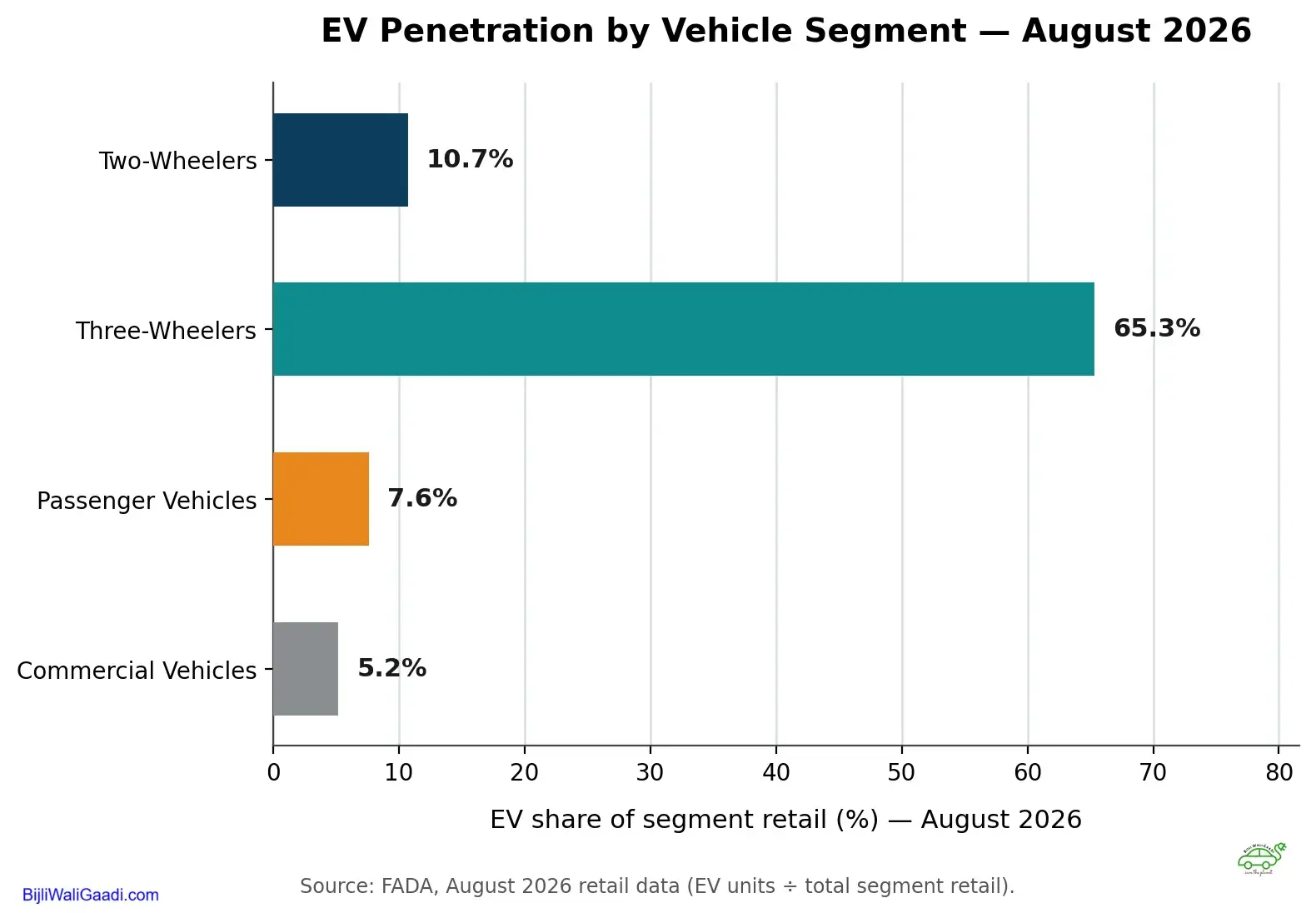
India’s supply chain is not converting from petrol to electric — it is fragmenting into a multi-powertrain system. Two- and three-wheelers are electrifying fastest, hitting 10.7% and 65.3% EV penetration respectively in August 2026. Passenger cars are diversifying across CNG, hybrid and EV rather than converting to EV alone. Component value is moving from engines and exhaust systems toward batteries, motors, power electronics and charging hardware — while India’s actual battery-cell capacity still trails far behind what companies have announced.
India’s Auto Market Is No Longer a Single-Powertrain Story
FY2025-26 was a record year for India’s overall auto industry by SIAM’s production data: 3.47 crore vehicles produced, led by 2.17 crore two-wheelers, 46.4 lakh passenger vehicles, 10.8 lakh commercial vehicles and 8.4 lakh three-wheelers.
Table 1: India’s Automotive Market — FY2025-26 (SIAM Production Data)
| Segment | FY2025-26 Production (units) |
| Two-wheelers | 21,705,974 |
| Passenger vehicles | 4,643,439 |
| Commercial vehicles | 1,079,871 |
| Three-wheelers | 836,231 |
| Total | 34,708,984 |
Note: SIAM production data, not retail sales — FADA’s separately reported FY2025-26 retail registrations were lower, since production includes exports and dealer inventory.
Maruti Suzuki’s own plan illustrates why “multi-powertrain” is the right word: it expects CNG (including compressed biogas) to be its largest single powertrain category by FY2030-31, at roughly 35%, with ICE and hybrids near 25% each and the rest electric — a company projection, not an industry consensus, but a useful signal of how a cost-sensitive market is thinking.
The August 2026 EV Numbers Reveal Where the Shift Is Happening
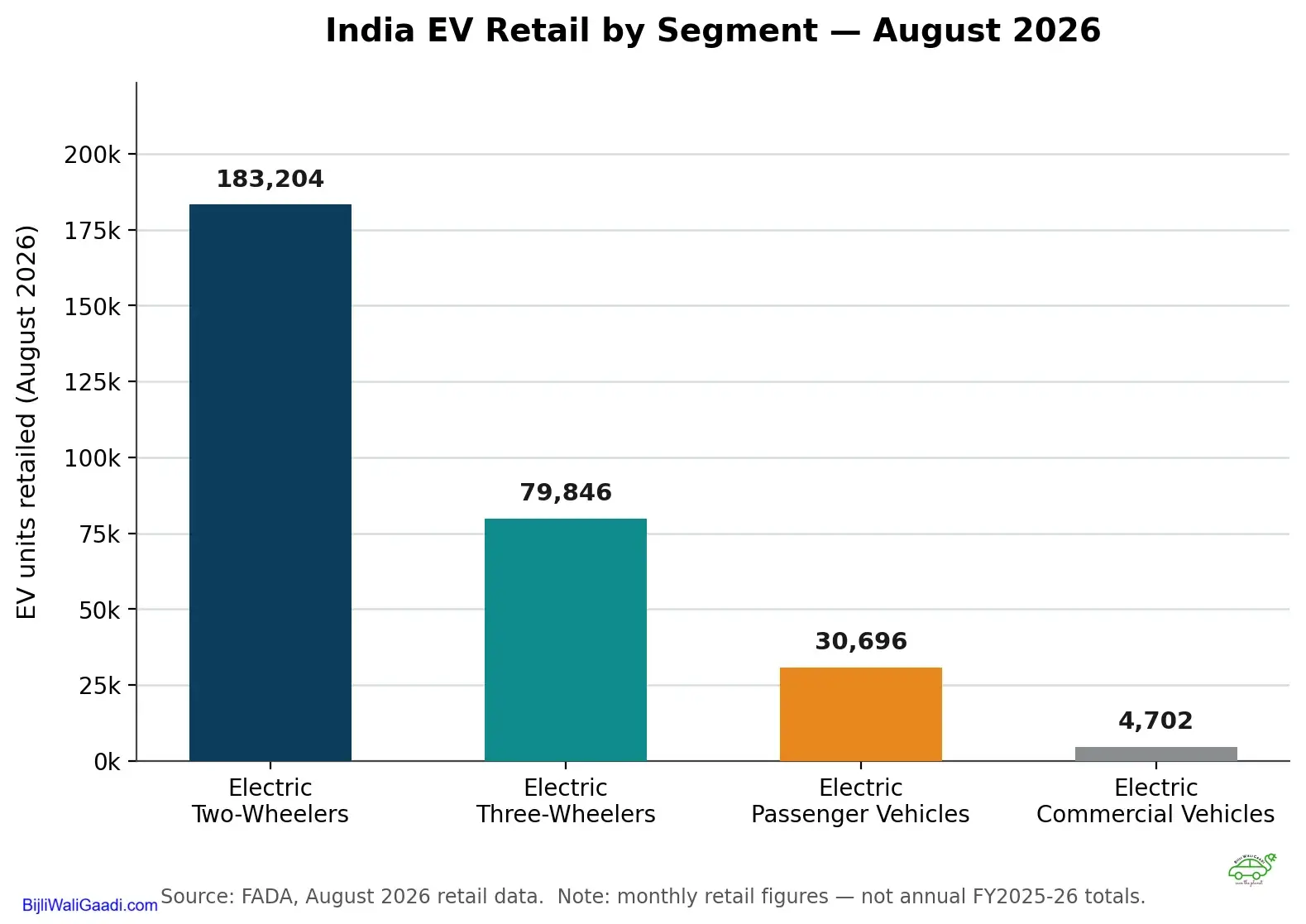
August 2026 gives the clearest recent snapshot: total EV retail hit 2,98,448 units, up 52.9% year-on-year, with overall EV penetration at 12.3% of all vehicle retail.
Table 2: EV Retail and Penetration by Segment — August 2026 (FADA)
| Segment | EV units | YoY growth | EV penetration |
| Two-wheelers | 183,204 | +67.1% | 10.7% |
| Three-wheelers | 79,846 | +25.3% | 65.3% |
| Passenger vehicles | 30,696 | +51.9% | 7.6% |
| Commercial vehicles | 4,702 | +188.3% | 5.2% |
| Total | 298,448 | +52.9% | 12.3% |
Monthly data, distinct from FY2025-26 annual figures (roughly 24.5 lakh EV units, ~8.5% penetration for the full year). Monthly numbers should not be read as the full-year run rate.
The passenger-vehicle fuel mix is the sharper story. In August 2026, CNG/LPG took 25.28% of PV retail, hybrids 9.04%, EVs 7.63%, diesel 17.21% and petrol/ethanol 40.85% — so the combined alternative-fuel category (41.95%) edged past petrol for the first time. Petrol remains the single largest individual fuel category; this is a market diversifying across four technologies at once, not one replacing another.
EVs Are Moving Value From Engines to Batteries and Electronics
An EV does not simply remove the engine — it moves value into the battery, motor, inverter and software layer.
Table 3: ICE vs EV — Where Component Value Shifts
| ICE component | EV equivalent | Supply-chain effect |
| Engine, transmission | Battery pack + reduction gear/e-axle | New supplier category; today import-heavy |
| Fuel injection, exhaust, catalytic converter | Not required | Direct pressure on ICE-only specialists |
| Starter motor, alternator | Traction motor + inverter + DC-DC converter | Higher electronics content |
| Radiator/engine cooling | Battery thermal management | New, safety-critical category |
| 12V wiring harness | High-voltage wiring + BMS + sensors | Higher precision, higher value |
Suppliers making powertrain-agnostic parts — tyres, seats, brakes, body panels, glass — see comparatively little disruption, since demand tracks total vehicle volume rather than fuel choice.
Battery Cells Are India’s Biggest Supply-Chain Test
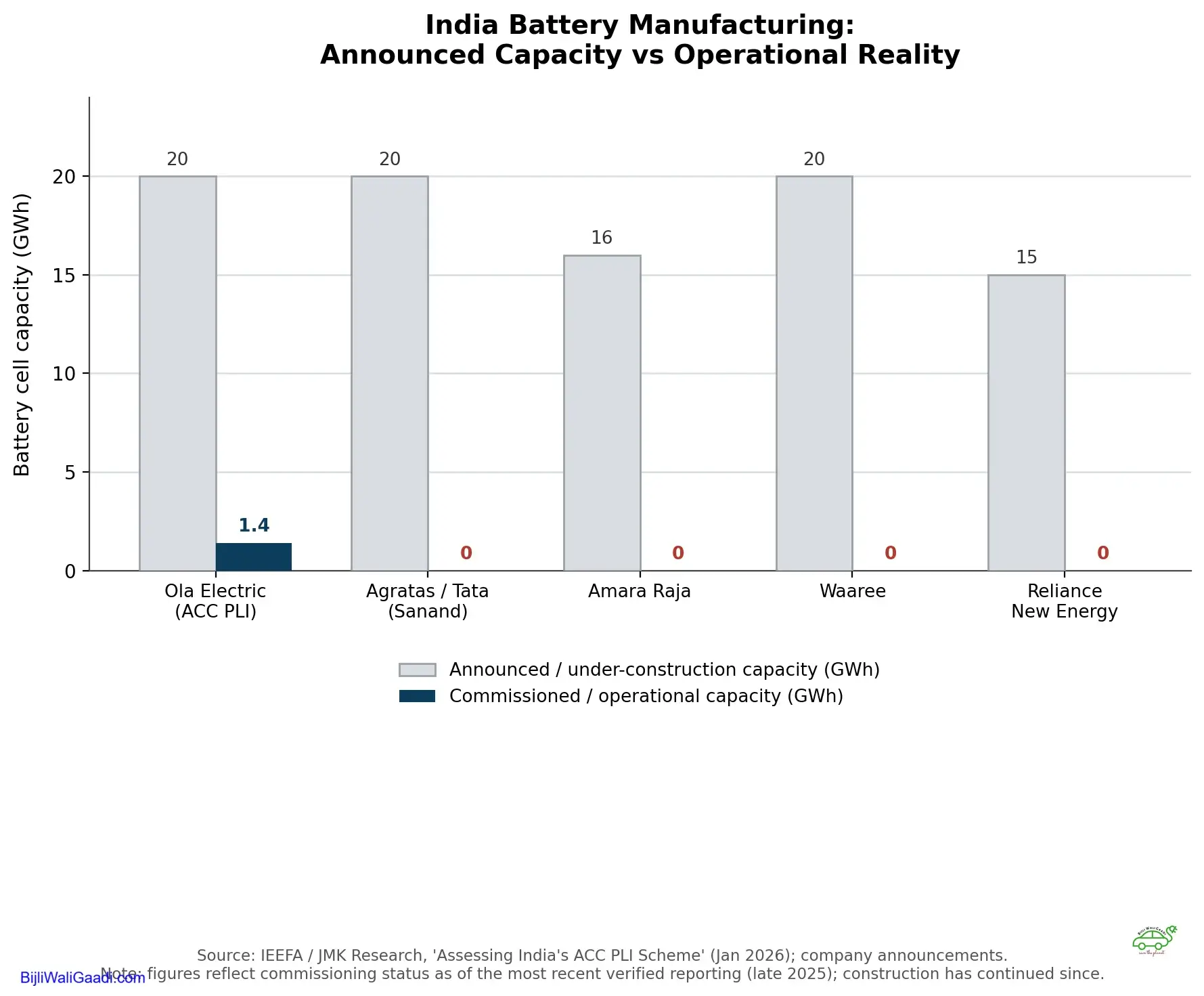
This is where announcement and reality diverge most. The ₹18,100-crore ACC PLI scheme targeted 50 GWh of domestic cell-manufacturing capacity. As of the most recent verified reporting (late 2025), only about 1.4 GWh had actually been commissioned — all from Ola Electric’s Krishnagiri plant. India’s cell-manufacturing build-out is progressing, but operational capacity still trails the headline numbers companies have announced.
Outside the original PLI list, a wider ecosystem is under construction: Tata’s Agratas is building a 20 GWh first-phase plant at Sanand, Gujarat, with structural steel complete as of April 2026 and commercial production targeted for 2027; Amara Raja (16 GWh, Telangana), Waaree (20 GWh, Andhra Pradesh) and Reliance New Energy (15 GWh) are at earlier construction stages. None were producing cells at commercial scale as of the latest verified reporting.
Near-term EV packs sold in India — including Maruti’s e Vitara and Mahindra’s BE 6/XEV range — still rely on imported cells (BYD, FinDreams) even where pack assembly happens domestically.
A related risk sits one layer up: China’s April 2025 export controls on rare-earth magnets, used in most EV traction motors, forced Maruti Suzuki to trim near-term e Vitara output targets. India’s response is now underway — the Cabinet approved a ₹7,280-crore scheme in November 2025 to build 6,000 MTPA of integrated rare-earth magnet manufacturing capacity across five beneficiaries, bringing magnet production, not just mining, onshore.
Auto Components Face a Two-Speed Transition
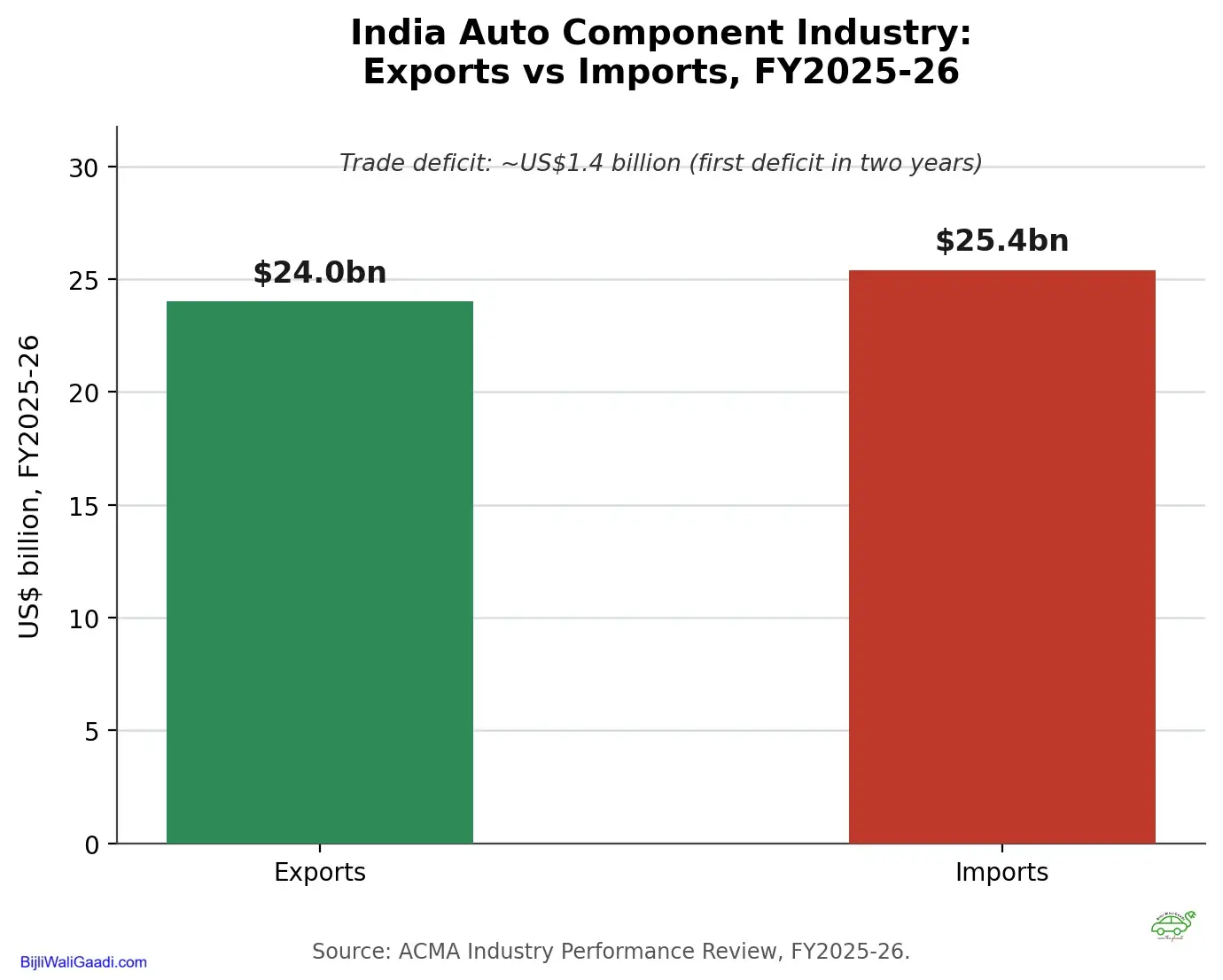
ACMA reported the component industry’s FY2025-26 turnover at ₹7.59 lakh crore (US$85.9 billion), up 12.7%, with OEM supplies at ₹6.52 lakh crore (US$73.4 billion), up 16.3%. Exports rose to US$24 billion while imports rose to US$25.4 billion, pushing the industry into a roughly US$1.37 billion trade deficit — its first in two years — which ACMA links to rising demand for EV and software-defined-vehicle components India still imports.
The number that best captures where things actually stand: EV components made up only about 4.6% of domestic OEM supplies in FY2025-26, excluding lithium-ion batteries. That is a meaningful new category, not yet a dominant one — most of India’s ₹7.6-lakh-crore component industry is still built around conventional and hybrid-compatible parts.
How India’s Major Automakers Are Rebuilding Their Supply Chains
Maruti Suzuki began e Vitara production at Hansalpur, Gujarat, in August 2025, using 49-61 kWh LFP packs from BYD, with most FY26 output earmarked for export to over 100 countries. Cell localisation, via the Suzuki-Toshiba-Denso joint venture, remains a phased, multi-year project; Maruti still imports cells today.
Tata Motors leads electric PV sales by volume, though its share fell from roughly 57% (FY25) to 39% (FY26) as rivals scaled up. Its edge is vertical integration through Agratas, spanning cell manufacturing at Sanand to pack assembly to vehicle integration.
Mahindra & Mahindra, per its FY2025-26 Integrated Annual Report, held a 37.4% revenue market share in electric SUVs and reached 9.6% EV penetration in its overall sales mix in Q4 FY26, up from 6% a year earlier. Its Last Mile Mobility arm led electric three-wheelers at 40% market share. The INGLO-based BE 6, XEV 9e and XEV 9S use 59-79 kWh packs from BYD and FinDreams.
Hyundai has named Tamil Nadu its flagship EV hub, targeting a rise in localisation from 82% to 90% over five to six years, with a ₹4,000-crore increase in sourcing from Tamil Nadu suppliers.
Kia, Toyota and Honda occupy the hybrid-and-electronics middle ground. Toyota and Honda pushed for lower hybrid taxation, and under GST 2.0 (September 2025), hybrid GST fell to roughly 18% for smaller cars and 40% for larger ones, against a flat 5% for EVs — narrowing, not closing, the tax gap.
TVS Motor and Bajaj Auto, legacy two-wheeler makers rather than EV start-ups, now lead electric two-wheelers, together holding more than half the segment by 2026, ahead of Ather, Hero Vida and a declining Ola Electric.
Three-Wheelers and Two-Wheelers Are Leading Electrification
Three-wheelers show that operating economics are becoming as important as purchase incentives: EV penetration reached 65.3% of segment retail in August 2026, driven by predictable routes and low running costs, even as central subsidies for high-speed e-autos have already wound down. The segment stays fragmented — the top five EV three-wheeler makers hold only around 36% combined share.
Two-wheelers are the largest EV segment by volume. The competitive order has shifted since 2022: TVS and Bajaj, not pure-play EV start-ups, now lead, while Ola Electric has fallen to single-digit monthly share amid service and inventory challenges.
Commercial Vehicles Are Moving More Selectively
Electric commercial vehicles grew 188.3% year-on-year in August 2026, off a small base — 5.2% penetration. A December 2025 PM E-DRIVE tender for 10,900 buses saw newer entrants (PMI Electro Mobility, Eka Mobility, Olectra) win the bulk of the order, while Tata Motors, VECV and Ashok Leyland received none in that round — though Ashok Leyland’s EV arm, Switch Mobility, separately won a 650-bus order for Mumbai and Pune in July 2026. Battery-electric, CNG, ICE and emerging hydrogen solutions are likely to coexist in heavy commercial applications through the decade, with technology choice increasingly determined by duty cycle, payload, charging access and total cost of ownership.
CNG and Hybrids Will Keep ICE Supply Chains Relevant
CNG requires conventional ICE architecture plus a gas-storage and delivery system, sustaining ICE-adjacent demand even though it counts as an “alternative fuel.” Strong hybrids from Toyota, Maruti and Honda draw on both ICE and EV component families at once. Together, they explain why India’s ICE-linked supply chain is shrinking as a share of new demand, not disappearing.
Charging, Critical Minerals and Recycling Are the New Supply-Chain Layers
Charging infrastructure is now a distinct supply-chain layer of transformers, switchgear, cabling, power electronics and payment/energy-management software. PM E-DRIVE has allocated ₹2,000 crore for public charging infrastructure, targeting new stations across 50 national highway corridors. Government data reported to Parliament put registered public charging stations at 27,737 as of March 2026, with 22,753 operational — figures that should be read as registered/operational counts, not interchangeably with other tallies using different methods.
Recycling is emerging as a compliance-driven industry under the Battery Waste Management Rules, 2022, with staggered EPR obligations: three-wheeler battery targets began from FY2024-25, two-wheeler obligations phase in from FY2026-27, and electric-car obligations start only around FY2029-30, reflecting longer expected battery life. EV manufacturing also adds new logistics needs — hazardous-material handling for lithium-ion transport, and reverse logistics to recover end-of-life packs — that an ICE supply chain never required.
Compact cluster map: Gujarat (Maruti Hansalpur, Tata Agratas, TDSG battery ecosystem); Tamil Nadu (Ola cell plant, Hyundai’s EV hub); Maharashtra (Mahindra Chakan, Bajaj); Telangana (Amara Raja battery); Karnataka (EV electronics and Exide’s upcoming lithium-cell plant).
What Happens to India’s Tier-2 and Tier-3 Suppliers?
Higher risk: exhaust systems, fuel injection, clutch assemblies, certain ICE-only transmission parts — categories facing gradual pressure as new-model mix shifts, though today’s enormous installed ICE parc keeps their order books full for now.
Growing opportunities: battery packs, BMS, motor components, power electronics, thermal management, high-voltage wiring, charging hardware, sensors and embedded software.
Powertrain-agnostic: tyres, seats, brakes, glass, body panels, suspension — demand tracks total vehicle volume, not fuel choice.
The disruption to ICE-specialist suppliers is real but gradual, not sudden.
2030 Outlook: India’s Automotive Supply Chain Will Be Multi-Powertrain
This is analysis based on current trajectories, not an official forecast.
| Segment | Likely direction | Main supply-chain implication |
| Two-wheelers | Rapid electrification | Motor, battery and BMS suppliers scale fastest here |
| Three-wheelers | EV dominance increasingly likely | Fragmented supplier base likely to consolidate |
| Passenger vehicles | EV, hybrid and CNG coexistence | Component makers need multi-powertrain product lines |
| Commercial vehicles | Selective electrification | Fleet economics and charging access decide the pace |
| Heavy trucks | Multiple technologies based on duty cycle | ICE, CNG, battery-electric and early hydrogen likely to coexist |
Conclusion
India is not simply replacing engines with batteries. It is redistributing value — from engines to batteries, from mechanical assemblies to electronics and software, from fuel distribution to charging networks. The August 2026 crossover, where alternative fuels edged past petrol in passenger vehicles, captures this precisely: CNG delivered the scale, hybrids delivered efficiency, and EVs delivered the fastest growth — together, not as substitutes for each other. The suppliers and OEMs treating this as a multi-decade, multi-powertrain restructuring, rather than a single switch from petrol to electric, are the ones positioned to benefit from it.
Frequently Asked Questions
Stay connected via Google 'Electric Vehicle' News
Follow BijliWaliGaadi | India's Trusted EV Insights Portal
source on Google