China’s Grip on EV Magnets Is Real — Indian and Global Engineers Are Building Around It
Stay connected via Google 'Electric Vehicle' News
Follow BijliWaliGaadi | India's Trusted EV Insights Portal
source on Google
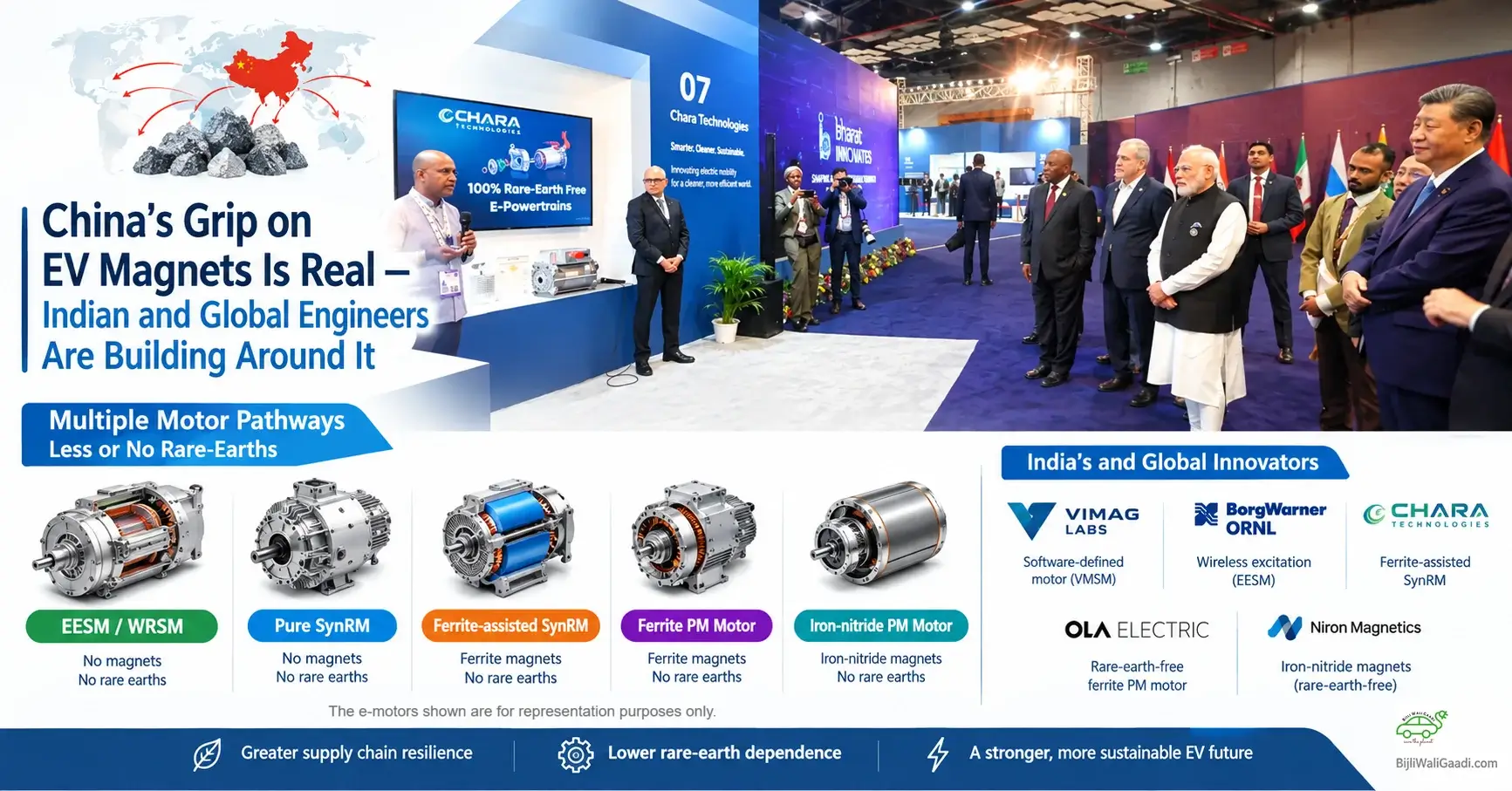
EV motor architecture has quietly become a supply-chain story as much as an engineering one. A handful of processing plants, concentrated in one country, sit between automakers and the magnets their traction motors have relied on for a decade — which is why Vimag Labs, BorgWarner-ORNL, Chara Technologies-Greaves Cotton and Ola Electric in India, and Niron Magnetics in the US, are all building traction motors, via genuinely different routes, that need little or no rare-earth material.
Why NdFeB Dominates Today’s EV Motors
The permanent magnet synchronous motor (PMSM) remains a major and widely used traction-motor architecture in modern EVs, prized for high torque density in a compact package. That performance comes from neodymium-iron-boron (NdFeB) magnets, which offer very high magnetic energy density. Dysprosium and terbium may be added to specific NdFeB formulations to improve coercivity and resist thermal demagnetisation, though not every EV magnet contains significant amounts of either.
Neodymium and praseodymium are light rare earth elements; dysprosium and terbium are heavy rare earth elements. All four sit within what the IEA calls the “magnet rare earths” group.
What China Actually Controls in 2024 — and Why 2026 Still Matters
Per IEA 2024 data, China accounted for about 60% of global mined production of magnet rare earths, but a much larger 91% of global refined output and roughly 94% of global permanent-magnet manufacturing. That gap between mining and finished-magnet share is the real chokepoint.
This isn’t a closed 2025 story. China introduced rare-earth export controls in April 2025, then expanded them in October 2025. The expanded October measures were suspended for one year, until 10 November 2026, under a broader US-China trade understanding — but the original April 2025 licensing requirements on several heavy rare earths remain in force. The IEA’s 2026 Global Critical Minerals Outlook says the 2025 restrictions demonstrated how concentrated mineral supply chains can create real industrial disruption, and that diversification remains incomplete — particularly downstream, in rare-earth metals, alloys and permanent magnets. As of 17 September 2026, the underlying risk is paused, not resolved.
Six Motor Pathways, Not One “Fix”
| Motor pathway | Permanent magnet? | Rare-earth material? | Rotor field / torque mechanism | Example |
| PMSM | Yes | Usually yes | NdFeB permanent magnetic field | Mainstream EV traction |
| EESM / WRSM | No | No | Electrically excited rotor winding | Vimag, BorgWarner–ORNL |
| Pure SynRM | No | No | Reluctance torque from rotor flux barriers | General SynRM architecture |
| Ferrite-assisted SynRM | Yes | No | Reluctance torque + ferrite magnet contribution | Chara / Greaves |
| Ferrite PM motor | Yes | No | Ferrite permanent magnet | Ola Electric |
| Iron-nitride PM motor | Yes | No | Iron-nitride permanent magnet | Niron Magnetics |
Rare-earth-free and magnet-free are not interchangeable. A magnet-free motor contains no permanent magnet at all; a rare-earth-free motor may still use ferrite or another non-rare-earth permanent magnet. Ferrite itself is rare-earth-free, relatively inexpensive and thermally robust, but has substantially lower magnetic energy density than high-performance NdFeB — so matching a PMSM’s output typically requires different rotor/stator geometry or more magnet volume.
How Vimag Labs’ Software-Defined Motor Works
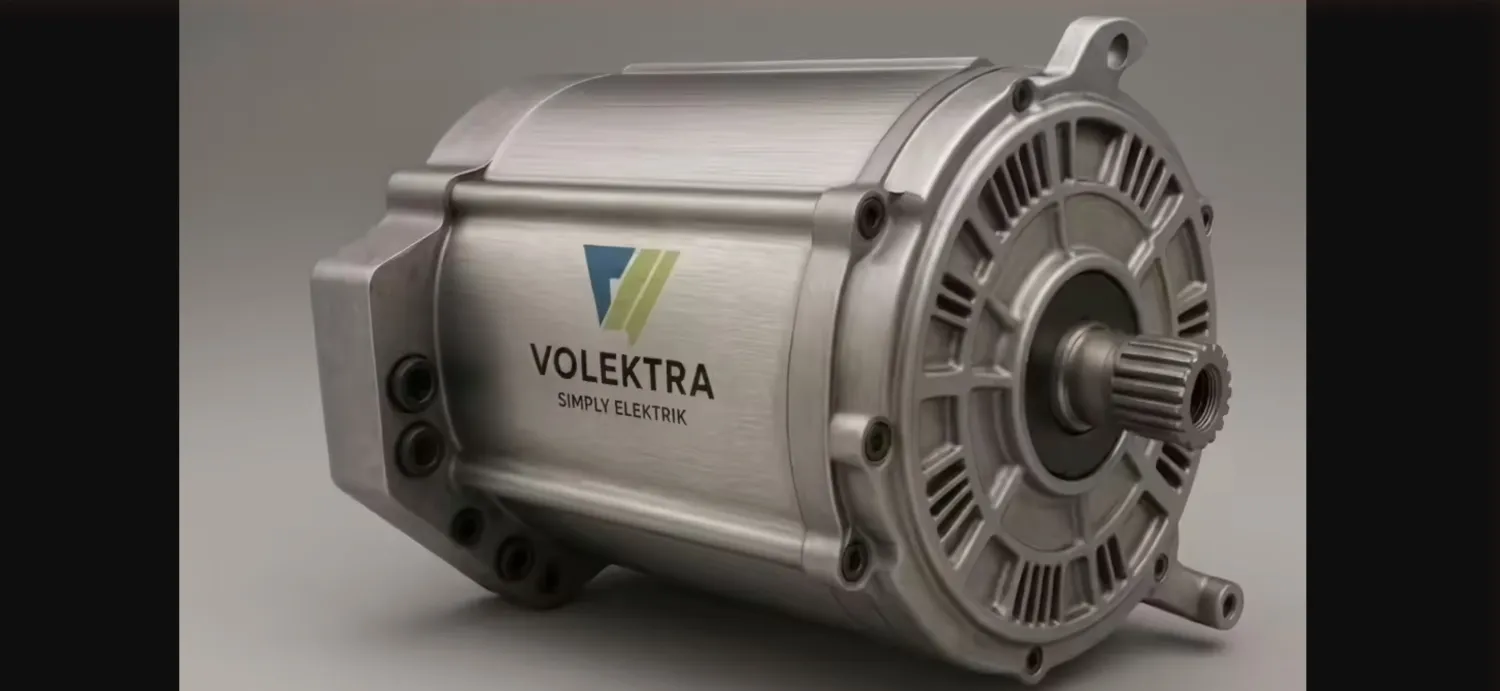
Bengaluru-based deep-tech company Vimag Labs secured its fifth Indian patent in July 2026, covering a rotating-transformer-excited synchronous motor, commercialised as the Virtual Magnet Synchronous Motor (VMSM) under its Volektra brand. A stationary primary winding induces current across a small air gap into a rotor-mounted secondary winding; a rotor-mounted rectifier converts this to the DC current that magnetises the rotor, with the field generated and controlled electronically via proprietary software and power electronics — brushlessly, with no slip rings.
Vimag says its VMSM is designed to match or exceed permanent-magnet solutions across targeted duty cycles — a company claim, not an independently verified result. It holds five granted patents, ten pending applications and fifteen trademarks, has raised a $5 million Series A led by Accel, and has a manufacturing MoU with Jendamark India. Its work is described as active pilots and development programmes with two-wheeler and passenger-car manufacturers, with expansion planned into commercial mobility and high-power systems — not mass-market deployment today.
BorgWarner and ORNL: Removing Brushes as Well as Magnets
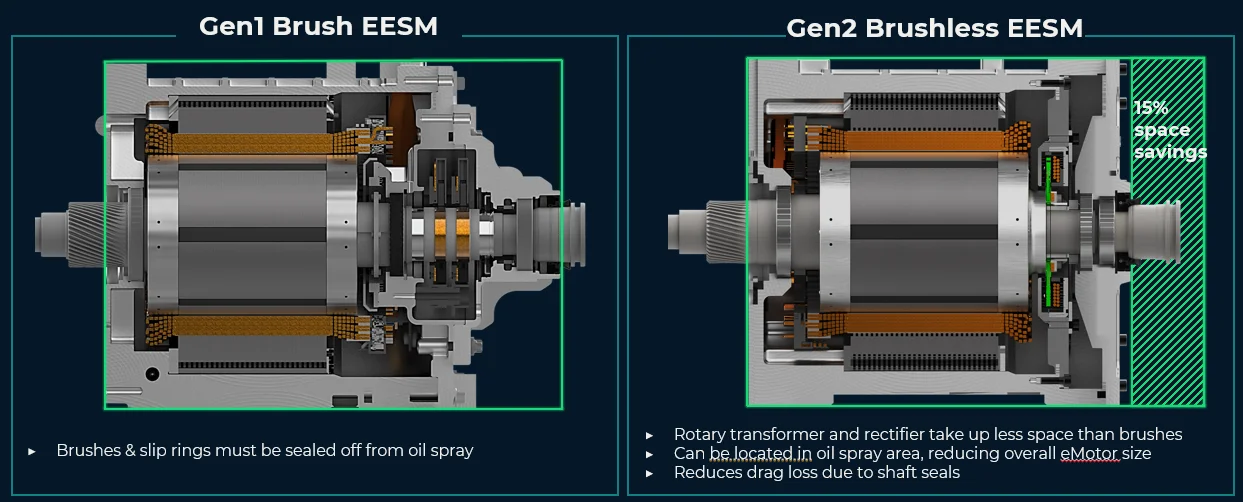
BorgWarner and Oak Ridge National Laboratory won a 2025 R&D 100 Award for a rotary-transformer-based wireless excitation system for electrically excited synchronous motors, developed under a partnership running since 2021. The system eliminates rotor permanent magnets, brushes and slip rings by transferring excitation power to the rotor wirelessly.
BorgWarner reports 92–95% rotary-transformer power-transfer efficiency, operation above 20,000 rpm, and roughly 15% motor-size reduction versus its prior design. These are company-reported figures from a demonstrated development platform, not confirmed mass-production specifications.
Chara, Greaves and Ola: India’s Multiple Routes
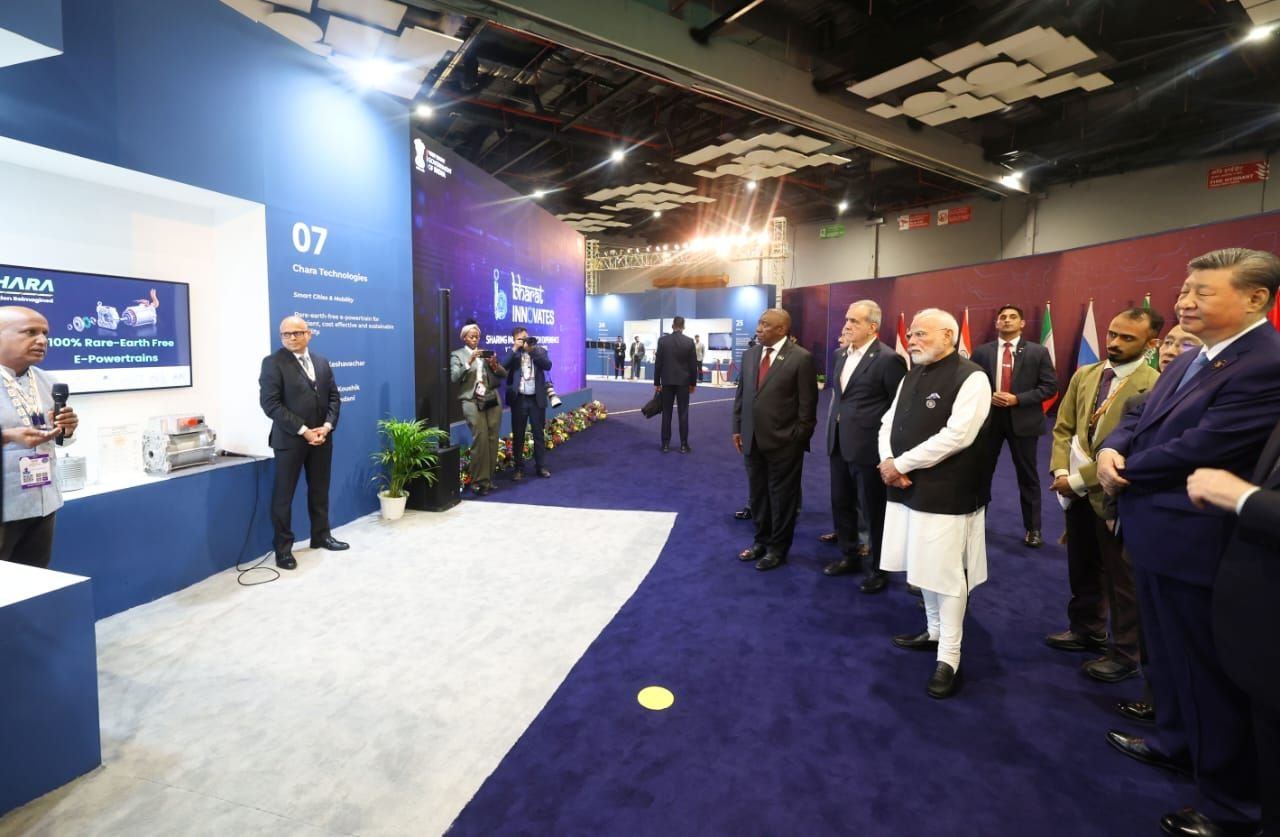
India is running several routes in parallel, not chasing one national fix. Chara Technologies and Greaves Cotton are pursuing a rare-earth-free route through ferrite magnet-based synchronous reluctance motors, licensed by Greaves‘ ePowertrain business for passenger and cargo electric three-wheelers manufactured at Shendra, Aurangabad. The ferrite magnets remain permanent magnets — this is not a fully magnet-free design — but they avoid the neodymium, praseodymium, dysprosium and terbium used in conventional high-performance magnets. Chara claims a 15–20% cost advantage over comparable PMSMs; that figure is the company’s own. Separately, Greaves’ broader ePowertrain business already powers L3 and L5 vehicles for multiple OEMs, not all of it built on Chara’s specific technology.
Ola Electric took the substitution route instead. In October 2025, it became the first Indian two-wheeler maker to secure Global Automotive Research Centre certification under AIS 041 norms for an in-house rare-earth-free ferrite permanent-magnet motor — not magnet-free — with Ola saying its 7 kW and 11 kW variants matched the net power of the rare-earth motors they replace.
Niron Magnetics: Scaling Rare-Earth-Free Magnets, Not Eliminating Magnets
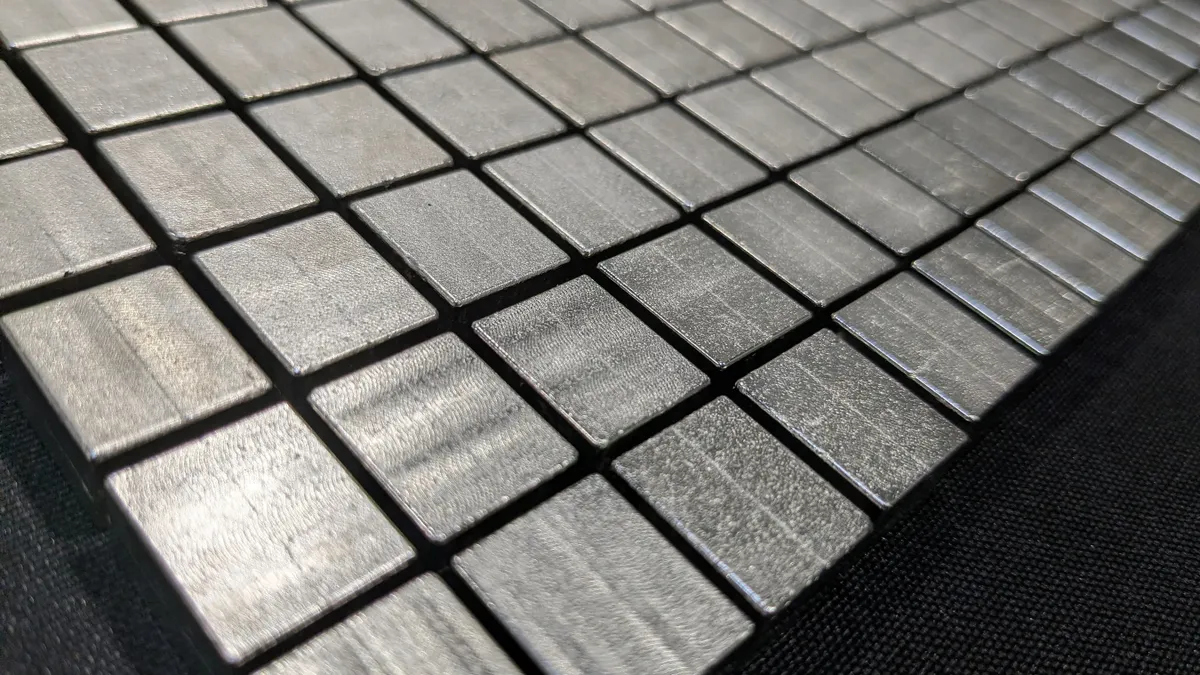
Niron Magnetics is moving beyond laboratory development toward commercial-scale manufacturing of rare-earth-free iron-nitride permanent magnets — it is not developing a magnet-free motor. In August 2026 alone, it secured a conditional $150 million commitment from the US Department of War’s Office of Strategic Capital, followed by a separate $150 million loan from the Shakopee Mdewakanton Sioux Community, both directed at its Sartell, Minnesota plant. On 9 September 2026, Honda Motor Co. invested through its Xcelerator Ventures programme. The Sartell facility, targeted for 2027 startup, adds to earlier backing from GM and Stellantis; none of these partners has yet deployed Niron’s magnets in a production EV.
Engineering Trade-offs Nobody Should Skip
PMSM remains compact and mature but carries rare-earth supply exposure. EESM eliminates permanent magnets and allows a controllable, speed-dependent rotor field, but adds rotor excitation losses and thermal/control hardware — rotary-transformer excitation offsets this by removing brushes and slip rings. Pure SynRM can be fully magnet-free with a robust rotor, but needs careful optimisation for torque density, ripple and high-speed performance. Ferrite-assisted SynRM and ferrite PM motors avoid rare earths entirely but must compensate for ferrite’s lower magnetic energy density, typically through added material or different geometry. No architecture here is universally cheaper, lighter or more efficient than the others.
What This Means for India’s EV Industry
Two- and three-wheelers provide an important early test bed because their cost-sensitive, high-volume applications create strong incentive to reduce motor cost and critical-material exposure. Whether SynRM, ferrite or electrically excited designs scale fastest will depend on efficiency, packaging, duty cycle, certification and production economics — not on any architecture already proven superior.
The Bottom Line
The significant development isn’t that PMSMs have been defeated. It’s that automakers now have several credible engineering pathways to reduce rare-earth dependence: Vimag and BorgWarner-ORNL through magnet-free electrically excited motors, Chara-Greaves through rare-earth-free ferrite-assisted reluctance motors, Ola through a rare-earth-free ferrite permanent magnet, and Niron through a rare-earth-free iron-nitride permanent magnet. With China’s expanded export controls paused only until November 2026, supply-chain diversification — not a single winning motor design — remains the industry’s real objective.
FAQs
–
Stay connected via Google 'Electric Vehicle' News
Follow BijliWaliGaadi | India's Trusted EV Insights Portal
source on Google