800V SiC E-Axles: How EV Torque Control Is Actually Evolving
Stay connected via Google 'Electric Vehicle' News
Follow BijliWaliGaadi | India's Trusted EV Insights Portal
source on Google
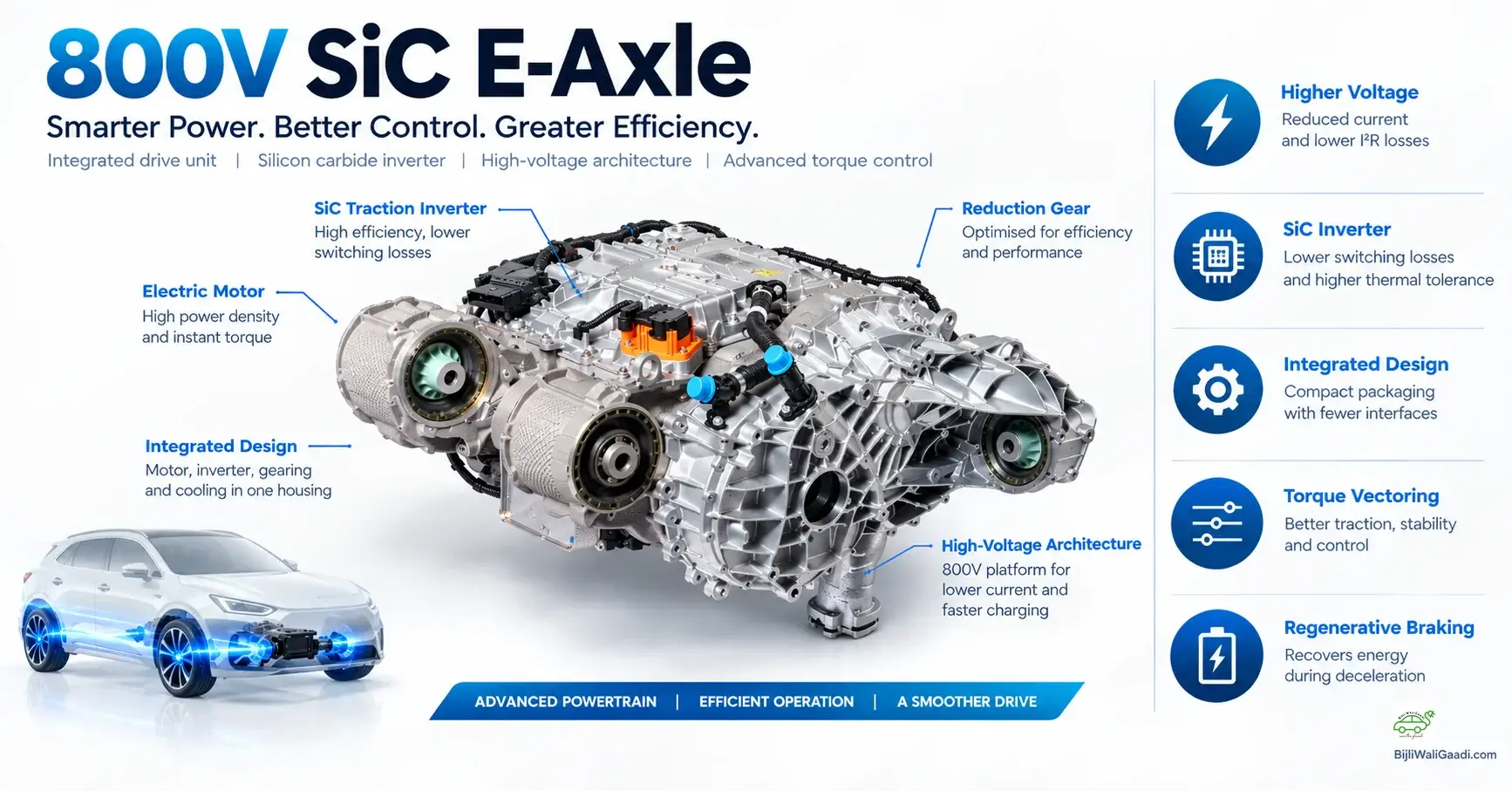
An 800V SiC e-axle integrates an 800 V-class electrical architecture, SiC-based traction inverter, motor and gearing in one housing — several distinct technologies whose proven gains and supplier-specific claims are worth separating.
Key Takeaways
Why 800 V Architecture Matters
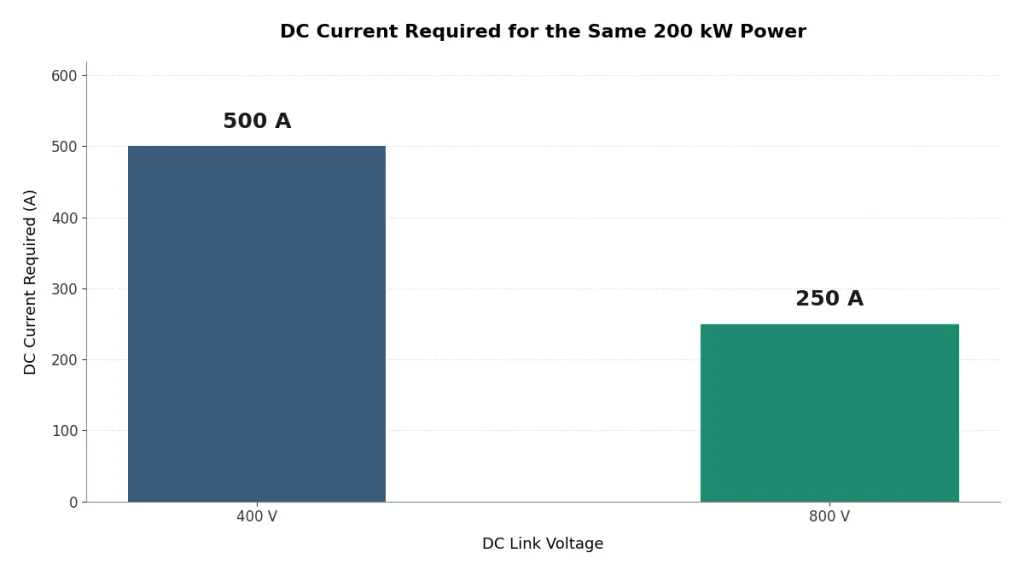
For a given power, P = V × I, so I = P/V: raising voltage lowers the current needed for the same power. Since resistive losses scale with I²R, lower current can reduce conduction losses in appropriately sized high-voltage conductors and busbars, and potentially allow smaller, lower-current-rated conductors, subject to thermal, insulation, packaging and safety requirements. This applies to current at constant power, not total electrical losses.
At a constant 200 kW, a 400 V link needs roughly 500 A versus roughly 250 A at 800 V, shown below.
How SiC Changes the EV Traction Inverter
SiC, a wide-bandgap semiconductor, can offer lower switching losses and higher junction-temperature capability than silicon in suitable designs, though benefit depends on voltage, frequency and cooling. Infineon’s automotive CoolSiC 750 V G2 MOSFETs include devices specified for −55°C to +175°C — a product-family spec, not a universal SiC limit. Device-level tolerance doesn’t mean the full inverter runs continuously at that temperature; packaging and system cooling still apply. Infineon’s HybridPACK Drive portfolio includes CoolSiC-based 750 V and 1,200 V modules qualified to AQG324, illustrating the power-module technology available for high-power EV traction inverters.
How Integrated E-Axles Improve Packaging
An e-axle can integrate the motor, inverter, gearing and, depending on architecture, a differential into a compact housing, cutting interfaces and sharing cooling. For one current AxTrax 2 configuration, ZF specifies 210 kW continuous power and up to 26,000 Nm peak output torque, alongside an integrated 800 V SiC inverter, hairpin motor and 3-speed transmission — configuration-specific ZF figures, not industry benchmarks. (See BijliWaliGaadi’s 400V vs 800V EV Architecture and E-GMP vs Wunderbox.)
Where Torque Vectoring Fits In
A representative, though not universal, control chain runs: sensors → state estimation → supervisory control → torque allocation → motor control → FOC/current control → inverter switching → motor torque → tire-road forces. Motor-control loops generally update faster than supervisory functions.
Torque vectoring, traction control, stability control, brake-based intervention and differential locking are related but distinct. Torque vectoring controls the distribution of drive torque between axles or wheels and, in some systems, is supplemented by selective brake intervention to influence yaw moment and dynamics. Multi-motor EVs achieve this via independent motor control; dual-motor and four-motor systems differ in their level of independent torque control. Mechanical differentials remain common in single-motor cars and many commercial e-axles; vectoring doesn’t universally replace them.
AI and Predictive Control: What’s Actually Changing
AI/ML is one possible approach for estimating vehicle state or actuator needs and influencing torque targets — not a requirement for torque vectoring. MPC is not automatically AI: classical control, observers and gain scheduling can perform torque allocation without machine learning, which may augment these functions though production algorithms are often undisclosed. 800 V SiC e-axles don’t universally use AI, and AI doesn’t inherently mean lower latency.
800V SiC E-Axle Technology Compared
| Technology area | Earlier/common approach | Modern 800 V SiC/integrated approach | Engineering significance |
| DC-link voltage | ~400 V class | ~800 V class | Lower current for the same power |
| Power semiconductor | Silicon-based, including IGBT | SiC MOSFET | Potentially lower switching losses and higher power density in suitable designs |
| E-drive integration | Separate or partly integrated | Integrated e-axle | Fewer external interfaces and compact packaging |
| Cooling | Application-dependent | Application-dependent, including oil cooling in some designs | Can support power-density targets |
| Torque distribution | Mechanical differential and/or electronic control | Independent motor control in multi-motor systems | Enables electronic torque allocation/vectoring |
| Charging | Higher current at a given power | Lower current at a given power | Can facilitate high-power charging with appropriately matched systems |
Efficiency and Regenerative Braking
Regenerative-braking recovery depends on motor/inverter efficiency, gearbox losses, battery SOC and temperature, charge-power acceptance, tire-road adhesion, braking demand and speed. SiC can reduce conversion losses during regeneration but does not set a fixed recovery percentage.
What This Could Mean for Indian EVs
Globally, 800 V and SiC electronics have been particularly visible in higher-power, premium EV applications, though adoption is expanding. For Indian manufacturers, the trade-off involves semiconductor cost, thermal performance, charging needs and supply-chain availability. India’s high ambient temperatures make thermal design important, though SiC’s temperature tolerance doesn’t alone solve thermal management. (See BijliWaliGaadi’s SiC & 800V EV Powertrain Efficiency.)
Frequently Asked Questions
Stay connected via Google 'Electric Vehicle' News
Follow BijliWaliGaadi | India's Trusted EV Insights Portal
source on Google