Trump Cuts Fuel Economy Rules Set Under Biden: What It Means for EVs
Stay connected via Google 'Electric Vehicle' News
Follow BijliWaliGaadi | India's Trusted EV Insights Portal
source on Google
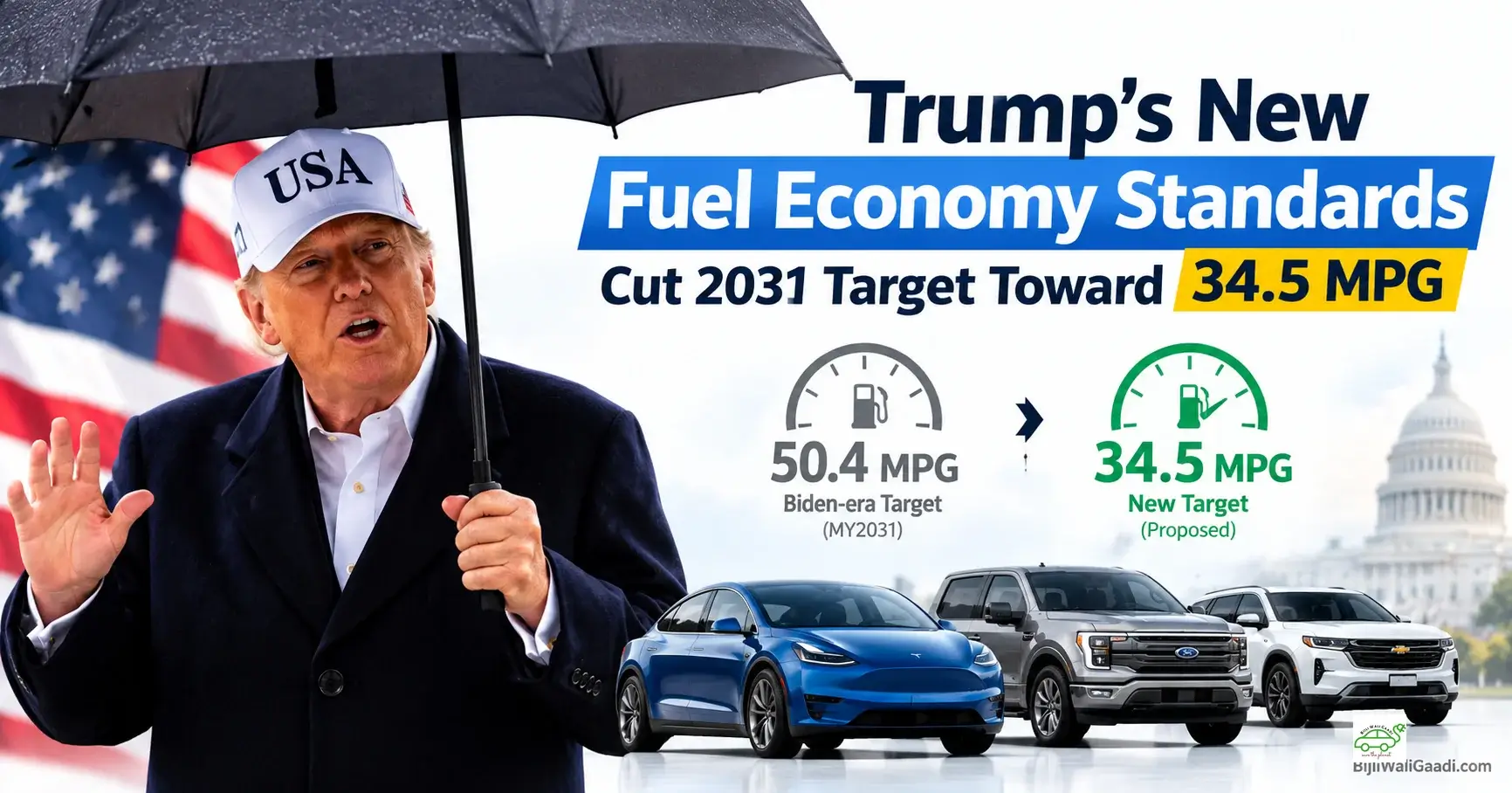
Trump Announces New U.S. Fuel Economy Standards
President Donald Trump said Saturday, September 26, 2026, that he had approved new federal fuel economy standards for passenger cars and light trucks, framing the move as ending Biden-era requirements he called an “EV mandate.” The U.S. Transportation Department said it would formally finalize the sharply lower vehicle fuel economy standards through 2031 on Monday, September 28, 2026, two days after Trump’s announcement. Transportation Secretary Sean Duffy called the coming rule a “major victory” for auto workers, with additional details expected upon publication.
The regulatory action concerns Corporate Average Fuel Economy (CAFE) standards, a fuel-efficiency program administered by the National Highway Traffic Safety Administration (NHTSA), not a standalone law requiring electric vehicle (EV) sales. As of Trump’s Saturday statement, the underlying rule text had not been publicly released, so several specific provisions could not yet be independently confirmed against the earlier proposal.
Biden-Era CAFE Rules Targeted a 50.4-MPG Fleet Average by 2031
Under the Biden administration’s 2024 final CAFE rule, required fuel economy was set to increase steadily, with an industry fleetwide average projected at roughly 50.4 mpg by model year (MY) 2031. A December proposal from NHTSA projected a fleetwide average fuel economy of roughly 34.5 miles per gallon by 2031, compared with approximately 50.4 mpg under Biden-era standards.
It’s worth emphasizing that 50.4 mpg, like 34.5 mpg, is a fleetwide, sales-weighted manufacturer average — not a requirement that every individual passenger car or light truck achieve that figure. Automakers comply by balancing smaller, more efficient models against larger trucks and SUVs across their entire U.S. sales mix.
The Earlier NHTSA Proposal Set a 34.5-MPG MY2031 Target
The 34.5-mpg figure Trump referenced traces to a Notice of Proposed Rulemaking (NPRM) NHTSA published December 5, 2025, titled “The Safer Affordable Fuel-Efficient (SAFE) Vehicles Rule III for Model Years 2022 to 2031.” That proposal covered amendments to standards for both MY2022–2026 and MY2027–2031, and its public comment period closed January 20, 2026.
Because the final rule’s exact text was not publicly available at the time of Trump’s announcement, it remains unconfirmed whether the finalized standard matches the December 2025 proposal’s 34.5-mpg figure precisely, or whether adjustments were made after the comment period. Where this article uses 34.5 mpg, it refers to the proposed figure unless otherwise noted.
Trump’s “EV Mandate” Claim Needs Regulatory Context
Trump described the Biden-era policy as an “EV mandate” in his announcement. There is no federal law requiring individual Americans to purchase an EV. CAFE is a manufacturer-level fuel-economy compliance program, separate from:
- EPA vehicle greenhouse-gas emissions rules, a distinct regulatory track administered by the Environmental Protection Agency;
- State-level policies, including California’s vehicle emissions and zero-emission-vehicle sales requirements; and
- Federal EV tax credits, which Congress eliminated in separate 2025 legislation, unrelated to this CAFE action.
Consistent with statutory requirements, the fuel economy standards proposed in the December 2025 rule are founded on light-duty vehicles powered by gasoline and diesel fuels, a category that includes non-plug-in hybrid vehicles, and NHTSA said it had not considered the imputed fuel-economy performance of battery-powered electric vehicles in formulating the proposed standards. In practice, this means the proposed standard-setting methodology is calibrated primarily around gasoline, diesel and conventional hybrid vehicles rather than crediting EVs directly within the stringency calculation — a more precise description than saying EVs simply “count as zero” under the program.
What the CAFE Changes Could Mean for U.S. Automakers
A lower fleetwide target could ease compliance pressure on automakers, particularly those with larger trucks and SUVs in their lineups. NHTSA’s December proposal estimated the change would cut average new-vehicle costs by about $930 per vehicle, though that figure was described by the agency as derived from assumed technology savings passed through to consumers, not a guaranteed retail price outcome.
The December 2025 proposal also called for eliminating the inter-manufacturer CAFE credit trading system, which currently lets automakers that exceed their targets sell surplus compliance credits to manufacturers that fall short. The regulation change would also reclassify crossover vehicles as cars instead of light trucks, according to reporting on the December proposal. Whether these specific provisions carried through unchanged into the final rule was not independently confirmed in the sources available at publication.
CAFE credits should not be confused with EV tax credits, EV charging incentives, or emissions credits under EPA’s separate program — they are strictly a fuel-economy compliance mechanism.
What the New Fuel Economy Rules Could Mean for EVs
Lower fleetwide targets could reduce one of the regulatory incentives that had encouraged automakers to expand EV production to help meet fuel-economy averages. That does not mean EVs disappear from the market or that automakers will halt EV production; it means the fuel-economy program may exert less pressure toward EV-heavy product mixes than under the Biden-era trajectory. Automakers’ actual EV strategies will also depend on separate factors, including consumer demand, state rules, and the now-eliminated federal EV tax credit.
What the Changes Could Mean for U.S. Car Buyers
NHTSA’s December proposal projected the change would increase fuel consumption by around 100 billion gallons through 2050, raise fuel spending by $185 billion, and increase carbon dioxide emissions by about 5%, relative to the Biden-era baseline. These are the agency’s own projections for the proposed rule, not confirmed outcomes of the final action, and could shift if the final text differs from the December proposal.
Trump said the new standards would lower new-vehicle prices; that is his characterization of the policy’s likely effect, not an independently verified guarantee.
When the New CAFE Rules Take Effect
The Transportation Department said it would finalize the standards on Monday, September 28, 2026. The targets under discussion apply through MY2031, meaning compliance requirements would phase in over several model years rather than take effect immediately for all vehicles. As with any major federal rule, legal challenges are possible once the final text is published, as has occurred with prior CAFE rule changes under multiple administrations.
Trump vs. Biden-Era U.S. Fuel Economy Rules
| CAFE policy element | Biden-era 2024 rule | Trump/NHTSA 2025–2026 action |
|---|---|---|
| MY2031 industry fleet average | ~50.4 mpg | ~34.5 mpg in Dec. 2025 proposal; final figure not yet independently confirmed |
| Covered model years | MY2027–2031 | MY2022–2026 and MY2027–2031 amendments proposed |
| CAFE credit trading | Existing inter-manufacturer system | Elimination proposed; final status not yet confirmed |
| Crossover classification | Existing framework | Reclassification as cars proposed; final status not yet confirmed |
| Regulatory status | Finalized 2024 | Announced Sept. 26, 2026; formal final rule expected Sept. 28, 2026 |
Conclusion
Trump has announced approval of a CAFE overhaul expected to lower the fleetwide fuel-economy target toward the roughly 34.5-mpg figure proposed by NHTSA in December 2025, down from the Biden-era 50.4-mpg MY2031 goal, with the Transportation Department saying it would formally finalize the rule September 28, 2026. The change does not amount to a legal ban on EVs, though it could reduce regulatory pressure that had encouraged automakers to expand EV production. Several specific provisions — including credit-trading elimination and vehicle reclassification — remained tied to the December proposal and had not been independently confirmed in final form at the time of this report.
FAQ
Stay connected via Google 'Electric Vehicle' News
Follow BijliWaliGaadi | India's Trusted EV Insights Portal
source on Google