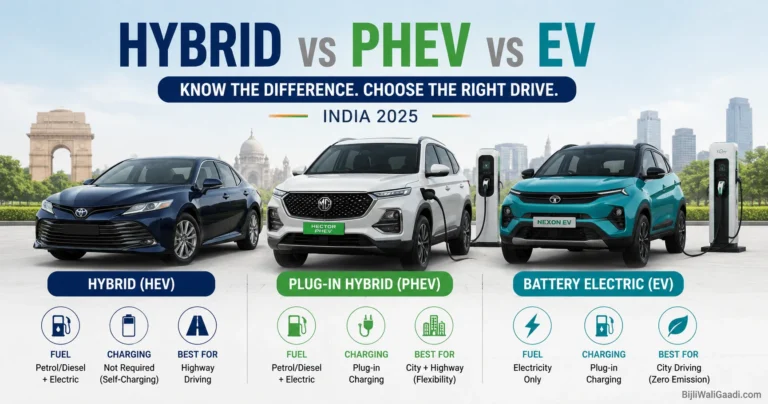
400V vs 800V vs 1200V EV Architecture: The Complete Engineering Guide to High-Voltage Platforms
Stay connected via Google 'Electric Vehicle' News
Follow BijliWaliGaadi | India's Trusted EV Insights Portal
source on Google
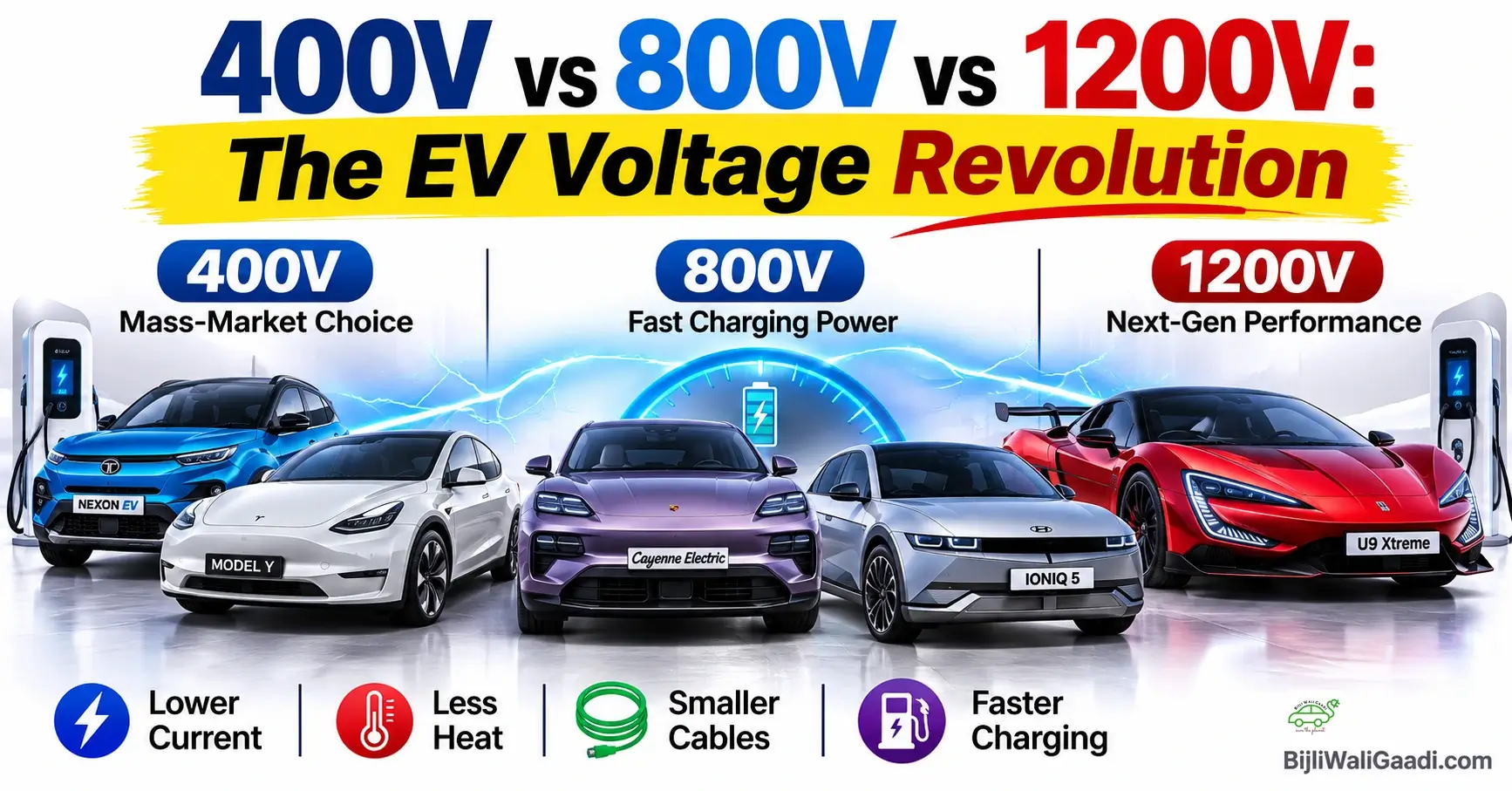
Key Takeaways: What Traction Voltage Changes in an Electric Vehicle
- Higher bus voltage delivers the same power at lower current, which cuts I²R heat and conductor size.
- 400V suits mass-market cost targets. 800V and ~900V suit fast charging and performance. 1200V suits extreme power.
- A 1200V bus cannot safely use 1200V-rated switches. The usual design rule points to 1700V+ SiC devices.
- The YANGWANG U9 Xtreme is the first production 1200V case study.
- For ₹8–25 lakh Indian EVs, 400V remains the practical choice.
High-Voltage EV Architecture Explained: How Traction Voltage Sets the Limits of an Electric Powertrain
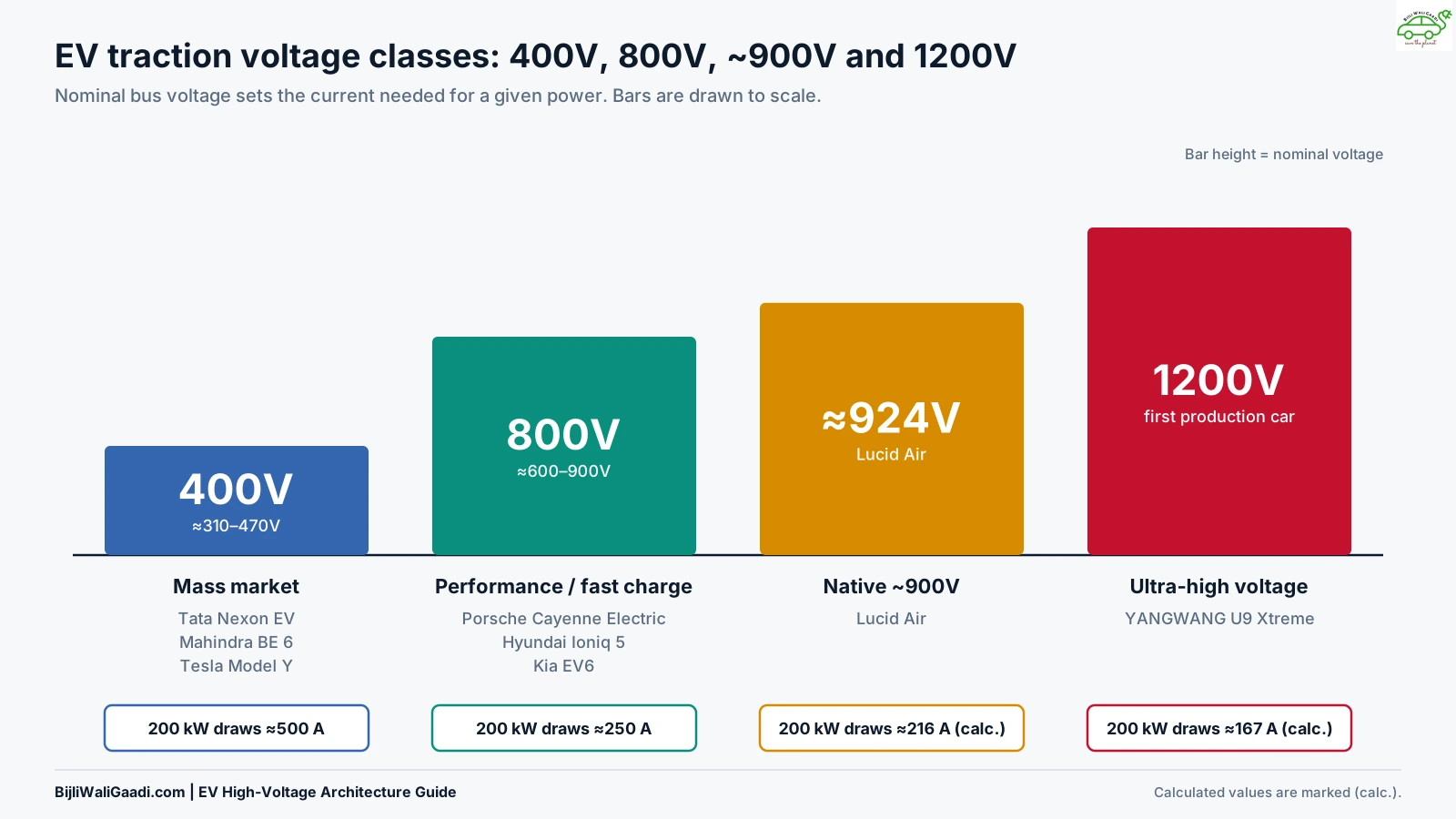
An EV’s traction battery works at a nominal DC bus voltage, and that number fixes the current needed for any given power. Current in turn decides conductor heating, cable and busbar size, inverter stress and charging limits.
Four classes now exist. 400V serves the mass market. 800V (about 600–900V) serves performance and fast charging. The Lucid Air sits near 924V. The YANGWANG U9 Xtreme is the first production car at 1200V.
The Physics of EV Voltage: Power, Current, Conductor Heating and Cable Size
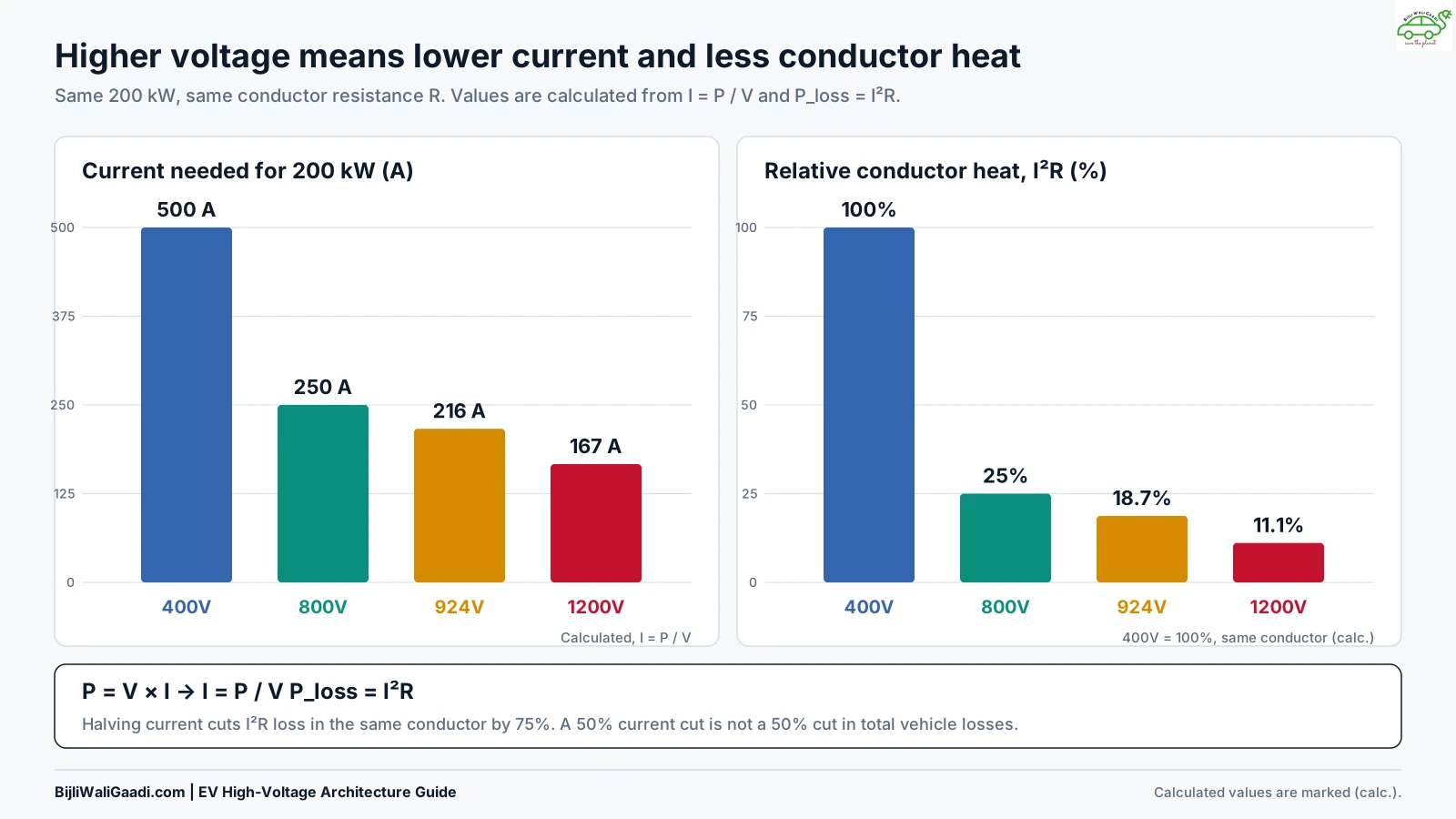
Power is P = V × I, so current is I = P/V. At a constant 200 kW:
- 400V: about 500 A
- 800V: about 250 A
- 924V (Lucid): about 216 A (calculated)
- 1200V: about 167 A (calculated)
Conductor heating follows P_loss = I²R. Halve the current and loss in the same conductor falls 75%. Alternatively, hold loss constant and shrink the copper: at fixed current density, cross-section scales roughly with 1/V. Published cable sizes vary by design (our earlier comparison lists 50 mm² at 400V and 12.5 mm² at 800V for 200 kW), so treat them as design-specific, not a fixed ratio.
Two limits apply. A 50% current cut is not a 50% cut in total vehicle losses, and insulation and safety requirements rise with voltage.
400V vs 800V vs 1200V Engineering Breakdown: Platforms, Real Cars and Trade-offs
400V Architecture: Mass-Market Efficiency, Charger Compatibility and Silicon IGBT Cost
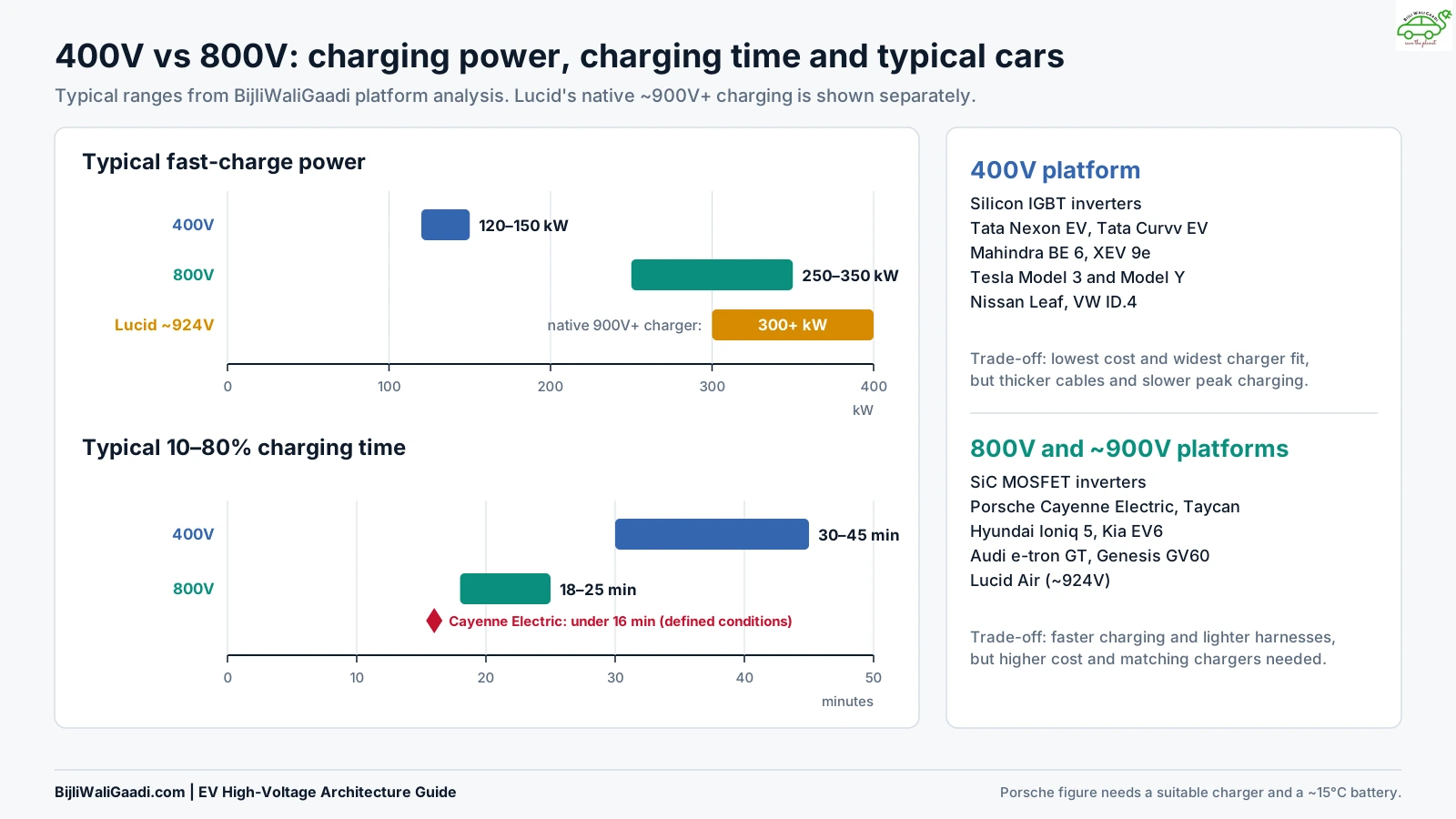
Most mass-market EVs still use 400V: the Tata Nexon EV, Tata Curvv EV, Mahindra BE 6 and XEV 9e, Tesla Model 3 and Model Y, Nissan Leaf and Volkswagen ID.4. Inverters typically use silicon IGBTs. Typical fast charging is 120–150 kW, or 30–45 minutes for 10–80%.
Its strength is ecosystem fit: harnesses, connectors, BMS hardware and chargers are standardised around it.
800V and ~900V Architectures: Fast Charging, Lighter Harnesses and SiC Inverters
800V cars include the Porsche Cayenne Electric, Taycan and Macan Electric, Hyundai Ioniq 5, Kia EV6, Audi e-tron GT and Genesis GV60. The Lucid Air runs at about 924V. Typical charging is 250–350 kW, or 18–25 minutes for 10–80%.
The Cayenne Electric charges at up to 390 kW (400 kW under specific conditions). Porsche states 10–80% in under 16 minutes with a suitable charger and a battery at about 15°C. That is a conditional figure, not a guarantee.
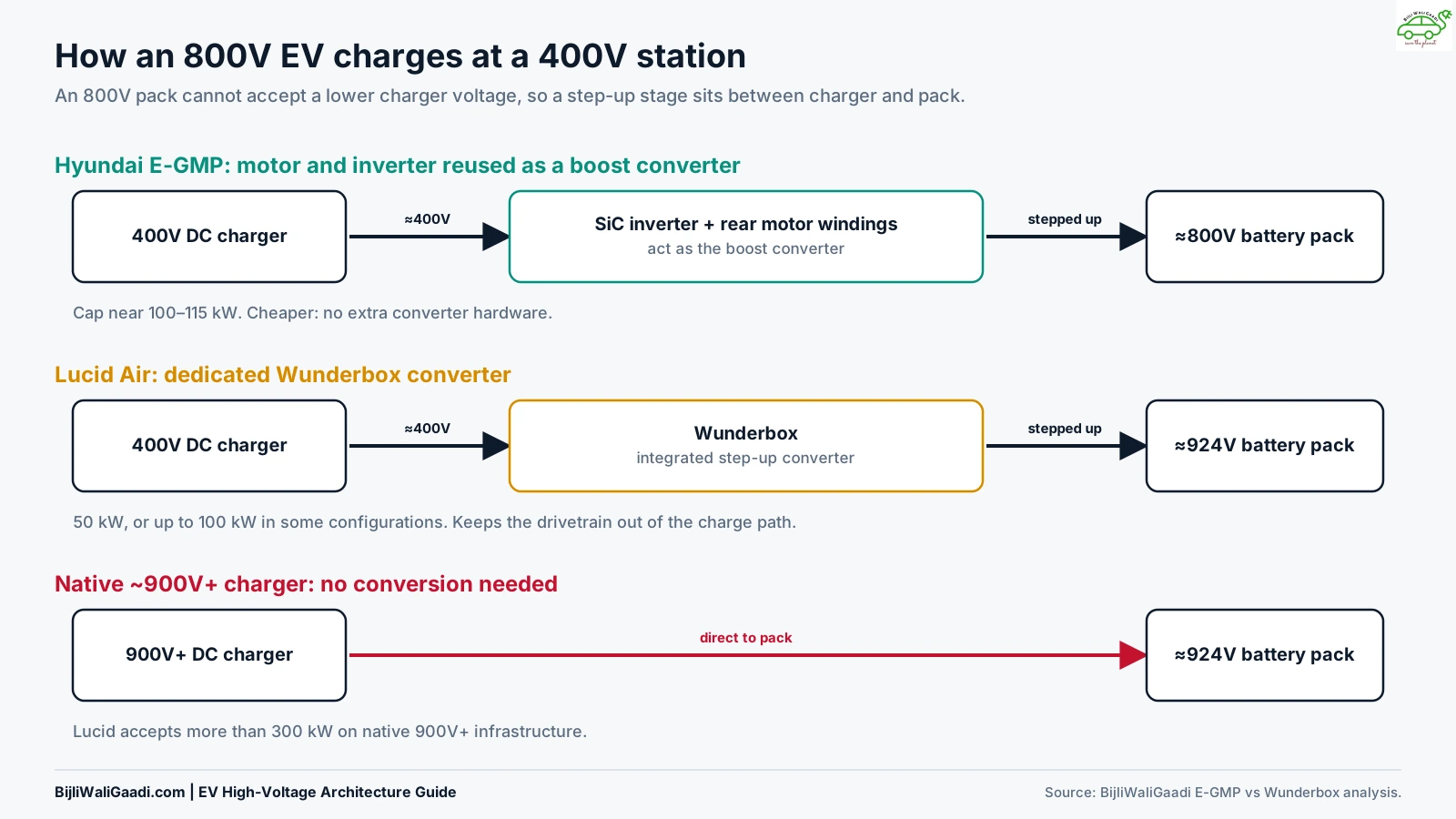
Compatibility with 400V chargers needs a step-up stage. Hyundai E-GMP reuses the rear motor windings and SiC inverter as a boost converter, capped near 100–115 kW. Lucid’s Wunderbox does it in a dedicated block at 50–100 kW on 400V, while accepting more than 300 kW on native 900V+ infrastructure.
SiC gains are real but modest. Hyundai says its E-GMP SiC inverter improves efficiency by about 2–3%, worth roughly 5% more driving, a figure specific to E-GMP.
1200V Ultra-High-Voltage Case Study: The YANGWANG U9 Xtreme
BYD’s YANGWANG U9 Xtreme is the first production model on a 1200V platform, up from 800V on the standard U9. BYD cites support for up to 1000 A. Four motors, one per wheel, each make 755 PS (555 kW), for 3,019 PS in total. It reached 503.17 km/h on Abu Dhabi’s E11 on 1 November 2026, and production is limited to 30 units.
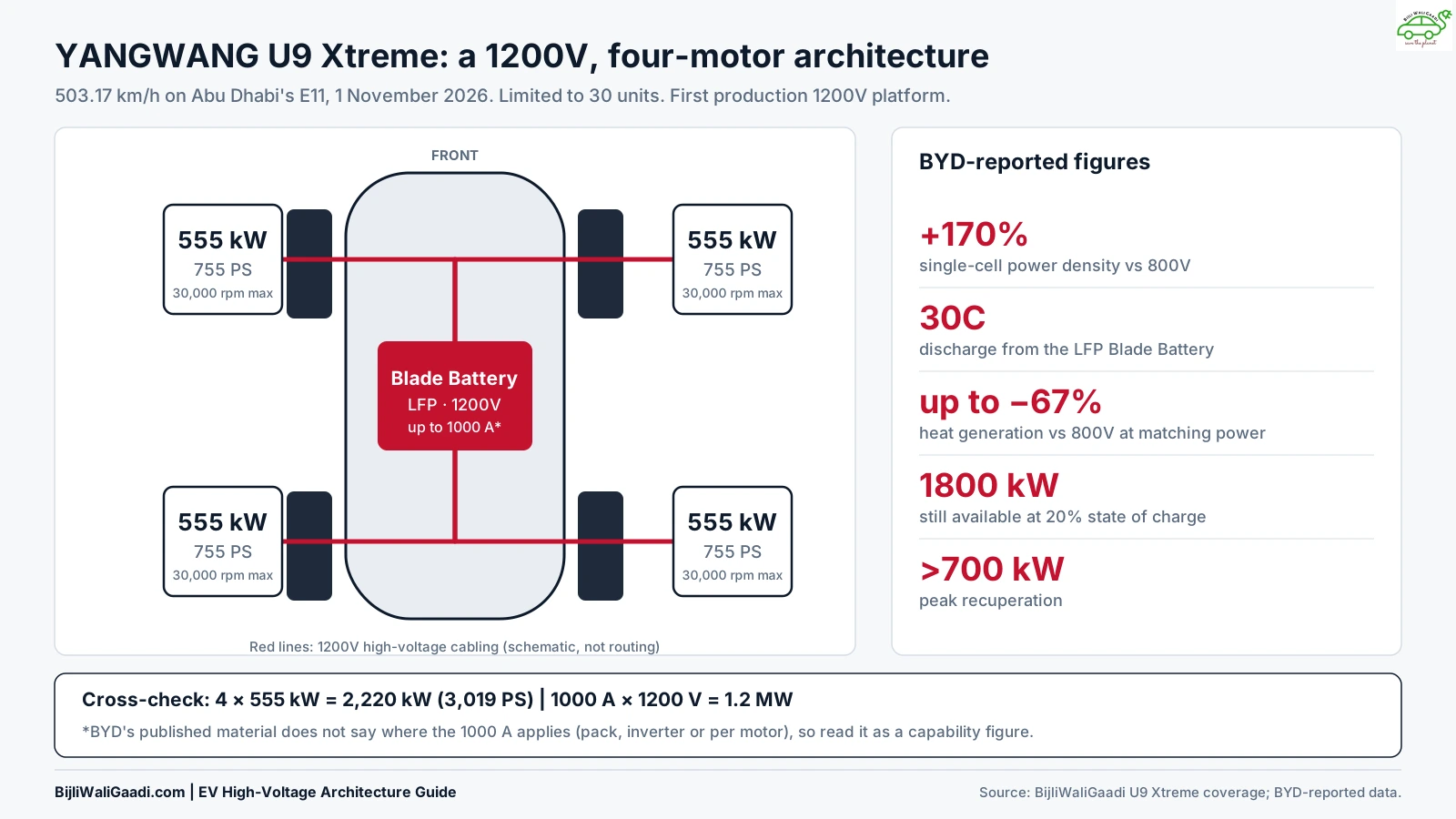
Against an 800V system, BYD reports:
- Single-cell power density up 170%.
- 30C discharge from its LFP Blade Battery.
- Heat generation down by up to 67% at matching power.
- 1800 kW still available at 20% state of charge.
- Peak recuperation above 700 kW.
Read “1000 A” carefully. At 1200V, 1000 A is 1.2 MW, yet the motors total 2,220 kW and BYD cites 1800 kW at 20% state of charge. The published material does not say where the 1000 A applies (pack, inverter or per motor), so treat it as a capability headline, not a total bus current.
Power Semiconductor Engineering: Why a 1200V EV Bus Requires 1700V+ SiC MOSFETs
Why Inverter Switches Must Be Rated Well Above the Battery Bus Voltage
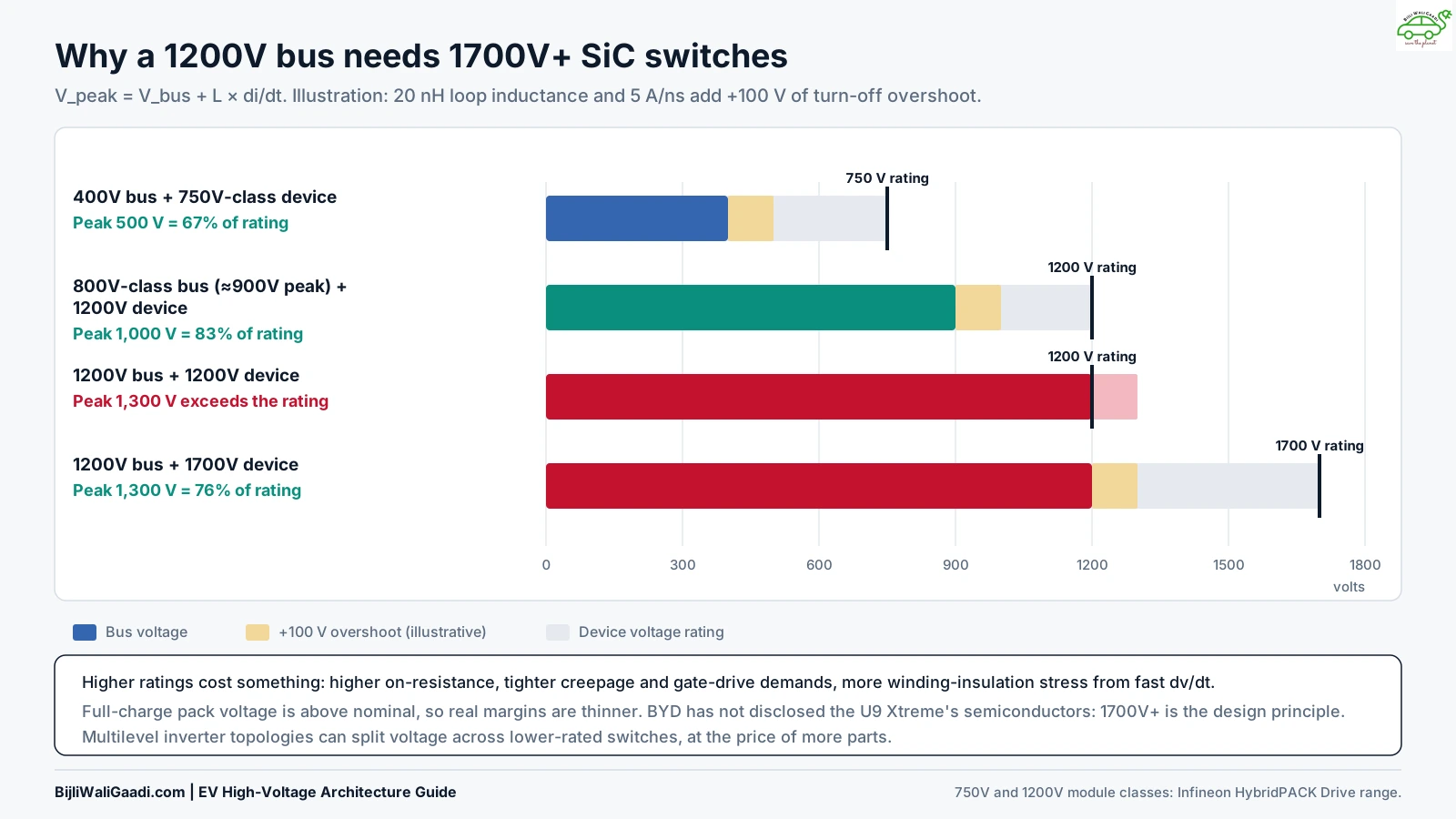
An inverter switch sees more than the battery voltage. When it turns off, current through stray inductance produces an overshoot:
V_peak = V_bus + L × di/dt
As an illustration only, 20 nH of loop inductance and 5 A/ns gives 100 V of overshoot. Pack voltage at full charge also exceeds nominal, and designers keep a reliability margin below breakdown. The rating must sit well above nominal bus voltage.
How 800V Buses Use 1200V SiC Modules and 1200V Buses Need 1700V+ Devices
The device classes track the bus. Infineon’s HybridPACK Drive range includes 750V and 1,200V CoolSiC modules, matching 400V and 800V buses respectively. A ~900V peak on a 1200V device uses 75% of its rating, which leaves a workable margin.
At a 1200V bus, a 1200V device has no margin at all, and the overshoot alone would exceed its rating. The next standard class up is 1700V, which is why a conventional two-level inverter on a 1200V bus calls for 1700V+ SiC. Multilevel topologies can split the stress across lower-rated switches, but they add parts and complexity.
Higher ratings carry costs:
- A thicker drift region raises on-resistance, so conduction loss per amp rises.
- Creepage, clearance and gate-drive demands tighten.
- Fast SiC edges (rise times below 100 ns, dv/dt above 10–20 kV/µs per our E-GMP analysis) stress winding insulation and drive bearing currents.
BYD has not disclosed the U9 Xtreme’s semiconductors. 1700V+ is the design principle, not a confirmed bill of materials.
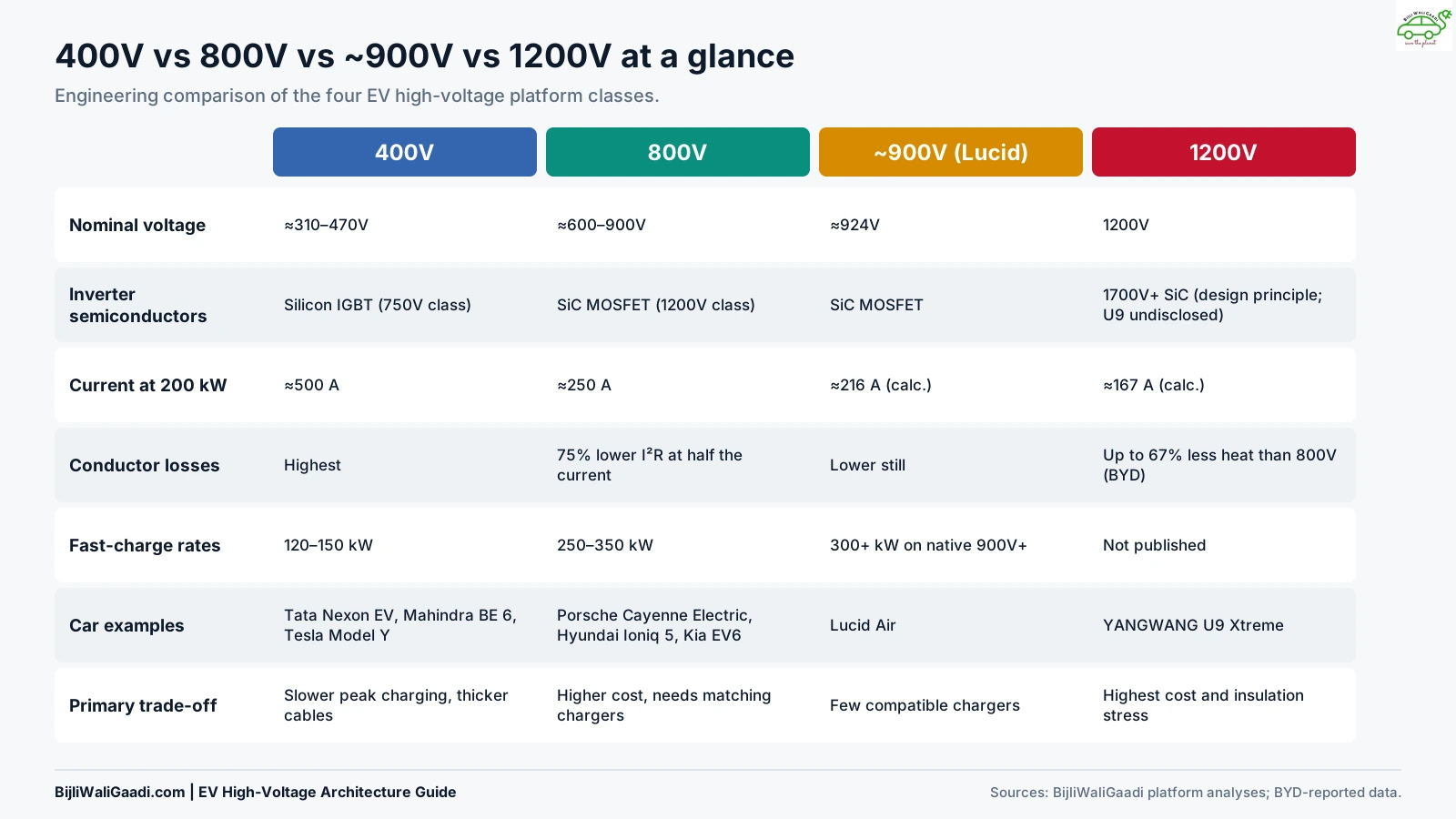
Consolidated EV Architecture Comparison Table: 400V vs 800V vs ~900V vs 1200V
| Parameter | 400V | 800V | ~900V (Lucid) | 1200V |
| Nominal voltage | ~310–470V | ~600–900V | ~924V | 1200V |
| Typical inverter semiconductors | Silicon IGBT (750V class) | SiC MOSFET (1200V class) | SiC MOSFET | 1700V+ SiC (design principle; U9 undisclosed) |
| Current for 200 kW | ~500 A | ~250 A | ~216 A | ~167 A |
| Conductor losses | Highest | 75% lower I²R at half current | Lower still | Up to 67% less heat than 800V (BYD) |
| Fast-charge rates | 120–150 kW | 250–350 kW | 300+ kW on native 900V+ | Supports MW charging |
| Car examples | Tata Nexon EV, Mahindra BE 6, Tesla Model Y | Porsche Cayenne Electric, Hyundai Ioniq 5, Kia EV6 | Lucid Air | YANGWANG U9 Xtreme |
| Primary trade-off | Slower peak charging, thicker cables | Higher cost, needs matching chargers | Few compatible chargers | Highest cost and insulation stress, hypercar scale |
Will 1200V Reach Mass-Market EVs? Cost, Charging Infrastructure and the ₹8–25 Lakh Reality
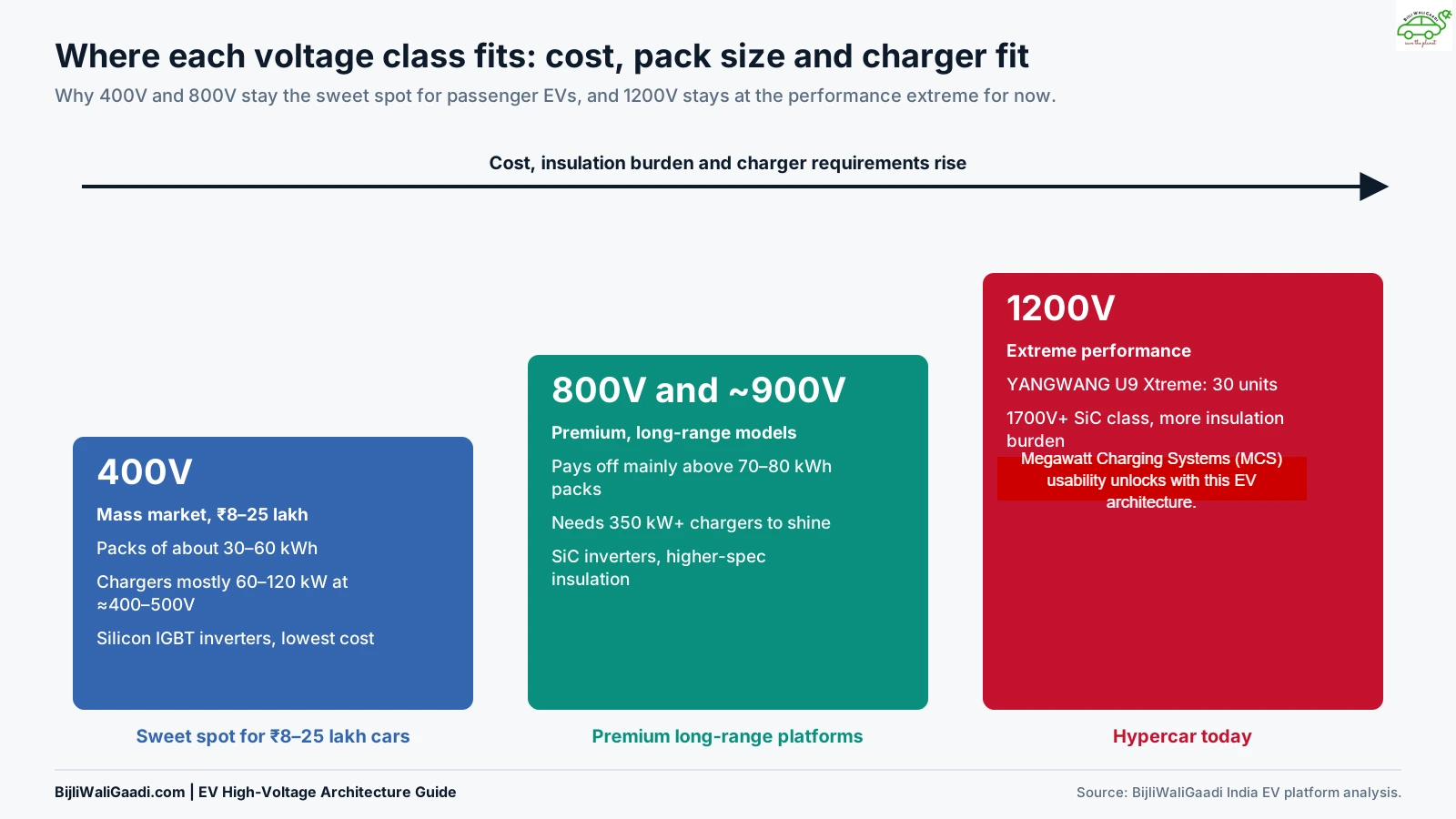
Not soon. Even 800V adds cost through SiC inverters, higher-spec insulation, tighter tolerances, safety components and higher-rated connectors. Most Indian EVs carry 30–60 kWh packs, and 800V pays off mainly above 70–80 kWh. A 1200V platform adds a costlier device class and more insulation burden on top.
Charging matters as much. With public chargers mostly at 60–120 kW and 400–500V, a higher-voltage car gains little. Unlocking 350 kW and beyond needs both chargers that support the voltage and grid connections sized for them.
Our view: 400V stays the sweet spot for ₹8–25 lakh cars, 800V for premium long-range models, and 1200V for extreme-performance cars until components and charging networks mature.
Frequently Asked Questions About High-Voltage EV Architecture
Stay connected via Google 'Electric Vehicle' News
Follow BijliWaliGaadi | India's Trusted EV Insights Portal
source on Google